Well, this was a fun one!
The first VIP visitors of 2026 arrived mid-afternoon this last Sunday and took the Miner Museum by storm.
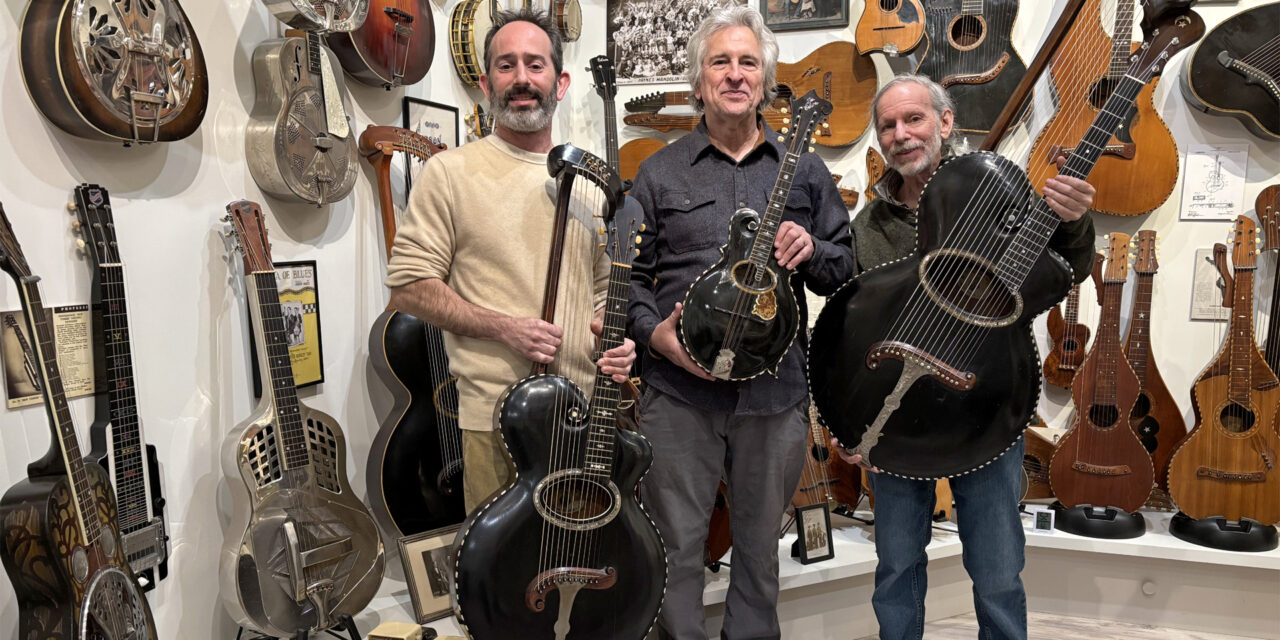
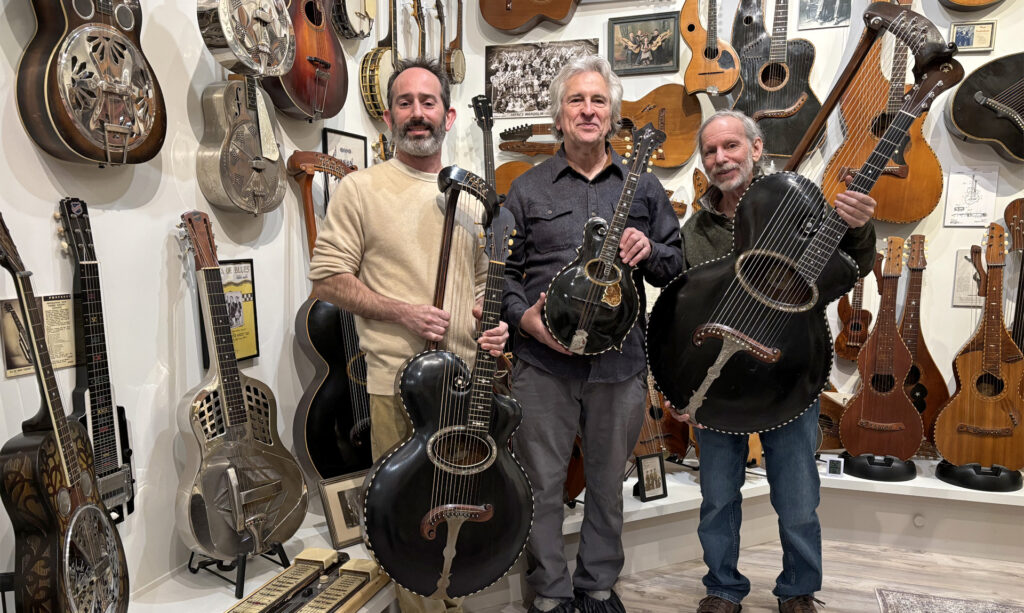
They were/are Phil Rowens and Robert Corwin, who among other things are Orville Gibson experts and collectors. Long-time virtual pals, I had met neither until now. Phil’s the fellow who loaned the incredible Orville scroll headstock harp guitar for our 2017 Carlsbad exhibit, and also a few years back discovered what would (finally!) become my latest acquisition. Part of their planned trip was to hand deliver that after we made the deal with his friend last November.
Meanwhile, Robert happened to have several restored instruments ready to be picked up from David LaPlante and Lark Street Music in two completely different directions but “on the way.” So, since both Phil and Robert had been anxious to come see the finished Miner Museum, they turned it into one epic road trip!
The timing was perfect, as one of Robert’s pickups was his finally-finished Gibson harp guitar – the Gibson Company’s 13th serialized instrument and only one of two surviving early large U’s with that giant soundhole (more below).
Besides a couple of incredible Martins he had also picked up on the way (Robert is one of the Martin collectors), he and Phil also generously packed up a few more precious instruments they knew I would be interested in seeing. All this stacked in a Ford Explorer and driven for hours on the ultimate road trip.
I’d seen photos of most of these instruments but was reminded again that seeing things like these in person makes all the difference. They live, they breathe, the tool marks and finger oils are still there. It was just incredible. We laughed, we cried, Phil had tales, and Robert regaled us at dinner and well into the evening (despite Phil jiggling the car keys) with stories of Joni and CSN&Y, Seeger and Dylan. Look him up – I knew only the basics of his lifelong career as rock music photographer (50 years with Peter, Paul & Mary alone). A living legend who should definitely be writing his memoires!
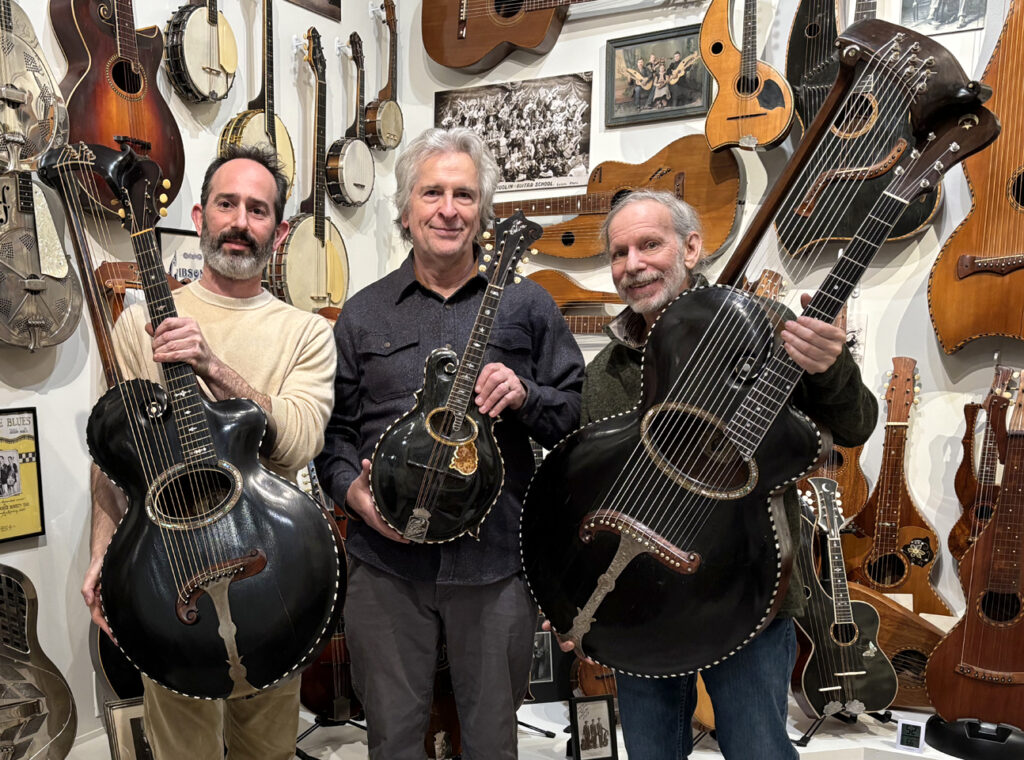
The only thing better than antique Gibson instruments are rope-bound Gibson instruments. So rare and hard to find (and for me, afford!). I finally acquired my first and only in 2019 – the c.1904 F3 mandolin I’m holding.
The two super early harp guitars are almost certainly Orville-built, at least predominately. Both have the heavy carved flat Orville-construction back, and Phil even found a “1901” inscription on the heel block of his Style R during restoration. Meaning, in Orville’s own handwriting, the instrument being completed later at the factory and serial #2770 label finally slapped on in 1903-1904. His instrument has six subs and is just shy of 18” wide.
I saw Robert win his HG in a small local auction several years back (and was glad it went to him!). Its headstock was mostly destroyed/missing and it had just three tiny pieces of rope binding remaining. David expertly replaced all that, while discovering that – surprisingly – this one didn’t have the expected cut out silhouette scroll in the headstock. Remaining wood evidence disclosed that it had to have been solid. They then came up with an appropriate period “crescent & star” inlay. It has the giant 21” wide body (this size would be retained until 1908), long neck scale of 27-1/4” (gone in 1906) and that giant soundhole (shortly to be reduced to something like what Phil is holding). You could literally put your toddler in there for a time out!
This one is historically important for all those features and more. Its factory serial number is 2513, so super early within the newly formed company (all concur that management began their numbering at 2501).
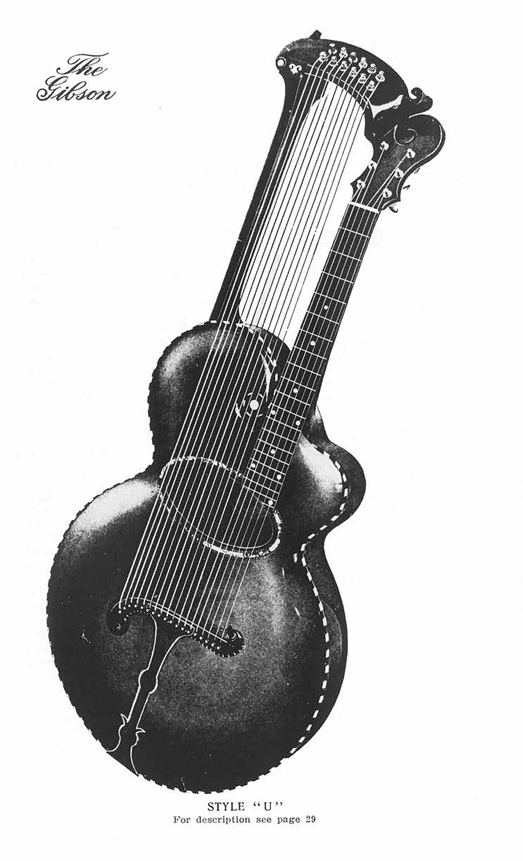
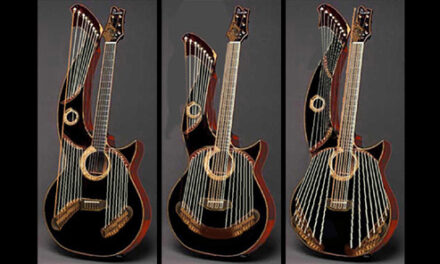
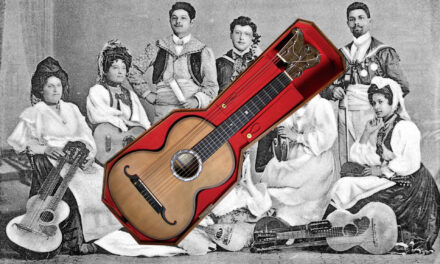
Other than the solid headstock, it matches the 1903 catalog (above) fairly precisely (its sub-bass head is also somewhat beefier, with a different inlay). The most obvious difference? It has only nine sub-bass strings. It continues to mystify us why these seem to have been as common – or more – than the 6- and 12-bass versions yet were never catalogued or even mentioned as an option. Its tuning unknown – and this being before Walter Boehm entered the picture to give Gibson all of its new harp guitar tunings – we all think the best guess is that it was chromatic down to G. After years of research and consultation (with Benoit Meulle-Stef, myself and others), that’s the tuning they went for, with David using Aquila classical strings for the neck (which sound decent) and light nylon for the subs (which don’t). Still, the intention was for it to be playable.
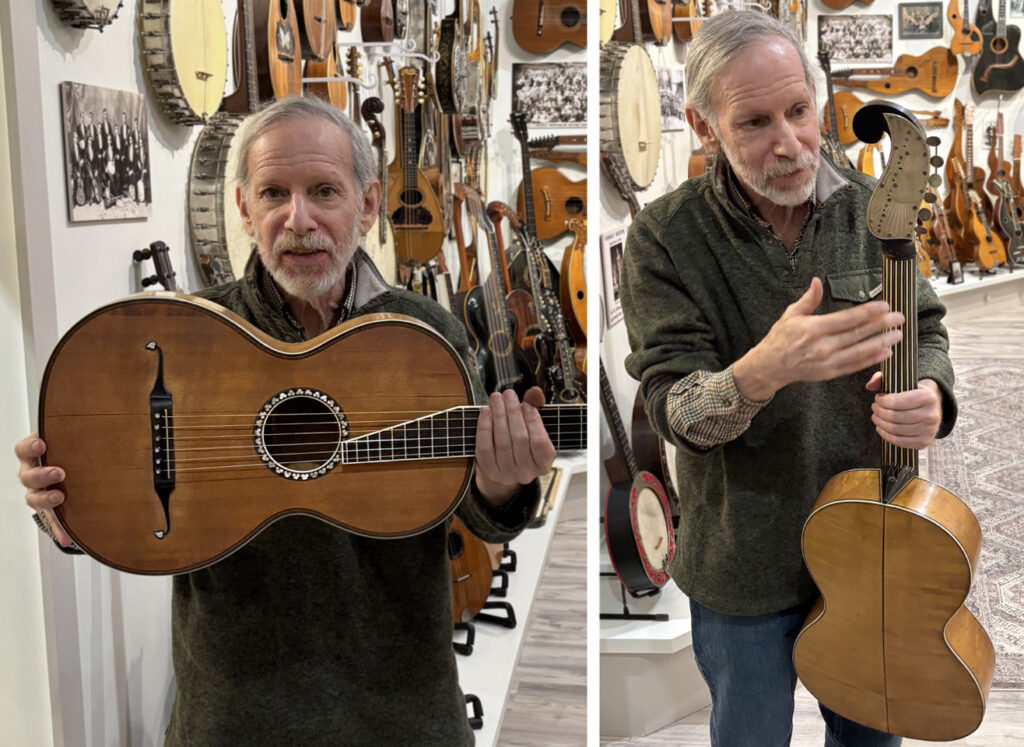
One of Robert’s Martin treasures. You might recognize it, as it’s been in several books. Unlabeled, so originally thought to be a Stauffer, it matches two labeled early Martins. Though it can’t be proven, Robert believes it to have been built by Martin’s friend Heinrich Schatz, c.1834.
See more at https://www.vintagemartin.com/stauffer.html ( (If you haven’t been to his Martin site, you’ll be blown away by his photographs, research and free information.)
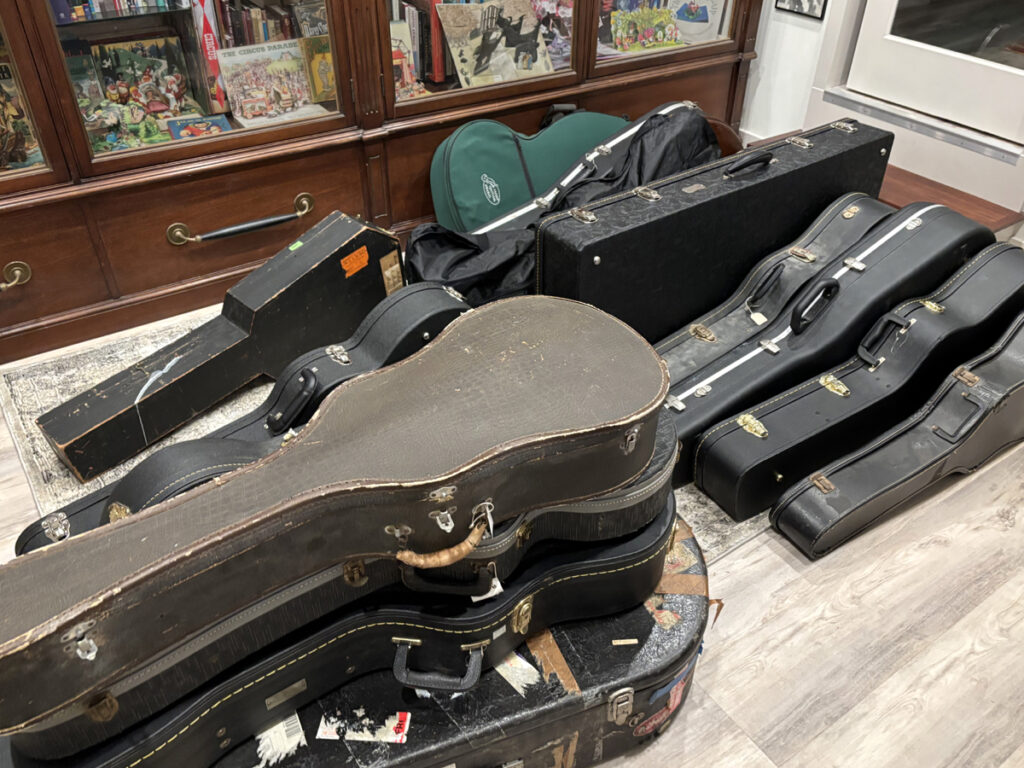
As soon as they arrived, we quickly moved all the instruments into the first Museum room. I couldn’t believe the stack of cases! In the back is my very own old Harp Guitar Music gig bag, containing Dyer harp guitar #917 – that’s the one with the “centered bridge” on the site (which he bought from Montaine Antiques some years back).
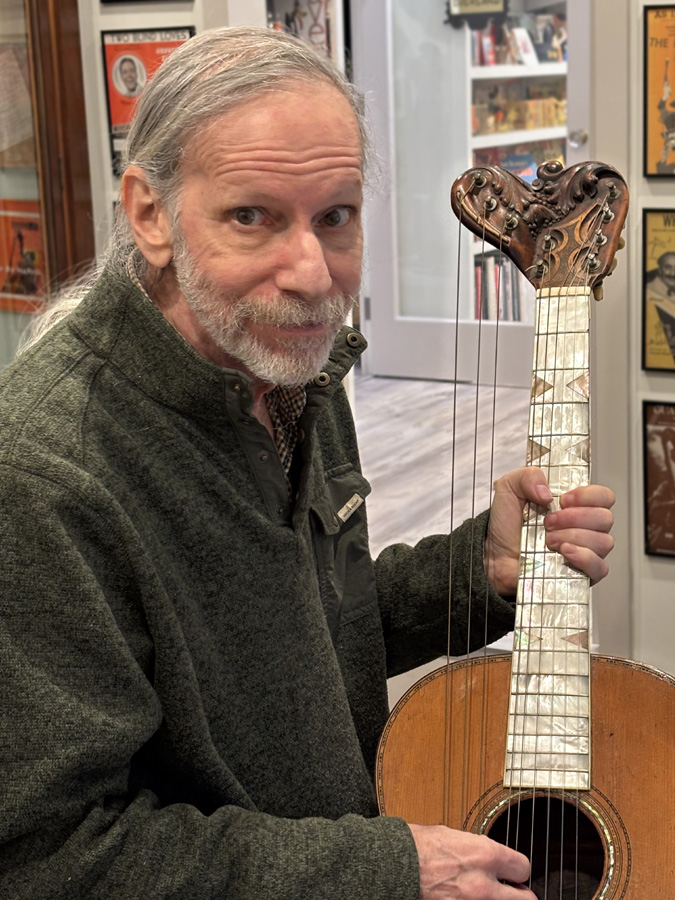
They both love this stuff and sharing it as much as I do. Robert was clearly anxious to start with harp guitars and had brought his Bohmann so I could see it in person.
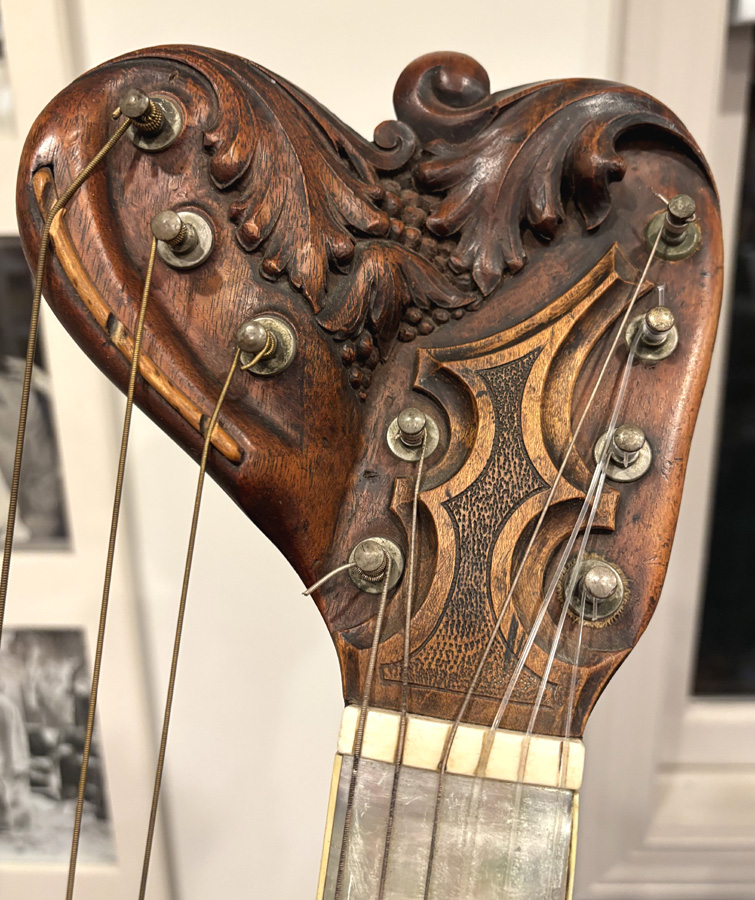
This has long been on my Bohmann page, using Robert’s excellent images, but they do not do it justice. Perhaps this “in situ” shot will give you an idea. I was already under the opinion – and this only further convinced me – that Bohmann had a colleague carve the bridge and incredible headstock of this early, experimental harp guitar. There’s no way Bohmann could do work like this, as his prior instruments had a crude rectangular slab head and the subsequent models had very simplistic – if intriguing – three-dimensional carved headstock shapes.
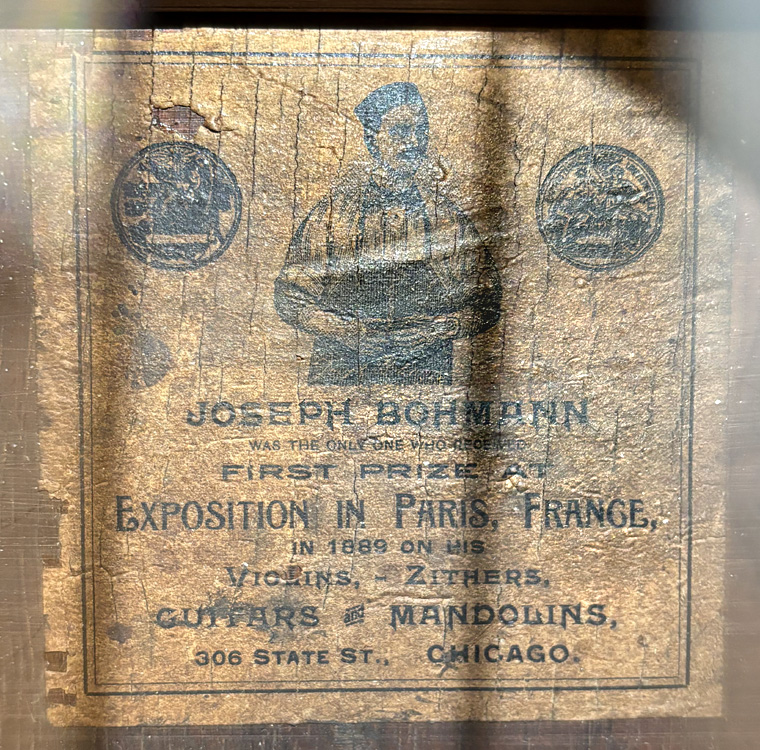
It has the Paris award label (which includes only the two Paris stamps), which would date this unique instrument to c.1889-c.1894.
See https://www.vintagemartin.com/Bohmann.html and https://www.harpguitars.net/history/bohmann/bohmann1.htm for more.
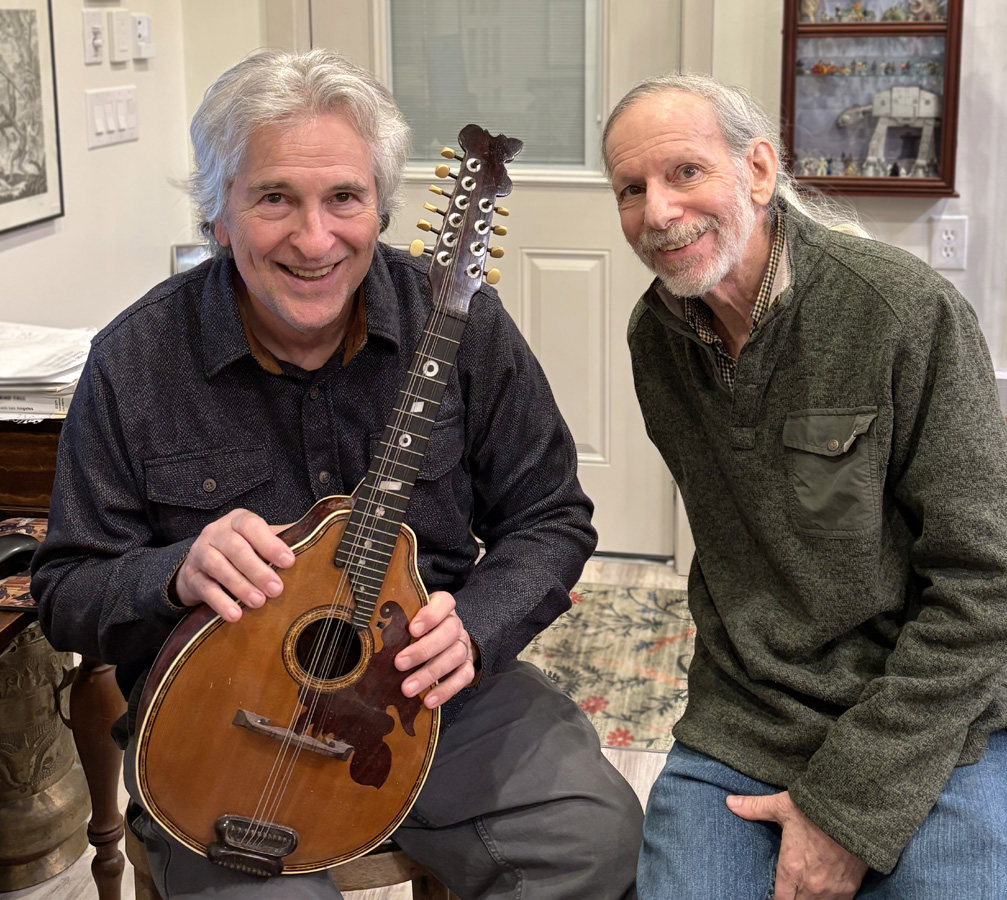
He also brought his Bohmann 5-course mandolin/mandola. This is the later ‘teens line of instruments with heavily domed tops and backs, with the tuned metal sympathetic rods inside. Check out that pickguard and asymmetrical headstock!
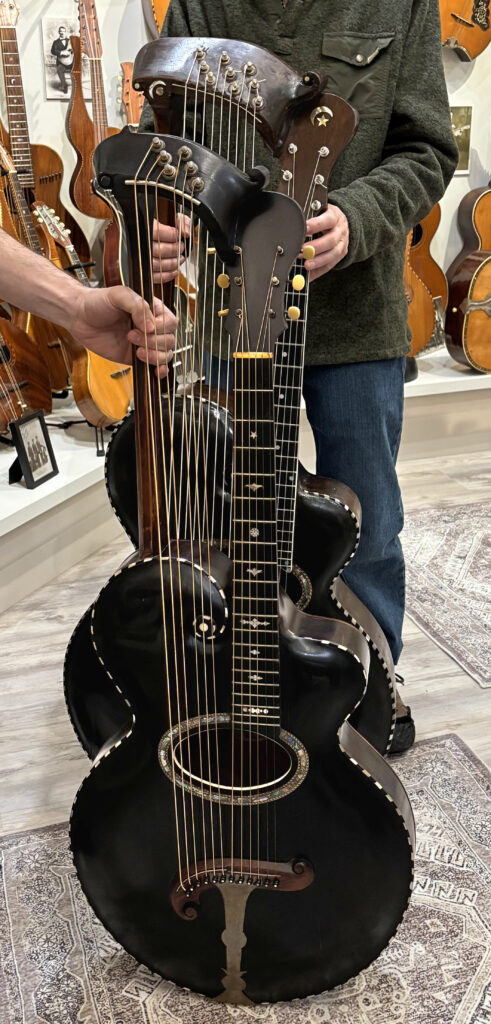
Back to the Gibsons, Phil wanted to see the two harp guitars in relation to each other. How often does one get a chance?!
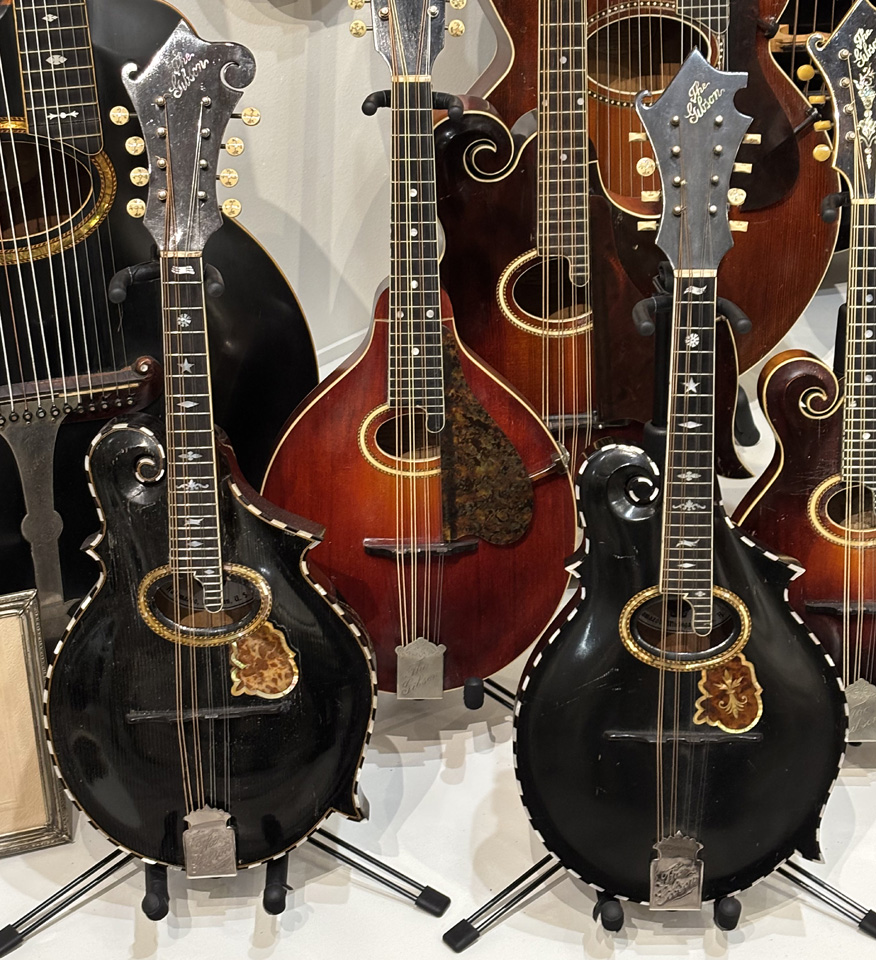
Soon after I finally got an F3, Phil found his own, which he brought along. Mine is #3008, which we put at c.1904; his # is a bit higher. They are extremely similar, with the typical “Orville and the Company still experimenting” differences (I’m sure early Gibson nerds will enjoy finding them all; Phil loved the added inner gold border to the rope border on mine). His is in way better overall shape, other than the broken headstock. Again, pretty cool to see two at once!
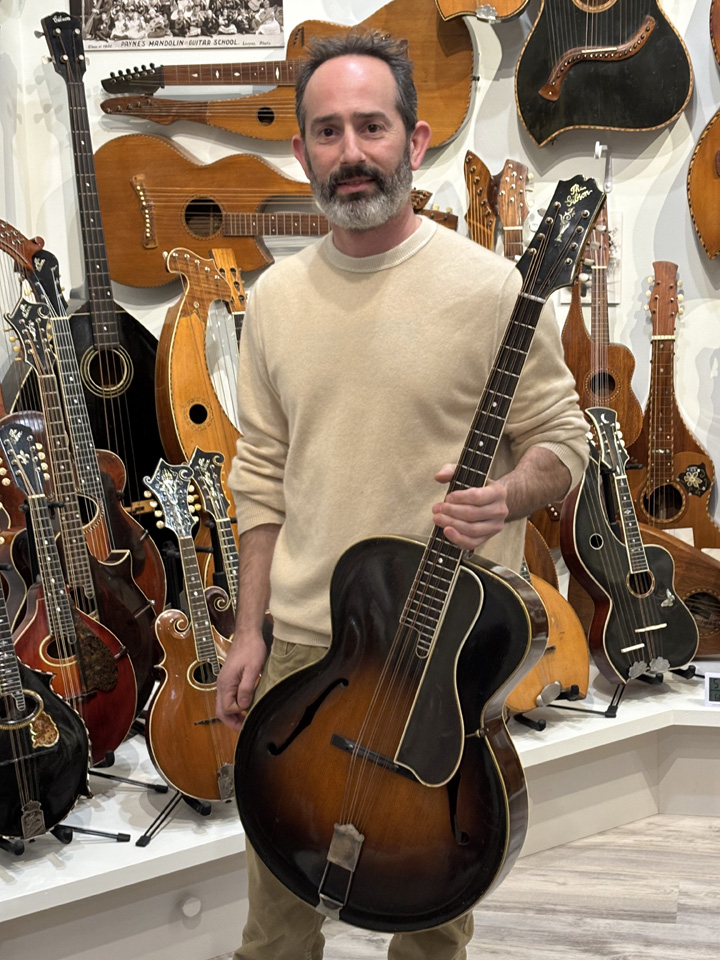
Phil kindly brought his unique K5 mandocello to share with me as well.
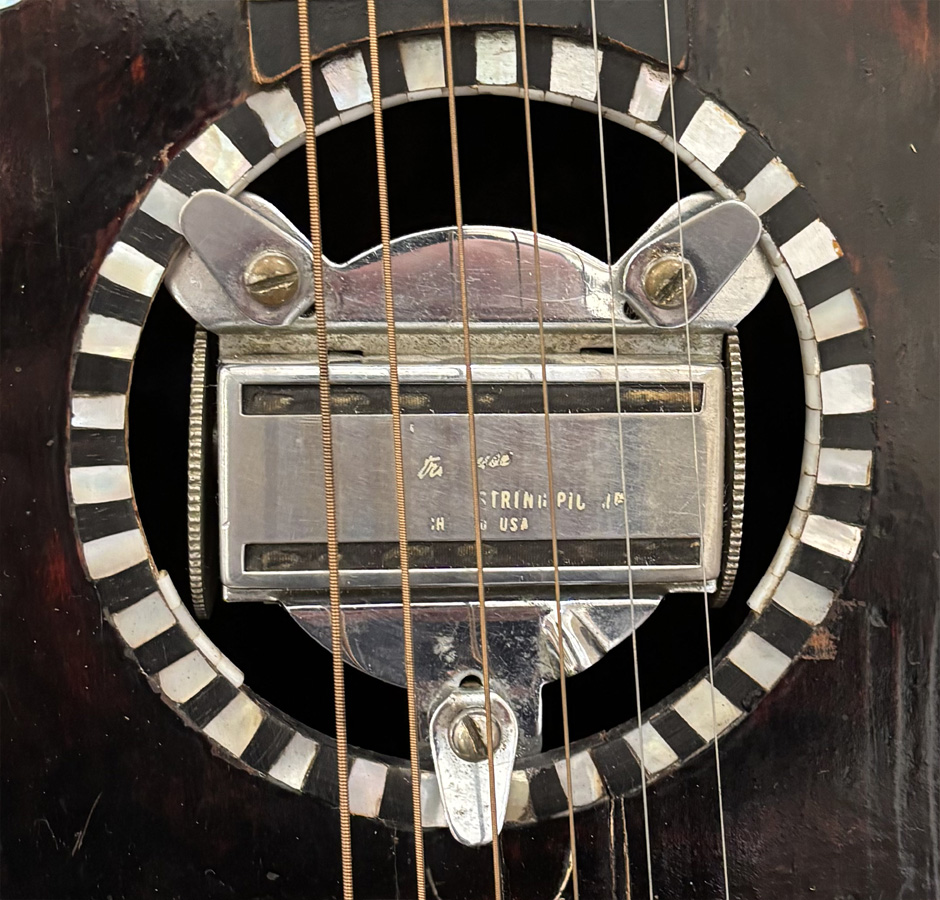
I have to let Phil introduce and tell the story of the very curious instrument that contained this fascinating (later) pickup. But I couldn’t resist showing you this wild vintage “STRING PIL USA” pickup.
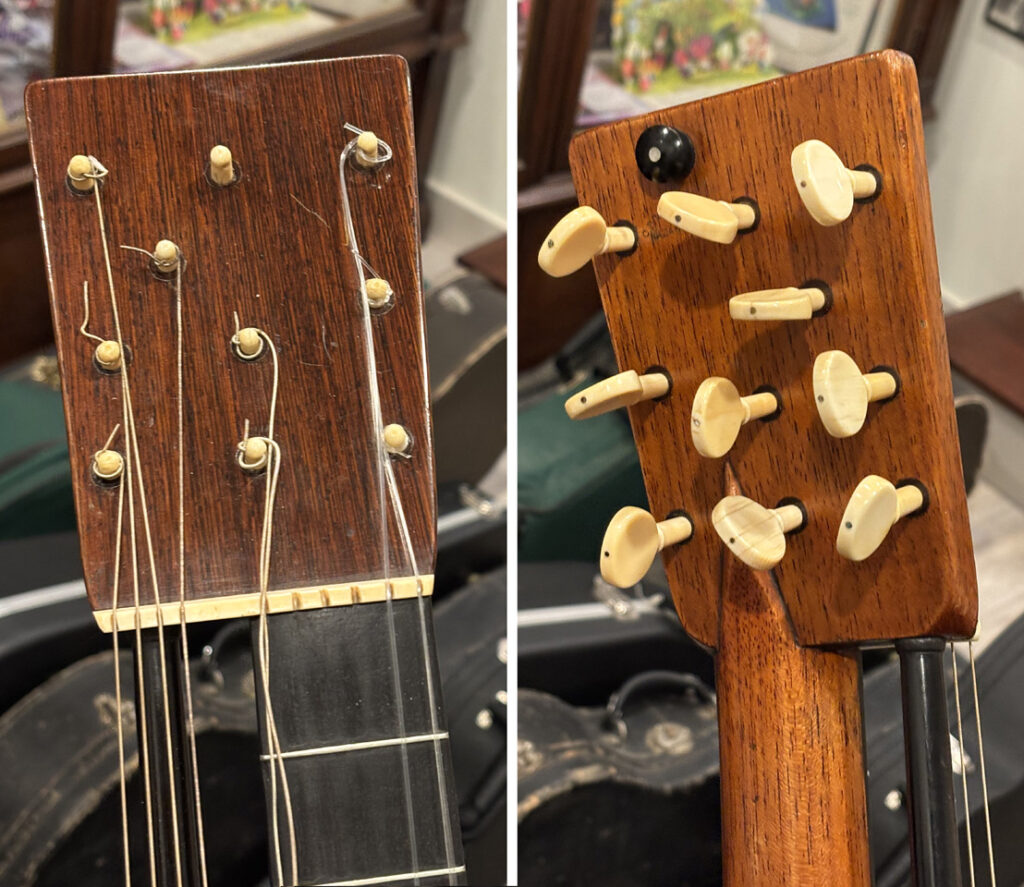
I was secretly hoping Robert might’ve packed this one up, and he did. This one is rare and important: an all original 1902 Martin 10-string harp guitar. I have yet to create a Martin harp guitar page on Harpguitars.net, as I’m still gathering info. Robert is way ahead of me!
See more at https://www.vintagemartin.com/Martin02_00021_10String.html
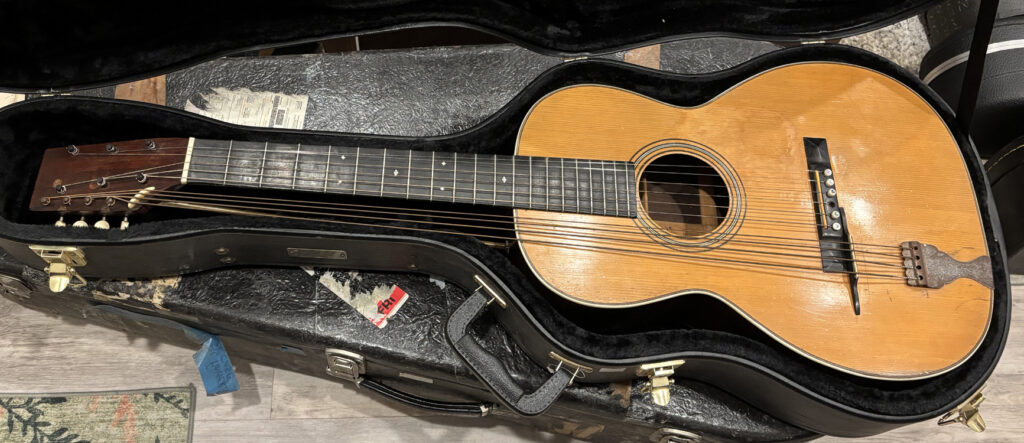
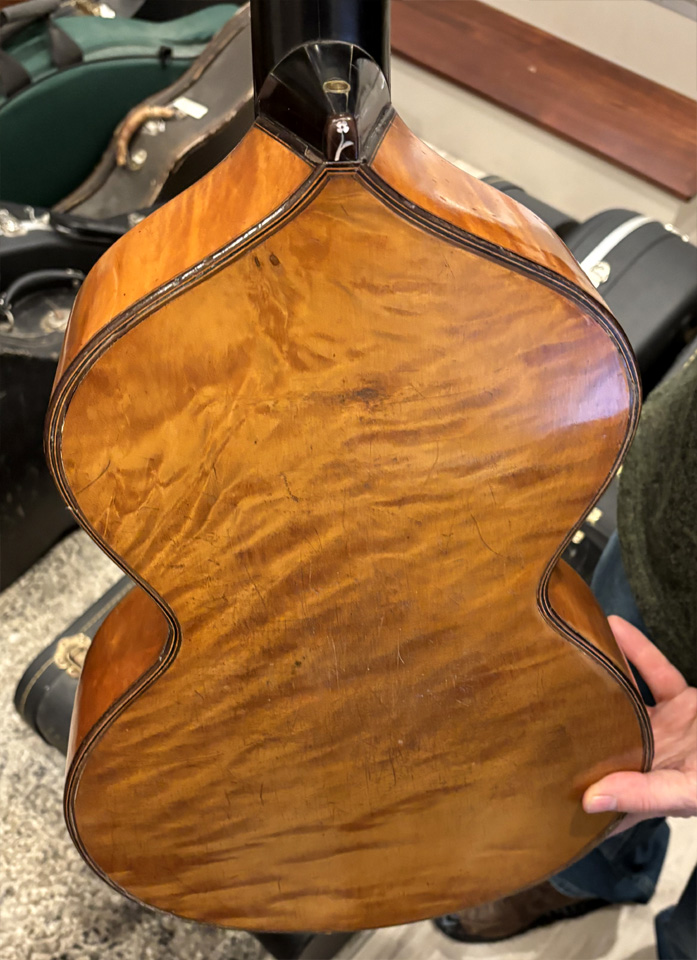
This one is not on his site, as it’s obviously been Frankensteined. It’s a Martin 6-string from around the same period (he has its serial # ledger entry) that someone must have decided to turn into their own 10-string harp guitar.
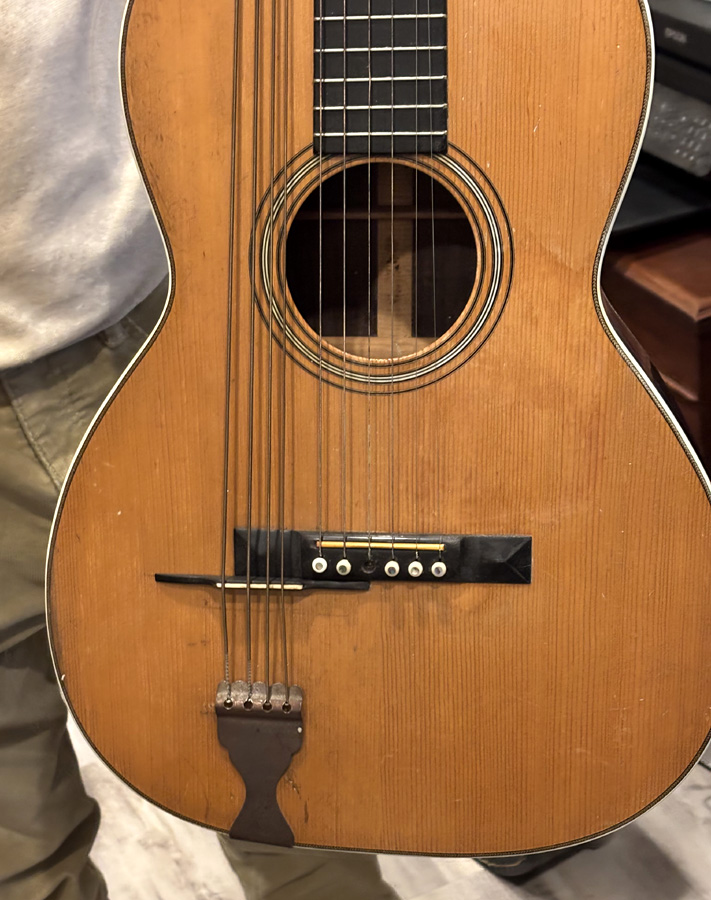
Kluge-y and wonderful in every way.

Another incredible instrument you’ve seen in books is Robert’s 1831 Stauffer “Renaissance” Style Legnani Model Guitar. Every single inlaid tuner and bridge pin remains!

Now I know why all these guys are into these “early romantic guitars” – again, holding something like this and inspecting its details up close is humbling.
See more at https://www.vintagemartin.com/StaufferRenaissance.html
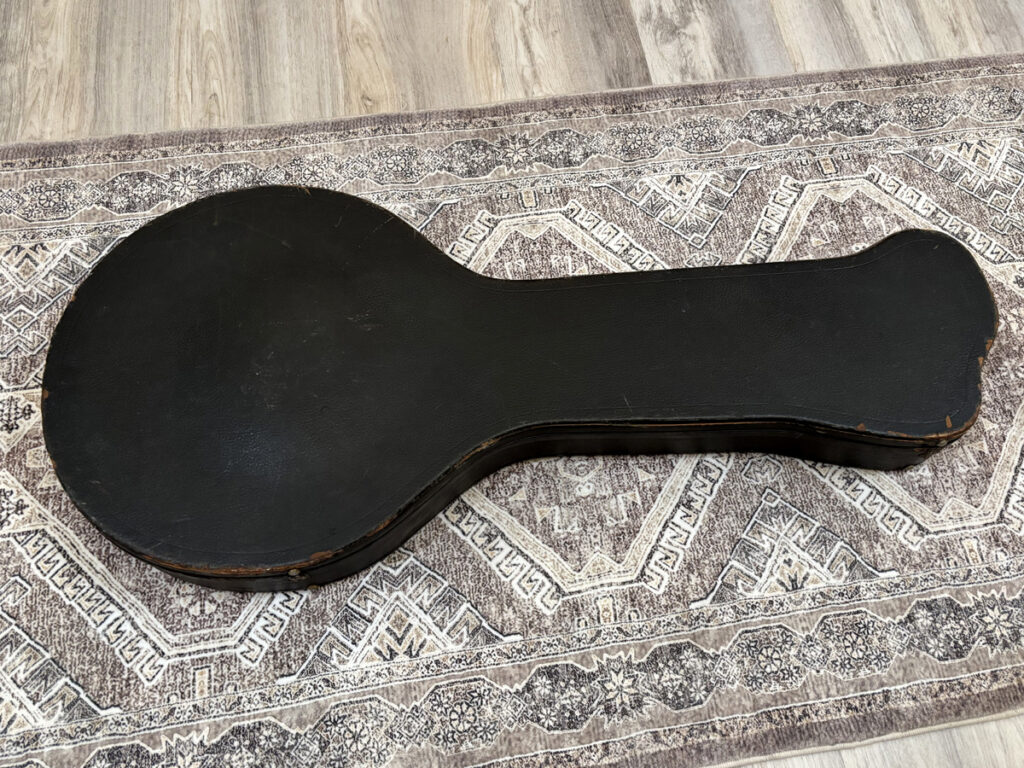
After the guys left, I saw they had left a case behind… Oh yeah! In all the excitement, I had completely forgotten about my own treasure.
Any guesses? Shouldn’t be too difficult.
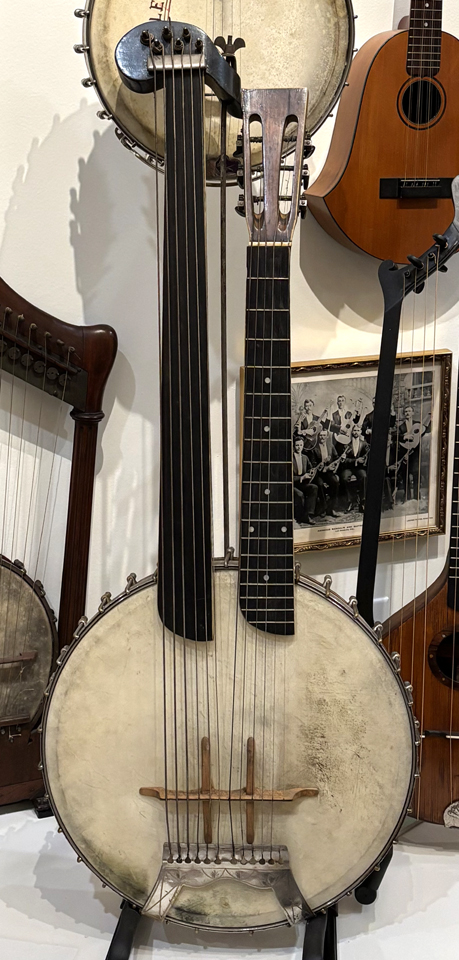
No, not a “double-neck” – an authentic original rarer-than-hen’s teeth c.1915 New York “harp guitar banjo.” That’s a 16” head!
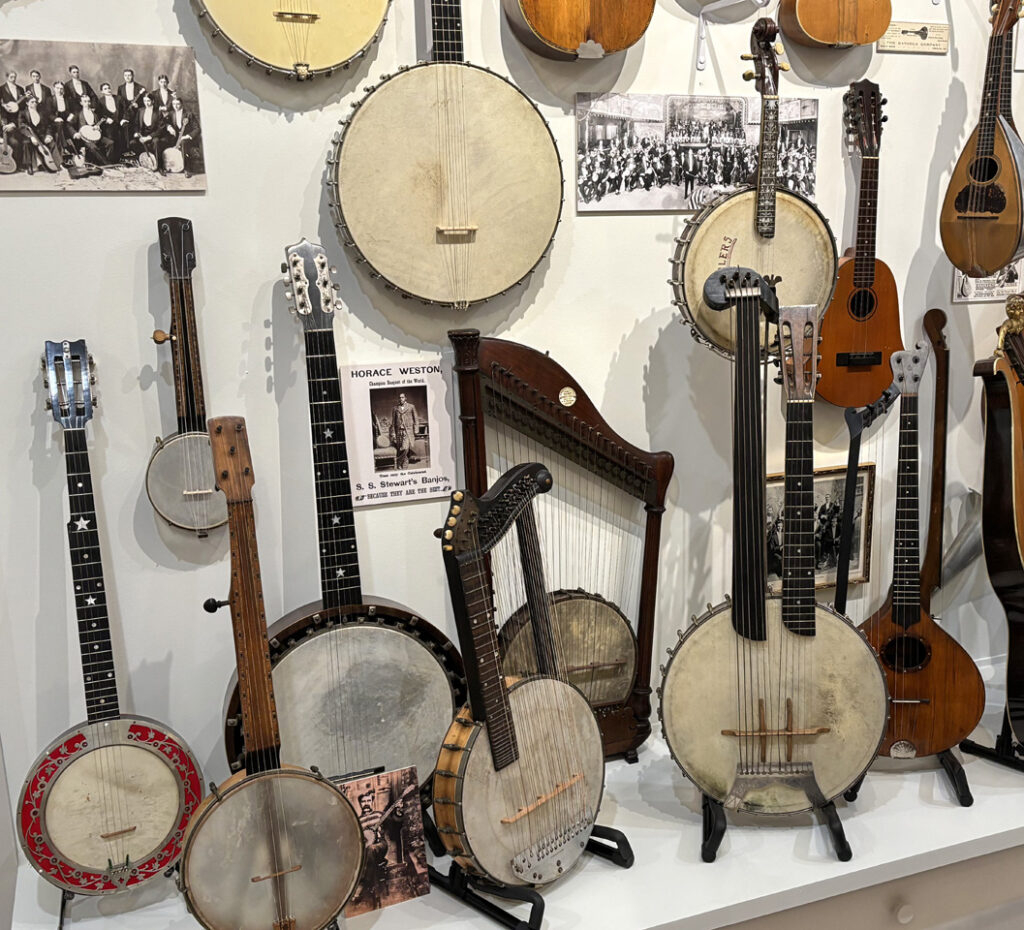
Even better, it wasn’t until I had already committed to the sale that I learned it was stamped – McGinnis & Shaw! What a story (that I will soon write). That’s a McG & Shaw bandolin hanging just above it. Both were intended for members of the Clef Club, the James Reese Europe booking outfit and orchestra seen on the wall behind. A story close to my heart (that I have written: https://www.harpguitars.net/players/europe,public.htm )
So, as you can guess, I am beyond thankful and indebted to Phil for making this acquisition happen. (Yes, the collection is now complete with every hybrid imaginable: Zither banjos and a banjo-zither, harp-banjo and patented banjo-harp, and even a wooden harp-mandoline-banjo!)
And thanks to both Phil and Robert for going above and beyond the call of duty for vintage guitar show and tell!