
Greetings, readers and harp guitar/music aficionados!
It’s time to formally announce The Harp Guitar Foundation Archival Project.
This is something that I’ve been thinking about for some time, and, thanks to some significant donations over the years, we were finally able to hire a part-time assistant for this monumental task.
The goal? Specifically, we hope to transition HTML and WordPress articles on Harpguitars.net into PDF format.
It seems that over the last couple decades, I’ve managed to publish at least a thousand articles on this (and my minermusic.com) web site. Some are just short essays or instrument blurbs, some are just quick-news-for-that-point-in-time, and some are scholarly 10,000-word articles.
And even ignoring the research and writing, there are still thousands of images that exist (Miner Music has 4400 files, Harpguitars.net has over 56 thousand).
Certainly, much of this content has value. And so, this is what we’ve come up with, and we’re now ready to unveil its beginnings (30 articles so far). We’ve tried and can’t really do any form of a quick copy>paste, which ends up filled with artifacts and errors and causes more problems than it’s worth. There is also a certain amount of valid and necessary editing, from updating old Introductions and fixing links, to correcting small errors, to major updates and re-writes where warranted (my part). It is no small task! We started with some “low hanging fruit” (original PDF format articles), some of the major historical “thesis” web articles and will continue in priority until the budget runs out.
The new Library:
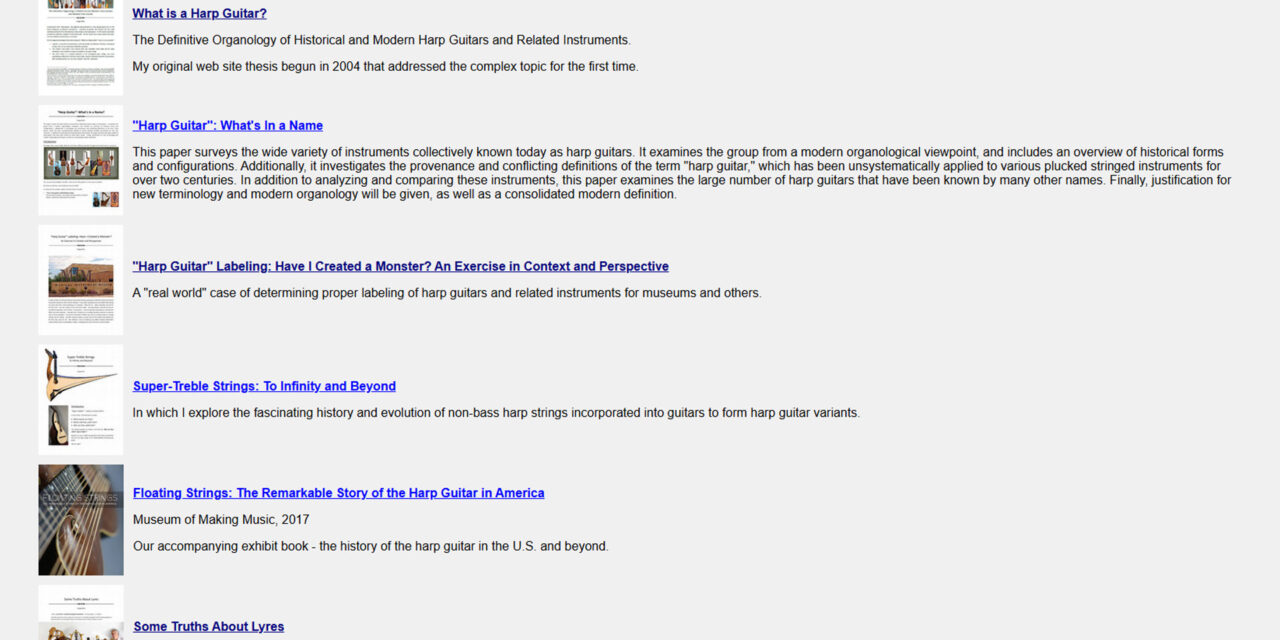
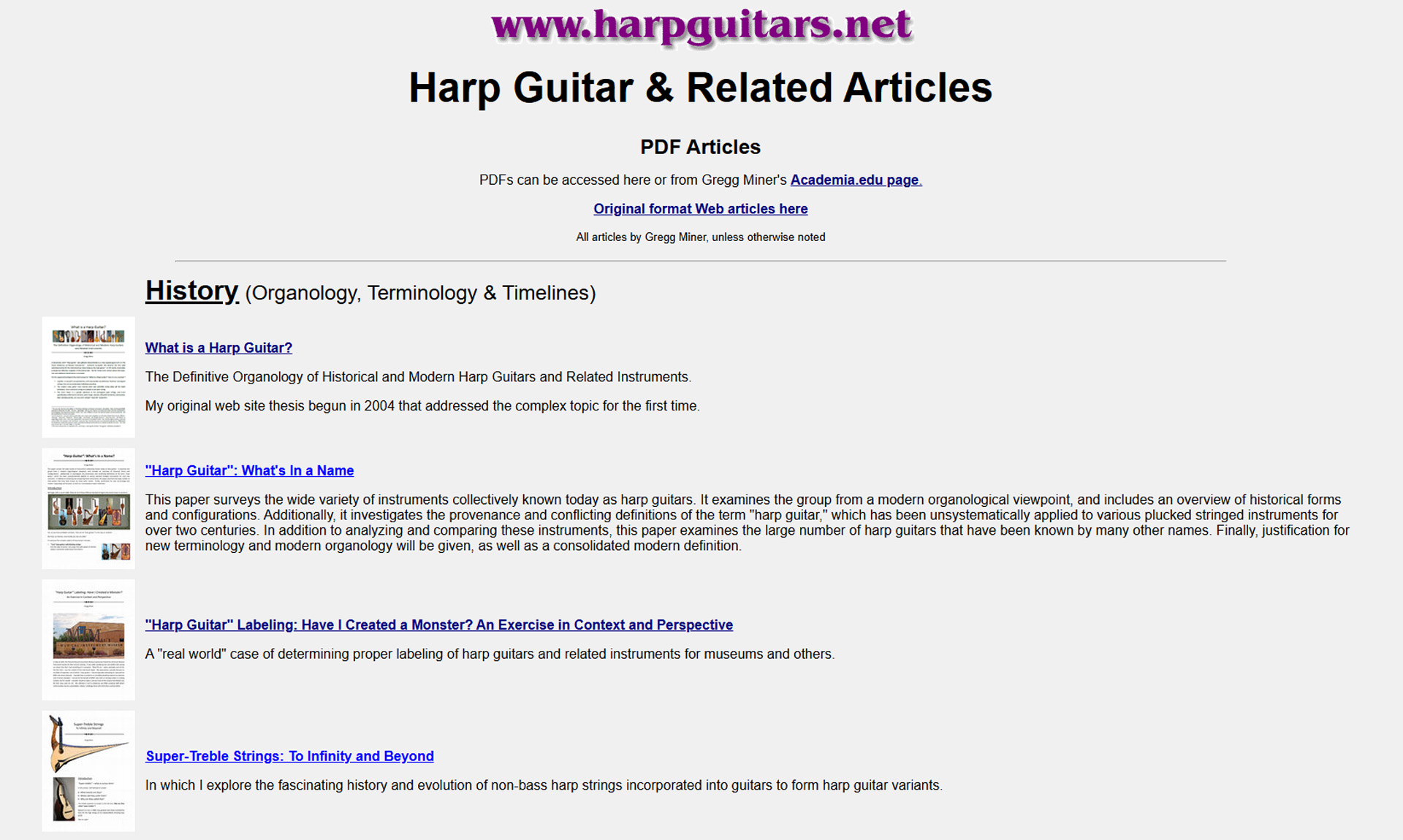
From the current WordPress home page of Harpguitars.net, the large “Articles” link is intact, but takes one here.
The “Web Articles” link takes you to the original list of the site’s old HTML articles, which forms much of our task list. The “PDF Articles” link takes you to the new PDF Archive with thumbnail “article markers” (as this will become quite the chockfull resource!).
Note that both pages also have a link at top to my Academia.edu page. This is a duplication of the entire PDF library, but on their platform, to provide an additional “backup” and also engage an additional, different audience. (Check it out as you wish. I’ve already found myself sourced by a number of guitar scholars who I’ve never heard of/from and would sure like to see that grow.)
From either source, one can quickly Download or Save any of these files to your computer.
To that end, I encourage anyone and everyone to save articles to their own drives for potential future backup and accessibility (articles that interest you, and if you have space). This provides another simple layer of “safety copies” out in the world as we continue to explore more permanent options. YES – please steal my work! Just don’t re-post or publish anywhere without permission or a credit for any quotes.
I have even published special Members Only articles and commercial books in this new archive, so that they are now accessible for free to the public.
Which brings me to:
You know that annoying little “and Viewers Like You” nudge you get when you watch those “free” PBS programs? Think of this a little like that, and, yes, that “You” is you!
But seriously, please DO note that the foundation is a tax-deductible non-profit and donation funds are now also being used for this new intensive, time-consuming project. If you’ve read any of my articles or utilized this site for your own research, I hope you agree that this is a worthwhile endeavor.
Additional background on the project:
I have thought long and hard about this over many years, while brainstorming with colleagues across the globe, including collectors, writers, and scholars and museum/library/university professionals at our many AMIS meetings, etc. (And no, the latter do not have the means to take this on, they’re all behind on their own “fish to fry.”)
I see our collective problem as three-fold.
- Manpower. Meaning, volunteers or paid staff to actually do the tedious-yet-meticulous work, whatever it might entail.
- Format Technology. Meaning, the format and media and online or physical sources to access digital media for the foreseeable future (photos and text, along with databases, etc.).
- Content Accessibility Technology. This goes along with #2, but rather than being about the content itself, it concerns the servers and hosts (or whatever our AI overlords dream up for us) in the future. Currently, this boils down to a single key failure point: the custodian. For our example, that’s me. While Harpguitars.net is always funded out a few years, my dream of extending that well past my own lifetime is not feasible. Why? Because almost once a year, the site owner must respond to a new task. It’s an endless Whack-a-Mole game of server migration, software revision/upgrade, security, full-on technology swap, you-name-it. Nothing is permanent, and so, to continue, each and every company or entity, or in this case, web site, will need permanent stewardship. That could be a benefactor or descendant, one that could extend it out some years or even decades. In my case, that will not be an option. I’ve investigated, and there finally are new start-ups thinking about and tackling this 21st century conundrum for a price. But which of those businesses might still be solvent in a decade…or a century?! Thus, our plan to update to (and continue with) Adobe PDF format, which most wise experts agree is expected to last the longest – or at least be “readable and convertible” the longest for future technology needs.
Are you with us?!

A formidable task, I am sure, but also a formidable body of work to handle and something to be applauded (both the work and the migration). Remember that the most expensive webmaster in the world (who is also known to have philanthropic moments 🤗) is still around, i case you need technical advice or assistance.