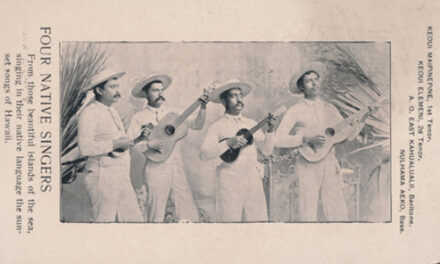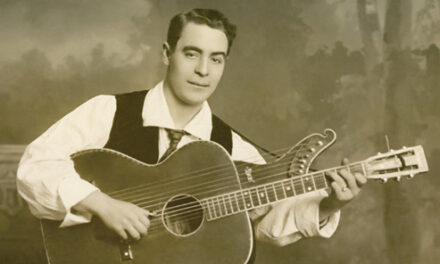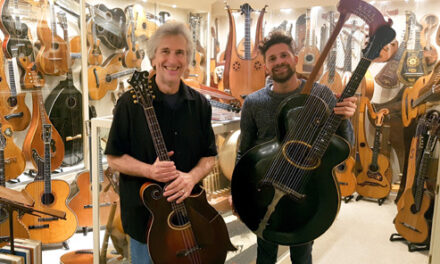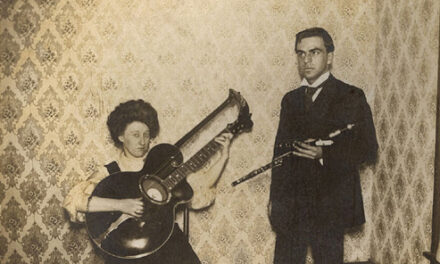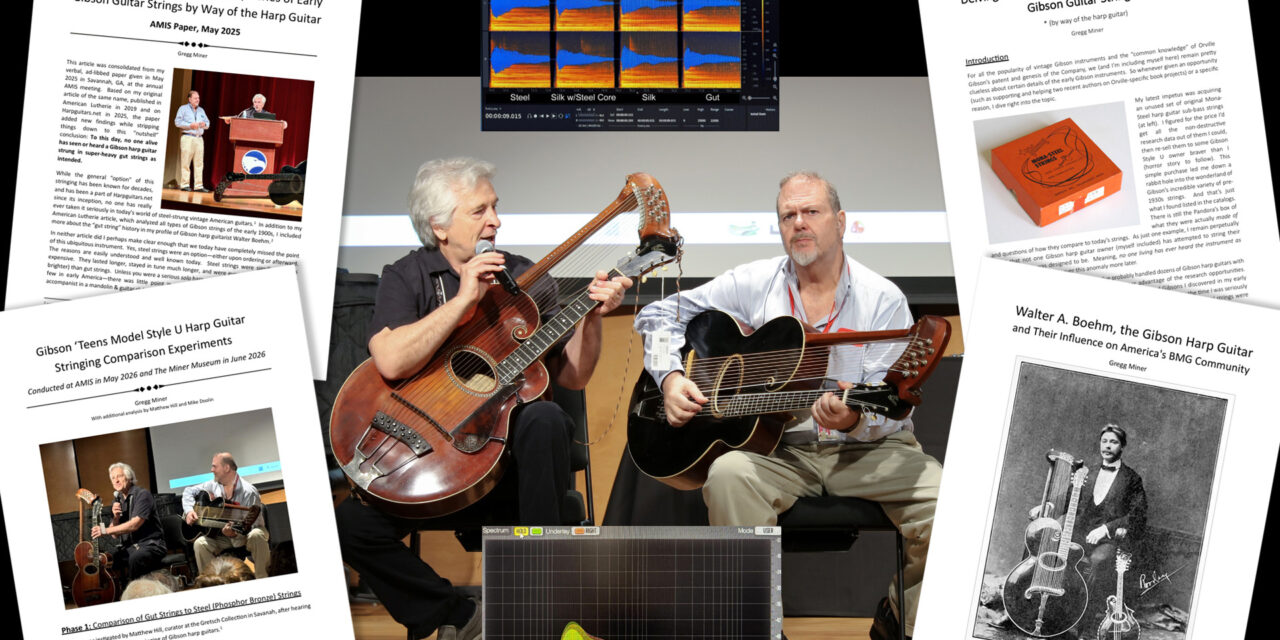
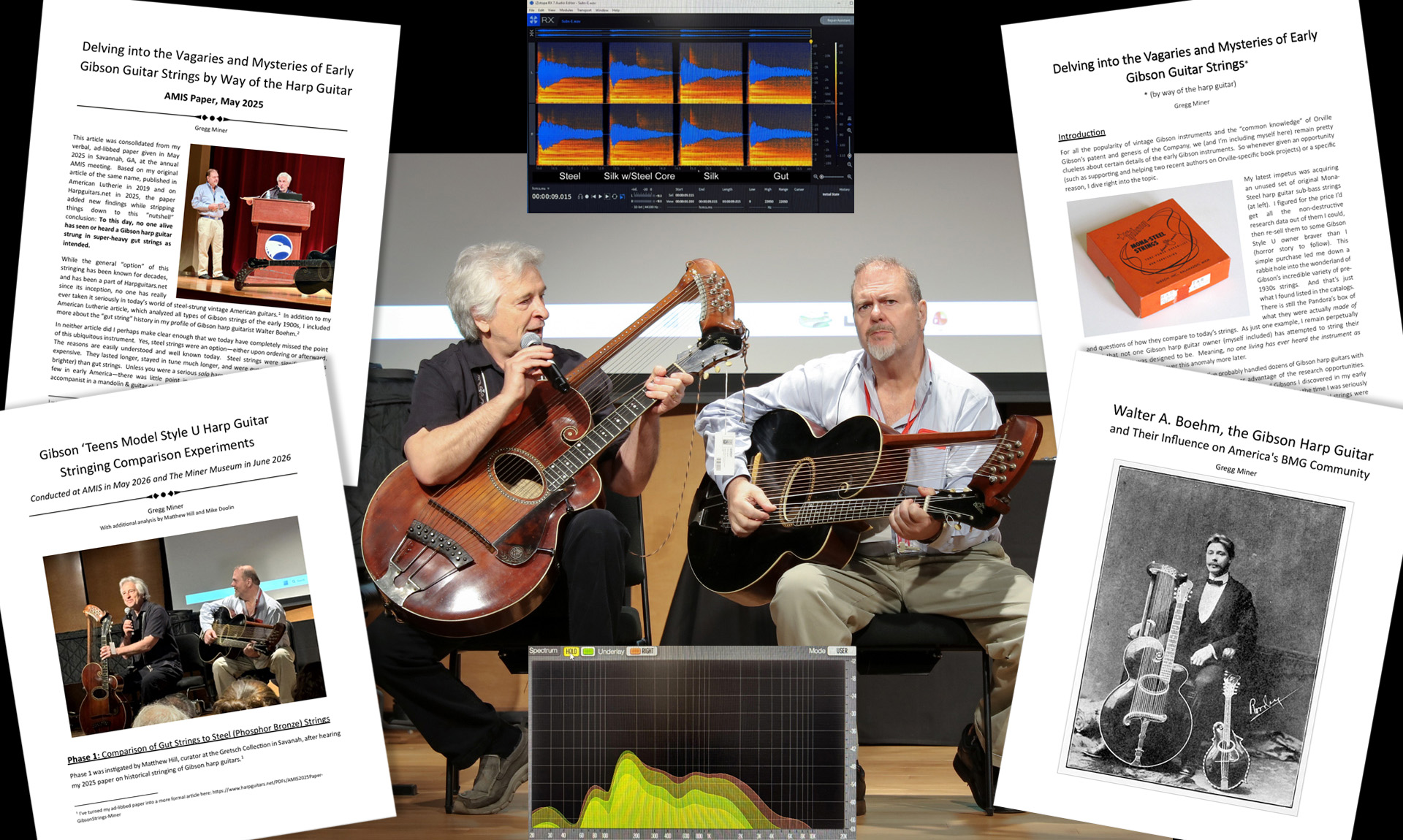
I hope you can tell from the above montage that I’ve been a busy boy. This post is meant as an advertisement and “call to arms” not just for fans of Gibson harp guitars, but for any and all American guitar historians, performers, collectors, restorers, and curators, Gibson or otherwise. If you own, play, study, or are otherwise curious about Gibson harp guitars (or Gibsons and similar American guitar history in general – be that as a private collector, modern musician, or museum curator, I consider this series of articles pictured above a must-read.
Indeed, more than one scholar considers this perhaps my most important work yet (I couldn’t say). Simply put, I have completed Phase 1 & 2 (along with all the backing historical research) of an in-depth, albeit incomplete, Gibson Harp Guitar String Study. Initially, I only intended to provide the historical evidence and call attention to today’s reality. But Matthew Hill forced the issue, and so we jumped in with both feet! Now, with his help, I’ve completed two new articles and polished the others of this series. (Thanks to Mike Doolin, as well.)
It doesn’t matter if you play a Gibson harp guitar, or just hope to, nor what kind of crazy music you’re thinking of trying on it. Recording? Plunking? Displaying? It all boils down to:
Before you begin, aren’t you curious about the true history and use of this iconic, but little-understood instrument? Before you string it up, don’t you want to know what your instrument was designed and built for?
This isn’t to lecture – I’ve owned a 1915 Gibson Style U since 1983 and am only finally beginning to understand why I’ve always struggled with it.
Eventually, I created a proper set of Gibson sub-bass strings to offer at Harp Guitar Music. I’ve probably sold over a hundred sets by now. My advice? Don’t buy them.
Do your homework first. No matter how many times I’ve sent shoppers first to my old American Lutherie article on Gibson strings, or to learn about Boehm and the BMG world, it doesn’t matter…they all just order my steel-string Gibson set for their Gibson harp guitars.
Hey, they certainly work. But…
Two of the articles shown above have been up for a while; two have just been published. They form a series that can be read in any order, or in the order I list on my Articles page under “Instruments” (the read order suggested by my colleague Matthew Hill, seen in the montage above, ending with Walter Boehm). There is overlap among all four articles, so readers, hobbyists, players, luthiers, and scholars are encouraged to peruse all of them, as each will have different components, details, clues, observations, opinions, and key takeaways for the particular disciplines I mentioned.
I encourage you to comment here (or email me), as this topic is woefully under-represented and little discussed across the entire vintage guitar and museum spectrum.
And I, for one, could use the help!
Sir Gregory