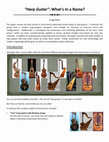
What is a Harp Guitar?

A Modern Organology of Historical and Modern Harp Guitars and Related Instruments

by Gregg Miner
Updated February, 2009

For the layperson looking for the short answer of "What is a Harp Guitar?," here it is in a nutshell (from Definition 10 below):
  • A guitar, in any of its accepted forms, with any number of additional "floating" unstopped strings that can accommodate individual plucking
  • The modern harp guitar must have at least one unfretted string lying off the main fretboard; these unfretted strings are played as an open string
  • The word "harp" is a specific reference to the unstopped open strings, and is not specifically a reference to the tone, pitch range, volume, silhouette similarity, construction, floor-standing ability, nor any other alleged "harp-like" properties. 

This, of course, is an oversimplification, and only one of a dozen historical definitions of the term, but describes the family of instruments that is the main focus and purpose of Harpguitars.net.  For the researcher or aficionado seriously interested in this complex topic, read on....

Introduction

This is not a history of the harp guitar. Though it includes many historical elements, it is meant to be an organization of the instruments into clearer and more logical groups. This dissertation is just one way to address the classification of harp guitars. There are undoubtedly many ways, and no one way is "right." One obvious alternate system might be to organize regionally or historically - this would keep German instruments together, Knutsens with Knutsens, etc. However, I have chosen to organize by form - specifically, the conceptual methods for attaching extra "harp strings." This proved to be the only way to answer accurately, and in encompassing detail, "What is a harp guitar?"

An important point as one reads through the information is this:
Harp guitars are never consistent in features, and are found under a wide variety of names. Conversely, some historical instruments called "harp guitars" are not necessarily what we now define as a harp guitar. Organology (the classification of musical instruments) is rife with problems in addressing the sometimes arbitrary or downright misleading names given to new instruments by their original makers. Additionally, organology is not necessarily conducive to the changing world of new musical instrument development. Luckily however, we are not locked in like scientists who must always adhere to the first "type" name. In fact, with harp guitars and other evolving musical instruments, we must be open to both re-classification and re-naming. NOTE 1

Immediate and basic questions we should ask are:

  • What is a Harp Guitar?
  • Where did the term come from?
  • When did the meaning as we take it today become accepted? and:
  • Is it even the most appropriate term?

  Before everyone gets worried, the answer to the last question is – Yes, I definitely believe it is. But I avoid answering any of these questions directly. Instead I suggest that you draw your own conclusions from the data, interpretations and concepts presented below. If they differ from mine, share them. If they agree with my findings, then let's start putting these concepts, terms and semantics into practice.

This dissertation consists of the following sections. They are best read and understood in sequence.
ETYMOLOGY, terminology and interpretation.
DEFINITIONS of the term "harp guitar."
A new organization of harp guitars and related instruments into FAMILIES & FORMS.
A FAMILY TREE including a PHOTO REFERENCE library.
A DISCUSSION of the topics
– throughout the presentation and in extensive FOOTNOTES (click on "Note" to read, then use your browser "Back" key to return to main text).

Note to scholars: I fully admit that I have committed the unpardonable sin of not providing a detailed list of specific sources.  Where not noted directly within text, sources can be requested, though many sources consist of the thousands of photos and research collected and presented on this site.  See Bibliography for printed sources.


ETYMOLOGY, TERMINOLOGY and INTERPRETATION

It immediately becomes clear that musical instrument reference material might be interpreted differently depending on what language the source material is in. It is therefore important to note that this thesis is being presented as an English-language American study. I'm sure we would see different conclusions from our German, Dutch, French, Italian, Spanish, and even British counterparts. So in researching the history of harp guitars and the various uses and combinations of the words "harp" and "guitar," we must also account for original terms first presented in other languages, and how best to accurately translate them.

Thus, the first phase of our study must necessarily begin with the very words "harp" and guitar." Not too difficult:

English old German modern German French Italian Spanish
harp Harfe Harfe harpe (arpe [indicative mode: arpi] in use in 1800s per Benoît Meulle-Stef) arpa arpa
guitar Guitarre Gitarre guitare chitarra guitarra

Additionally, we understand the basic instruments these two words refer to. Things get a bit tricky, however, when we try to translate "harp guitar." Now, translation is not always literal, as individual specific or regional names for the instrument, along with all its relatives, come into play. Unfortunately, there is virtually no precedent of anyone attempting to address this. The closest I've found so far is Curt Sachs' Real-Lexikon der Musikinstrumente, published in 1913. NOTE 2 Unfortunately, I found Sachs confusing and perhaps contradictory. The following table lists all of his applicable entries: NOTE 2b

Sachs' nominal term (old German) Sachs' (old German) synonym Modern German Sachs' French Sachs' English
Guitarrenharfe Harfenguitarre Gitarrenharfe harpe-guitare, guitare-harpe harp-guitar
Bassguitarre Kontrabassguitarre Bassgitarre guitarre theorbee none given
Guitharfe (for a specific instrument) none given na none given none given

Note Sachs' 1913 inclusions of "harp guitar." He provides many related entries, with Guitarrenharfe as the nominal term. He lists Harfenguitarre as a synonym and harp-guitar (rather than "guitar-harp") as the English term. What is especially noteworthy are the three definitions Sachs gives for the term. He uses it to describe two strange early forms of "true" harp guitars - one of which he admits "has the best claim to the name" (see Definition 3 & 4 below). But then he qualifies it by stating that the name is usually understood as referring to two of the Light instruments - but not Light's Harp-guitar (see Definition 2 below)! Sachs goes on to list Bassguitarre and Kontrabassguitarre (but not kontraguitarre) as separate entries without comparing them to either Guitarrenharfe or the Guitharfe. They are explained simply as a Guitarre mit Bordunsaiten (guitar with bourdon ["low, drone"] strings). At the end of this entry he gives the French equivalent as Guitarre theorbee, and refers to the Bissex entry. NOTE 3 Yet another separate entry, Guitharfe, is the most confusing of all, and is discussed in Definition 9 below. Thus, with Sachs providing separate entries and names for several historical variations on what I now class as "true" harp guitars, he establishes the segregation, misleading names and confusion that are unresolved to this day (leading to the present dissertation).

One key question is who assigned the "Guitarrenharfe," or "harp-guitar," name to the two "true" harp guitars Sachs lists. The original makers? Sachs? The respective Museum collection curators? NOTE 4 I still cannot say for certain who introduced the term, nor when.

More recent uses:

The 1966 5th Edition of Grove's Dictonary of Music & Musicians does not include an entry for harp guitar. More unforgivably, the current Grove Music Online edition has only the entry, "see Harp-lutes." A couple mentions of Gibson and Dyer harp guitars, but that's all. By 1992, Baines' The Oxford Companion to Musical Instruments finally includes 3 definitions for "harp-guitar": the Light instrument, the Scherr instrument, and Gibson's harp guitar. That's it! BUT he now clarifies the Light instrument (supporting my proposals below) by listing it under the entry: 'Guitars' only in name.

Clearly, many American makers and musicians were commonly (but not unilaterally) referring to "true" harp guitars by that name by the 1900s. The earliest reference I have yet found is in the 1891 Hansen patent, who in his text labels his instrument a "harp-guitar." NOTE 5   After learning of this key provenance, I was lucky enough to obtain the sole Hansen specimen (labeled), and subsequently did further research into the topic (my article can be obtained here).   So far, Hansen's is the first provable use.

Regardless of the cold and nebulous trail, we now have a few decades, if not a full century or more, of the vernacular use of the obvious and natural “harp guitar” to refer to the "true," currently described instrument.

But is "harp guitar" the best and most proper term to use?

I firmly maintain that it is. Besides the hundred-plus years of provenance and established vernacular in (at least) America, I’m sure many of us concur that it is an easily understood and logical name for a guitar with open, unfretted strings. To modern aficionados, the strings (whether bass, treble or both) are "visually similar" to a harp’s strings, and, when plucked, utilize a harp technique and produce a harp-like tone. However, it is not clear whether this was the original intention of the word as a descriptor. In all of the evidence that I have seen, the makers and advertisers are comparing the tone of the harp guitar to the harp (presumably orchestral). Occasionally they refer to a "deep tone," and very rarely the extended range. No specific reference to the bass strings alone is made (as rationalization for the harp connotation), therefore the intended implication might have been that the instrument as a whole has a more "harp-like" "deep" and "resonant" tone. Whether this "tone" results from sympathetic vibration of the unstopped bass strings or from plucking them is also unclear. I have only found a very few specific references to plucking the bass strings, though I’m sure that was the intent in most cases. 
Nevertheless, even with these unknowns, these references to "harp-like tone" do nothing but add further rationale for using the term "harp guitar" as the common name for this family of instruments. NOTE 6 

So far, so good?
Now...what about those extra strings? How shall we refer to them?

I looked at all the options: diapason (historically refers to the open, diatonically-descending bass strings of the lutes), bourdon (similar historical use, referring to a low, "buzzing" drone string - as in hurdy-gurdy, but also lutes and guitars), open, unstopped and unfretted. These terms either sound unpleasant, or did not cover all the options required for harp guitars - the sub-bass, super-trebles, and banks of diatonic, chromatic or chordal strings whose range may overlap that of the main neck.
Though I was hoping for a nice, one-word term (like "diapason"), I ultimately chose the obvious, so-simple-I-forgot-it, perfectly logical term: “harp strings." If we can agree on "harp guitar," why not the appropriate "harp strings" (understanding that these are specific strings for a harp guitar, not an actual harp)?  I am thus using this throughout the presentation.

Here it comes:
I’ve almost single-handedly been pushing this for decades, but if we are to have any clear, accurate discussion of the scores of instruments on the present topic, we must use the term "course" in place of, or at least in addition to, "string." While I’m at it, let me make things even more difficult by suggesting that we must also now stop being complacent about misleading established names for other non-harp guitars. For instance, the common and popular “12-string guitar,” and the less common, but apparently well-established in classical or “romantic” guitar circles, “10-string guitar” (and similar 7- or 8-string, all fully-fretted). We should be careful when discussing guitars such as these and consider adding additional descriptors – such as (respectively) “a 12-string guitar of the common 6-course, double-strung variety,” and “the 10-string guitar of ten single courses.”


DEFINITIONS of Harp Guitar (also spelled harp-guitar)

In believed order of introduced usage:

Definition 1. Arpi-guitare, an instrument built by Paquet (Pacquet) ca. 1784 in Marseilles. The 7 guitar strings pass over a fingerboard suspended in space on a harp-like extension, allowing the strings to attach to a guitar-like bridge in a harp-like fashion.  I haven't even tried to classify this one, but placed it in my "Harp Guitars" in Name Only Gallery.

Definition 2. Harp-Guitar, an instrument invented in London in 1798 by Edward Light. Intended as a new "improved" decorative parlor instrument, with a simplified playing and learning technique facilitated by an "open" tuning copied from the earlier English guitar (a type of cittern). It quickly evolved into the Harp-Lute and British Lute-Harp (though was revisited in 1825 by Levien of Paris as the Guitare-Harpe). The final form, collectively known as "dital harps," had few frets and a full, 19-string diatonic harp tuning – thus it would be logical to assume that the "harp" portion of the name refers to either the tuning or the incorporation of unstopped strings. However, this is not where the word in Light’s hybrid name harp-guitar originated (in fact, the original instrument had no unstopped strings).  All indications show that the term simply referred to the tone of the instrument, though it is thought that it was also inspired by the construction of the body – a one-piece (and later, staved) round soundbox, in the manner of parlor and orchestral harps. This body design (and "harp" connotation) was retained throughout the entire series. NOTE 7  This oft-discussed "Harp-Guitar" is in a very different family of instruments (the Harp-Lutes) than the "true" harp guitars below.

Definition 3. Harp- guitar (Guitarrenharfe - Kinsky, Sachs. Brussels # 1550), ca. 1800-1825. An ingenious combination of guitar and harp, maker unknown, attributed to England. Sachs states that this "instrument type has the best claim to the name," and I would agree. It is a "true" harp guitar in every sense of the word, yet its like has never been seen since. A chromatic 31-string harp-like frame and body (rotated 90 degrees to join the guitar face) extend out of the fairly standard guitar body - with the guitar's neck forming the harp "column," complete with crown. Either this or the next entry may represent the first use of the term applied to a "true" harp guitar, but it is impossible to say (see footnote). NOTE 4 

Definition 4. Harp- guitar (Guitarrenharfe - Sachs. Heyer # 603), ca. 1800-1825. An instrument of unknown origin attributed to the same time period as the previous entry, which represents a second form of "true" harp guitar. Its basic form was repeated fairly closely (but likely coincidentally) by Gibson for their harp guitars.  Again, we don't know what it was originally called (see footnote 4).

Definition 5. Harp guitar (or guitar-harp), by Joseph Mast, 1827. A small instrument with an outline reminiscent of a harp. A 6-string guitar neck ....The name and date come from The Steve Howe Collection, with the information being repeated in Dangerous Curves by the Boston MFA. I haven't been able to confirm that either is accurate.  Like the Pacquet instrument, I haven't tried to classify it, but place it in my "Harp Guitars" in Name Only Gallery.

Definition 6. Scherr’s Patent Harp Guitar, a guitar with a long body extension reaching to the floor, invented in the USA by E. N. Scherr of Philadelphia and patented Oct. 6, 1831. It had no extra strings, but is so named because it is "approximate in power and superiority of tone" to the harp.

Definition 7. Double harp-guitar, by London harp maker J. F. Grosjean, c.1840. Very similar instrument to the Mast instrument above, but having two necks/fingerboards, the second neck being half length for tuning an octave higher.  Baines lists this V&A Museum instrument as having no label, so this name is just a descriptive one, without any nomenclature provenance.

Definition 8. Guitarpa. While perhaps the creative inventor's hybrid name, rather than an exact literal translation, this instrument is nevertheless important to the organology of harp guitars (and certainly to the history). It is the infamous instrument by Don Jose Gallegos displayed at the Great Exposition in London in 1851, which scholars have speculated might have influenced the designs of the mandolins and harp guitars of Orville Gibson. It also makes a tempting speculative source for inspiration for Knutsen's "super-treble" strings of 1900 - but this is presuming that he was aware of it, or had access to an illustration. It had 35 strings, 26 of which were "harp" strings on the body; a six string guitar neck; and extending from that, a 3-string, fretted "violoncello" neck (the "tone" of the cello, rather than actual playing technique, being the attribute). As fanciful as it is, it still conforms to the current harp guitar classification criteria (Form 4, though the combined elements cause it to be shown in the Composite Forms Gallery).

Definition 9. Guitharfe. NOTE, 5/07: Pending Re-write. I have found better information on this instrument, and can hopefully provide better details soon.  Essentially, everything you have ever heard or read about this instrument is wrong, or at best, still unclear.  The single specimen has been "in the queue" for the museum staff to describe and photograph for me for quite some time.

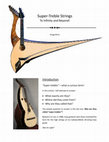
Definition 10. Harp guitar.  Both a specific name for certain maker's examples and a new modern "type term" for the subject of this web site – the family of “true” harp guitars.  Defined as: A guitar, in any of its accepted forms, with any number of additional unstopped strings that can accommodate individual plucking. These instruments, a separate and distinct category within the guitar family, are those most commonly and popularly referred to today as harp guitars. In this case (whatever the original intent of the use in the hybrid name), the word "harp" is now a specific reference to the unstopped open strings, and is not specifically a reference to the tone, pitch range, volume, silhouette similarity, construction, floor-standing ability, nor any other alleged "harp-like" properties. To qualify in this category, an instrument must have at least one unfretted string lying off the main fretboard. NOTE 9  Further, the unfretted strings - whether they were intended for playing or only sympathetic vibration - can be, and typically are, played as an open string. Beyond that, literally almost anything goes. Undoubtedly, the most common configuration is a series of from 1 to 12 sub-bass strings adjacent to the main neck’s low string (ex: Gibson, Knutsen/Dyer, Schrammel guitars). Less common varieties feature super-treble strings on the opposite side of the sub-bass strings (Knutsen, Sullivan/Elliott-style), sub-bass strings on both sides of the neck (Altpeter), or chord-group, melodic, or other non-bass strings only (Knutsen "zither harp guitar," Meulle-Stef tzouraharp). NOTE 10  Additional styles of technically "true" harp guitars include Manzer’s "Picasso" guitar and new creations by luthiers Fred Carlson and William Eaton. The earliest surviving specimen of what I would consider a "true" harp guitar that I am aware of is a 10-course French instrument built by Deleplanque in 1782 (not the Naderman bissex, see Hybrids below) - though similar "theorboed guitars" were briefly introduced over a hundred years earlier! NOTE 11 

Definition 11. Harp guitar: A "psuedo harp guitar," with a hollow "harp" arm, an extension of the upper bass-side bout, but utilizing no extra unstopped strings. Examples by several makers have been found, with Knutsen’s being the best known. Within the guitar family, these are a separate category - which I classify as "hollow-arm guitars - from the "true" harp guitars defined previously. NOTE 12

Regarding the last two entries, it is also common and should be considered acceptable to apply these definitions and "harp" prefix to similarly configured instruments other than guitar, such as mandolin, ukulele, tenor guitar, steel guitar, and so forth (examples are shown in the Photo Reference Library).

So - what do we make of all these definitions? Clearly, there are several instruments listed above that are harp guitars in name only - we can accept and use these historical names as long as we understand the context. Conversely, we can't just disallow previous names given to "true" harp guitars (such as bass-guitar, kontragitarre, etc.). Again, these names can still be used for their original purpose, if they are understood and if they are, in fact, known.  For example, the common European use of "bassgitarre" is simply vernacular for a vast array of European harp guitars, the majority of which had no specific name ("bass-guitar" or other).  If unclear, or without backing evidence, then "harp guitar" should probably be used - today, it has far overtaken "bass guitar" as the accepted vernacular (and classification) for all instruments, no matter what the country of origin may be.  Even if the evidence is clear, it may be best to begin preferentially using "harp guitar."

Perhaps if Edward Light’s Harp-Guitar had not evolved into the harp-lutes, and remained an accepted instrument, we’d be hunting for a new name. Likewise, if Scherr’s Patent Harp Guitar had not disappeared immediately as a curiosity. More recently (though still over 100 years ago), Knutsen’s 6-string One-arm Guitar was synonymous with "harp guitar." Today, we look back on well over two centuries of strange inventions and indiscriminate semantics - and it's time we got it right.


FAMILIES and FORMS of harp guitars and related instruments

Harp Guitars. This category within the guitar family includes the modern instruments being played today, along with their ancestors; and includes a huge variety of historical instruments.

In addition to the features outlined in Definition 10 above, this category can be broken down into several main forms. Besides the following discussion, the "Family Tree" on the next page will provide a clearer snapshot of the forms, while the accompanying Photo Reference Library will literally be "worth a thousand words." While this study cannot hope to cover every unique, one-of-a-kind harp guitar ever created, I can broadly sub-divide into categories as follows. I have listed them in approximate order of historical relevance and perceived importance, though the order may unavoidably appear somewhat arbitrary. These 13 categories can be seen in the PHOTO REFERENCE LIBRARY GALLERIES.

Form 1. Theorboed Headstock harp string attachment. 
1a.
Extension has no support.
Extension is pronounced, and emanates upward, to the side, or in a compound bend in true theorbo fashion.
1b. Extension is supported with a rod of metal or pillar of wood.
Similar extension shapes.
1c. Extension is a contiguous, slightly extended, enlarged, or "fanned" component of the main headstock.
Sub-bass string(s) can be held by a simple extension nut, extension of wood, or on an enlarged fan-shaped headstock (as introduced in the Naderman Bissex).

Form 2. Additional Neck harp string attachment. Double-neck configuration is the most common; occasionally three are seen. There may be rare occurrences of frets on the harp string (bass) neck. These may be intended for use with a capo, not for fingering - but sometimes, their presence is a mystery.
2a. Headstocks are unattached. A simple screwed-on metal connecting bracket may be present.
2b. Headstocks are connected.
A permanent piece of wood or metal joins two otherwise separate headstocks.
2c. Headstocks are a single-formed piece.
The appearance is not one of "joined" headstocks - instead, a single custom shape or structure connects the two necks.

Form 3. Hollow Body Extension harp string attachment. 
3a. Bass arm extension.
Harp guitars with a hollow "harp" arm, which is an uninterrupted extension of the upper bass-side bout. The well-known Dyer or Knutsen instruments are a classic example.
3b. Dual arm extension. A case where hollow arms extend from both upper bouts, as in lyre guitars.
3c. Continuous arm extension.
A full, hollow "arm" loop connects both upper bouts.

Form 4. Body harp string attachment. The harp strings are attached at both ends to the body of the guitar. Most often occurs in conjunction with other forms.

Form 5. Open Frame harp string attachment. The harp strings connect to a solid, generally continuous open framework. This "harp-like" frame typically (but not necessarily) connects the body and headstock.

Composite, Intermediate & Other Forms.
Composite: Includes or combines two or more harp guitar forms on one instrument, or can combine harp guitar forms with non-harp guitar families (such as sympathetic strings, or a second, mandolin neck).
Intermediate:
Lies somewhere between other forms. Even with the 11 total sub-forms above, there are many instruments that are difficult to place precisely. One example is the gray area between some “supported-theorboed headstocks” of Form 1b and the “harp frames” of Form 5 – the ubiquitous Gibsons conceivably fall into this area. Additionally, there are obvious gray areas within forms – such as gradual non-black & white transitions between double-neck Forms 2b and 2c. For now, I have not created an extra Gallery in the Photo Reference Library for Intermediate forms, but placed instruments where I thought best, and discuss them there.
Other: New or unique configurations that do not fit any of the 11 sub-forms. The Wulschner Regal harp guitar, with harp strings attached to a slab extension attached to a portion of the neck, is an example.


Fretted Harp Guitars. In some instances, there are instruments that may be tuned and played as harp guitars, but are provided with a full set of frets under all strings. In some cases, the frets are not intended for left hand fingering, but perhaps included for appearance's sake, or perhaps as a series of "nuts" behind which a capo (a device which clamps the strings to the fingerboard) can be attached to change the pitch of the "harp" string.  More typically, the instrument is a standard multi-course guitar (see below) that a player has decided to play "in the manner of a harp guitar" (by simply avoiding fretting the lower courses).


Harpolyre.  Salomon’s harpolyre, is essentially a Fretted Harp Guitar, and as close to a harp guitar as one could get.  However, it should probably be left alone in its own unique category.  See the full Gallery page for details.


Hollow-armed Guitars. This group may be also considered as "pseudo harp guitars". There are three forms, and they more or less duplicate the three types of Form 3 harp guitars - without the additional sub-bass or harp strings. The first form, often referred to by Knutsen as the "One-arm guitar," is analogous to the "bass arm extension" harp guitar form 3a above. "Dual-arms," such as Washburn's lyre guitar, have lyre-like arms emanating from a standard guitar body, and thus are separate from traditional lyre guitars, which stand upright on their incorporated base. "Continuous-arm" models include the recently-discovered Anderson/Knutsen guitar. NOTE 12  Examples in this Gallery.


Harp-lutes. While this term refers to a specific form of Edward Light instrument, I have also long believed that it is the best term that can be used in the broader sense as a family name to include all the Light inventions and the many copies and variations by other makers. There seem to be other scholars finally coming around to this idea as well.  All appear to have been made in the 1798-1830 period, generally in London (the Levien in Paris). The group includes Harp-Guitars (Guitare-Harpe - Levien), Harp-Lute-Guitars, Harp-Lutes, British-Lute-Harps (Dital Harps), Harp Venturas, Harp-Lyres, Apollo Lyres (superficially similar to lyre guitars), “Bass-Lyres” (additional open strings) and "Harp-Theorbos" (configured and tuned like the harp-lute-guitar, but resembling an arch-cittern). NOTE 13   See the Harp-Lute Gallery for forms.


Not included in the above definitions, but applicable to this discussion and study are:

Lyre Guitars. Well-known decorative "parlor" instruments of the 1800s. Most examples are French, and include various forms. The most common stand upright on a flat base which is incorporated directly into the shape of the guitar's body (the Apollo Lyres, in the harp-lute family, appear superficially similar to this form of "true" lyre guitar). A second, much less common, type has a rounded bottom, a suspended, "floating" fingerboard, and a larger number of strings (7-9). These are often referred to as "French lyres" - though obvious confusion exists with the equally-French lyre guitars. A few other oddball forms are also considered lyre guitars (see Lyre Guitar Gallery). Confusion also comes from harp guitar maker Mozzani naming his dual (and even single) arm harp guitars chitarra lyras. NOTE 8 

Multi-course Guitars. Also known as multi-string guitars, extended range guitars. Not to be confused with harp guitars, these are "extended-range" guitars with extra bass strings beyond the standard guitar's low E string. They are fully fretted across all courses (7, 8 and 10 are common). NOTE 9  Again, "when some players choose not to utilize the frets on the lower strings, they may be considered to be "playing in the manner of a harp guitar." Examples in this Gallery.

Multi-neck Guitars. Again, not to be confused with harp guitars, as there are no unstopped strings. Includes double or multi-neck guitars, where each neck is fully fretted and individually capable of standard playing. NOTE 14  Examples in this Gallery.

Sympathetic String Guitars. Guitars with extra strings inside or outside the body that are specifically intended only to resonate, and not be plucked or strummed. Gray areas undoubtedly occur, so the original or preferred intent of the extra strings should be weighed, along with the amount of the "occasional strum" or brush of these strings. Examples in this Gallery.

Arch-lutes. I use this term in its original, broader reference to all the various lutes with extended necks accommodating open diapason strings. These days, many experts reserve the name for just one of the instruments, which has a specific size and configuration. The lutes have a much older, and better researched history than harp guitars (though fraught with similar inconsistencies and exceptions). It is pretty well accepted that "arch-lutes" served as the inspiration for harp guitars (and all similar "theorboed" instruments). It is worth having some knowledge of them to recognize when someone has created a hybridization between harp guitar and lute. Examples in this Gallery.

Arch-citterns. This family could also use some new organology. The differences are known, but have not been clearly named. I separate the groups into what I call "true" arch-citterns and "false" arch-citterns. The instruments of the first group are theorboed versions of true, historically traditional citterns. The second (and most common) group consists of superficially similar instruments, descended from English guitars (ergo "false" citterns). There is also a third version of "arch-cittern," extremely similar to the "false" variety. The specific name is not verified - I use "harp-theorbo" (used sporadically by others) to refer to this instrument which is essentially a "false arch-cittern" version of Light's Harp-Lute-Guitar. Again, I include them in this study because of their similar "harp guitar" aspects, as interesting, related history. Examples in this Gallery.

Mixed Family Hybrids and Other Related Forms. Some obvious ones that should be included in a discussion of harp guitars are: 
The Swedish Lute. For all intents and purposes, a hybrid of equal parts of theorbo, arch-cittern and harp guitar. Authentic examples are extremely rare. The specific traditional form evolved from the cittern-like English guitar, developed by Mathias Petter Kraft (was it coincidence that both the "false" arch-citterns above and the Swedish lute were developed at the exact same time, and both from the English guitar?). It enjoyed four decades (1780-1820) as a "popular" instrument in its namesake country. A 15-course instrument strung in gut, it had 8 courses on the neck (sometimes 3 were doubled) and 4, 5 or 7 open bass strings. The tuning, developed from the English guitar, was an "open" chord on top with descending basses, much like the Light harp-lutes (coincidentally also inspired by the English guitar). Like the Light instruments, fingerboard capos and bass string sharpening levers were common. A thorough English-language dissertation on the instrument can be found on this web page by Kenneth Sparr.

Often confused with the above is a much more common, very similar instrument that is also called the "Swedish lute."  I classify and refer to them as "false Swedish lutes" to distinguish them from the "true Swedish lute" above.  They were - and still are - made in several countries and known by many names (Nordic bass-lute, Swedish lute or Scholander-lute.  The latter name being that of its most famous player, Sven Scholander, who was the "inventor" of the instrument [see Iconography: Harp Guitar Relatives]).  This simpler hybrid instrument became hugely popular from 1890-1920 and beyond, largely due to Scholander's success.  The verifiable story, in a nutshell, is that Scholander inherited a decades-old true Swedish lute and made all the modern changes - 6 neck strings, tuned like a standard guitar, and 6 diatonic basses (like some European harp guitars), plus modern geared tuners and silk & steel (instead of gut) strings.  He soon had a new instrument built from scratch that incorporated all these features, but he retained the essential shape of the old Swedish lute.

A nearly identical form is the so-called basslaute, which I refer to as a "theorboed guitar-lute."  Undoubtedly, it was inspired by Scholander's instrument, but features a typical lute-shaped body rather than the Swedish lute-shaped body. It is essentially a "harp guitar" version of the ubiquitous "guitar-lute" or German wanderlaute.

Both the above forms are still in use today, perhaps because of their commonness and similarity to a guitar. In fact, with 6 single strings on the neck, tuned like a guitar, and generally 4 or 6 sub-bass strings, these (generally) gut-strung instruments are as close to a true harp guitar as one can get - therefore, they can be said to be played as harp guitars. Not just a wandering minstrel's "folk" instrument, many were built by the finest guitar makers and played by well-known guitarists.  Not just a wandering minstrel's "folk" instrument, many were built by the finest guitar makers and played by well-known guitarists.

Another fascinating analog to harp guitars is the Russian torban. The history of this instrument is so rich and unusual, it could take up a web site by itself. And fortunately for us, it has! A wonderful English study can be found on Roman Turovsky's POLYHYMNION web-site.

There are many (perhaps endless) other historical and contemporary instruments that combine elements from different fretted instrument families. The difficulty is agreement in analyzing, categorizing and describing the features - and placing within (or between) harp guitar and related families. For example, I consider the Naderman Bissex a combination of lute and guitar, with "harp-guitar"-like results (coincidentally, Naderman was a famed harp builder). Ergo, it is a harp guitar relative, not the "first harp guitar." 5/08: But the plot has thickened: additional information on the bissex coming shortly.  All these, and other, hybrids are shown in this Gallery.


FAMILY TREE and PHOTO REFERENCE LIBRARY GALLERIES


FOOTNOTES

NOTE 1. For example, while Light’s Harp-Guitar and Scherr’s Patent Harp Guitar are indisputably “harp guitars” in name and by definition, they are not (or no longer) harp guitars by classification. Conversely, a plethora of names have been given to the instruments we now classify as harp guitars – bass guitars, contra guitars, arch-guitars, theorbo-guitars, compound guitars, one-arm guitars, chitarra-lyras – and on and on.
One thing that often seems to be overlooked or ignored in classification is the intent of the inventor or marketers of an instrument. Gleaned or inferred from advertisements or other clues, this aspect can greatly help piece together history and perhaps prove useful for organology (though certainly some inventors only provide contradictions!).  

NOTE 2. From Wikipedia, the free encyclopedia: Curt Sachs (June 29, 1881 - February 5, 1959) was a German musicologist. He was one of the founders of modern organology (the study of musical instruments), and is probably best remembered today for co-authoring the Sachs-Hornbostel scheme of musical instrument classification with Erich von Hornbostel. Sachs was born in Berlin. In his youth, he studied piano, music theory and composition. However, his doctorate from Berlin University (where he was later professor of musicology) in 1904 was on the history of art, with his thesis on the sculpture of Verrocchio. He began a career as an art historian, but gradually became more and more devoted to music, eventually being appointed director of the Staatliche Instrumentensammlung, a large collection of musical instruments. He reorganised and restored much of the collection, and his career as an organologist began. In 1913, Sachs saw the publication of his book Real-Lexicon der Musikinstrumente, probably the most comprehensive survey of musical instruments in 200 years. In 1914 he and Erich Moritz von Hornbostel published the work for which they are probably now best known in Zeitschrift für Ethnologie, a new system of musical instrument classification. It is today known as the Sachs-Hornbostel system. It has been much revised over the years, and has been the subject of some criticism, but it remains the most widely used system of classification by ethnomusicologists and organologists. In 1933, Sachs was dismissed from his posts in Germany by the Nazi Party because he was a Jew. Sachs consequently moved to Paris, and later to the United States, where he settled in New York City. He taught at New York University from 1937 to 1953, and also worked at the New York Public Library. He wrote books on rhythm, dance and musical instruments, with his The History of Musical Instruments (1942), a comprehensive survey of musical instruments worldwide throughout history, seen as one of the most important. Although much of it has been superseded by more recent research, it is still seen as an essential text in the field. Sachs died in 1959 in New York City. The American Musical Instrument Society has a "Curt Sachs Award", which it gives each year to individuals for their contributions to organology.

NOTE 2b. To further confound my efforts, I was reminded by my translators (see end credits) of the change in German spelling of Guitarre>Gitarre since Sachs' day!

NOTE 3. In addition to Sachs' above-mentioned "guitarre theorbee" and "Bissex," harp guitar scholar Stephen Sedgwick also provides eighteenth century references to other instruments such as a " chittarra Atiorbata" and " chitarra-salterio" (which Sedgwick describes as " a hybrid Italian guitar crossed over with the Eastern zither"). These translate respectively as "theorboed guitar" and "guitar-psaltery." The former was apparently present in both Italy and France about 1650 (see NOTE 11 below), and was undoubtedly a "true" harp guitar by the current definition. The latter is described as having internal (and later, external) sympathetic strings - so may not represent a "true" form. Regardless, neither provides precedent for the eventual specific name for the harp guitar.

NOTE 4. Unfortunately, the actual names used for Brussels catalog # 1550 and Heyer # 603 by the respective makers appear to be unknown (as neither has a label, or any other provenance). Regardless, by 1913, Sachs has assigned the "harp-guitar" name to both instruments. More specifically, in 1912, Georg Kinsky, conservator at the Musikhistorisches Museum von Wilhelm Heyer in Coln (where # 603 resides/resided), has labeled the instrument a "Guitarren-Harfe" (spelling it both with a hyphen and as one word). The following year, Sachs publishes it also as "Guitarrenharfe." Note in Etymology above that Sachs gives the English translation of Guitarrenharfe as "Harp-guitar" (not "guitar-harp"). Strangely, he further explains: "As a rule, when referring to a harp guitar, (the Heyer instrument) is not this one that is being described. Actually one of the two instruments made by Edward Light is intended, neither of which closely resembles the term harp guitar. They are his 'harp lute' or the 'harp lute guitar'."(!)

NOTE 5. There is still much detail to explore and undercover regarding the provenance of the term "harp guitar." Here are most of the dates and clues I am currently aware of:

Provenance in America:

  • 1891: Hansen patent (labels his instrument a "harp-guitar").
  • 1893: Abelspies patent (specifically states that his instrument "... may be termed a harp-guitar, as it combines along with a guitar of ordinary or special construction, a number of strings strung after the manner of a harp and plucked by the fingers as in that instrument.")
  • 1896: Music Trades article announcing Bohmann's new (1895) "harp-guitar" (12 chromatic sub-bass strings).
  • 1897: Knutsen's second U.S. patent labels his design a "harp-guitar frame" - the English patent 3 months later labels it a "harp-guitar."
  • 1899: Knutsen ad. Also key to the discussion of the term and discussion of hollow-arm "pseudo" harp guitars are these specific Knutsen details:
    Feb.1898 ad:
    " For a short time only C. Knutsen offers his One-Arm Guitars for sale at the following prices: 
                            Short Arm Guitar, - - - - - - - - - - -  $15.00
                            Harp Shape, 6-string Guitar, - - - - - $18.00
                            Harp Shape, 9 or 11-string Guitar, -  $20.00"
  • ca. 1899 Dyer flyer: “The Celebrated One-Arm Harp Guitar”
  • ca. 1899: Also uses “The One-Arm Harp Guitar” on labels in instruments.
  • ca.1900: “Symphony Harp Guitar” first appears. The name could have been coined by Knutsen or Dyer.
    These are intriguing clues that help us infer how Knutsen (and/or Dyer) intended the connotation of the word "harp."
    The 1898 "Harp shape” undeniably refers to the hollow arm. However, by his next ad, neither the arm shape nor appearance of the extra strings were the justification of the name. Again, it was simply back to the tone: “…increased (the guitar’s) volume four-fold, at the same time deepening and softening the tone until the music closely approaches that grandest of all stringed instruments, the harp.”
  • First verified Gibson use: 1902/1903 catalog.
  • First verified Lyon & Healy use: 1913 (prior to that, they used “bass guitar”)
  • First Maurer/Stahl use: the ‘teens. I expect to find earlier dates after completing additional research.

Provenance outside the United States:  Very few specifics are known, but new clues are starting to appear.

  • 1848, Europe: Harfengitarre appears in a review of a performance by Mertz in reference to a guitar with four extra bass strings.  This incredibly important clue comes from Alex Timmerman (Ivan Padovec, 1800-1873 and His Time, p.119).  The type of instrument is not known, and Timmerman speculates that it "could well have been a prototype of the ten-string 'Bogengitarre' ('Bow-guitar') later developed and built by Friedrich Schenk."  Timmerman brings up an excellent point.  As the “theorboed” Staufer and Scherzer style of harp guitar would later be colloquially referred to as “bass guitars” (a term Timmerman and others steadfastly adhere to), it is logical to look for another instrument candidate, and the hollow-arm bogengitarre is a good one.  “Bogen” (“bowed” or “arched”) refers to the hollow arm extension; coincidentally, Knutsen would refer to his very similar 1896 American invention as a “harp frame” or “harp shape.”  It is indeed tempting to postulate this scenario, even though it would make our naming conventions – and much of my organological premise – much more difficult to investigate and organize (i.e.: implying a possible historical convention of vernacular naming separation between two main forms of harp guitars: the Schenk-type hollow-arms and the Scherzer-type theorboed/double-neck instruments).  Until we are able to resolve this key question (which may be never) we can only make readers and researchers aware of it.  The other important part of this provenance – whichever instrument it referred to – is where the term came from.  Did the reviewer invent it?  Was it announced by Mertz or the program as a harfengitarre?  Unless we can trace this provenance down, we can’t really consider this a “formal” historical term, and so far it appears to be the only reference in Western Europe throughout the entire 19th century.
  • 1871, Russia:  Ad for Mark Sokolovsky's concert includes the statement: "2. Duet na russkie motivy ("Chem tebia ia ogorchila" i final "Po ulitse mostovoi") soch. Sora, isp. na dvukh arf-gitarakh g. Sokolovsky and g. Shokhin."  Russian guitar expert Oleg Timofeyev translates this as: "a duet on two Russian songs ("How did I upset you" and the finale "Along the street"), comp[osition] by F. Sor, to be performed on two harp-guitars by Mr. Sokolovsky and Mr. Shokhin." (source: Timofeyev)Again the question remains: where did the term come from?  From one of the two performers?  The ad writer?  The builder of either of the instruments?  Were these double-neck "bass guitars" – as typically used in Russia - or hollow arm instruments?  If the former, were they now known in Russia as harp guitars - or was this a one-time occurrence?  Another tantalizing clue as we piece together the difficult nomenclature history.
  • Oct 29, 1892:  Abelspies' German patent is titled "Harfen-Guitarre." (see Patents page)

To re-cap: It is critical to note that we don't yet know whether the three references above were actually supplied by the performers or makers, or whether they were "coined" by a reviewer, copy-writer, or other secondary source.  Either way, these are important, fascinating clues.  I.E: We still don't know if a specific European maker used the name "harp guitar" for any of these instruments.  Regardless, if American makers didn't invent the term, they certainly popularized it. Even so, “harp guitar” was never universally accepted. Even in 1921, Oscar Schmidt was still calling their Stella version a “Double Neck or Contra Bass Guitar.”  There is undoubtedly missing provenance of cases where inventors and manufacturers called their instruments harp guitars, and I imagine we'll find much new information over time.

NOTE 6. Specific specimens may still be referred to by the original name of the inventor, marketer, cultural practice, etc. However (and, yes, I know I'm going to affront several entire European countries), we’ve got to get rid of the terms "bass guitar," "kontraguitarre" ("contra- guitar"), and especially the redundant kontrabassguitarre -  historically accurate or not. Other than the necessary inclusion as an historical or specific regional term, they are inadequate and misleading for two reasons: 1. Since the Fender bass guitar was introduced in 1951, that lap-held, bass version of a standard guitar has become such a standard instrument that it has necessarily commandeered the name, now and for all time. 2. It has always been an inaccurate term. According to The Grove Dictionary: Contra: a prefix of which the musical meaning is "an octave below". So, whereas contrabassoon or bass clarinet correctly signify an instrument with a lowered pitch range of the same general spread, contra- or bass- guitar does not. The bass strings are in addition to the standard range, not in place of. To further complicate matters, the Havant Area Guitar Orchestra in the U.K. is now utilizing a true “contra guitar” (think of a “super-baritone guitar!). Even Anthony Baines finally began moving away from the term in his 1992 Oxford Companion to Musical Instruments by listing the discussed "bass guitar" with the caveat heading "Older meaning," while finally adding a small entry for "Harp-guitar" (he prefers the hyphen like I do – these days, a lost cause). 

NOTE 7. It may be that Light switched the "harp" and lute" terms when naming his new dital harp (the British Lute-Harp) because he realized it was now more harp than lute. While it is not a 100% practice, in hybrid instruments (and certain languages such as German "swap them"), the last word should refer to the "base form," with the first word as the "descriptor" (ex: harp guitar). Many original inventors and even some modern scholars insist on doing this backwards, a practice I personally detest.

NOTE 8. Pending Re-write

NOTE 9. Notice that I didn't say "lying off the 'neck'." While the majority of harp guitars have their harp strings lying well off the neck, some, such as the Lacotes, are positioned directly over an unfretted portion of a single neck. By contrast, while some guitarists may play their 10-course (10-string) fully fretted classical guitars (and similar as a harp guitar (utilizing the last few strings only as sympathetic open strings), these cannot be considered a true harp guitar (since the frets are provided to be played).  However, there may be instruments that have frets that are not intended for left hand fingering, but as a series of "nuts," behind which a capo (a device which clamps the strings to the fingerboard) is attached to change the pitch. These I consider "fretted harp guitars."  Salomon’s harpolyre had the option of incorporating this technique.  Other "gray areas" will be seen in "Families and Forms."

NOTE 10. The term "sub-bass" is used to refer to strings adjacent to the low E string on the guitar – because they are pitched below (sub) the E string. However, sometimes some of the sub-bass strings are tuned higher than the guitar’s low E string. The term "super-trebles" was coined by John Doan for the Knutsen-devised bank of treble strings which lie adjacent to the guitar’s high E string – which are normally tuned higher than that string.

NOTE 11. There is a similar, undated instrument in the Paris music museum, Cite de la Musique, which is attributed to the 1760s. More amazing are the early "theorboed guitars": specifically, a chitarra tiorbata (Italy) and a guittare Theorbee (France). According to early music scholar Richard Pinnell (EMM Jul 1979 # 7.3), the instruments are referenced in rare tablature music of Granta (Italy) in 1659 and Gallot (France) in the 1660-1684 period. They are believed to be theorboed versions of early 5-course guitars, with 7 basses lying off the neck or at least "unstopped" (as described). The tuning of the guitar neck, deduced from the music, was then-standard tuning (A, D, G, B, E) for the former, and chordal (C, E, G, C, E - similar to the drawing room English guitars a century later) for the latter - both with descending basses. Besides the specific clues within the music and text, a corroborating reference, with matching name and stringing, was found in a document of Antonio Stradivari confirming the existence of such instruments. Though no illustrations or specimens survive, it is presumed that these instruments had a body like the guitars of the time, rather than lute-like features. Thus, these 12-course (7+5) theorboed guitars must surely be the earliest known form of today's "true harp guitar," occuring about a hundred years before the next true harp guitars would turn up. Additional examples presumably written for similar instruments are reported by Tyler & Sparks (The Guitar and It's Music).

Note the distinction I make about the guitar versus lute construction. The fascinating and much-vaunted 1773 Naderman Bissex, while essential to the history of the harp guitar is, to my mind, an experimental (though revolutionary) hybrid of lute and guitar construction. Its key influence may have been the distinctive "fanned" headstock on a wide neck, which was utilized on the Lacote decacordes and other similar harp guitars. Though Baines placed the Bissex and another hybrid by Caron under “Guitars,” and specifically "Bass and other Guitars," he seems to agree as he calls them “precursive forms, each a Parisian free-lance design.” Baines and others struggle with these and many other hybrids because they are locked into the original over-simplistic instrument categories (Lutes, Guitars, Citterns, etc.) Should we be locked in? A key characteristic to bear in mind when analyzing whether an instrument is a true harp guitar or not is the very guitar aspect. This criteria should be applied to all candidates. Though guitar bodies now vary more widely than perhaps any other fretted instrument in the world, it is normally accepted that they should generally have a relatively flat back with separate sides, with, traditionally, an hourglass outline. By contrast, lutes have a relatively round back without distinct sides and an almond-shaped body outline. Citterns generally have a round or teardrop body with a flat or curved back, while the harp-lute family has a round or staved back on a somewhat triangular body. So, for example, we have to be careful with instruments like the Swedish Lute and theorboed German wanderlautes. Both are well-established "folk" hybrids that lie somewhere between lutes and guitars.

NOTE 12. There is plenty of provenance for using "harp guitar" for an instrument with a hollow "harp" arm, but no extra strings. Knutsen eventually switched to calling all his 'One-arm' guitars "harp-guitars" – whether they had extra strings or not. Dyer followed suit with their line of Symphony Harp Mandolins, Mandolas and Mando-cellos. Remember, they probably intended for the word "harp" to denote a "harp-like" volume and tone provided by the extra body cavity, with the arm further creating the visual appearance of a true harp guitar – justification for their name that we cannot simply discard. By the end of the 20th century, there was a long-established vernacular for "harp guitar" (and similar "harp mando," harp uke," etc) to label these distinctive instruments. However, note that they are now placed into a different category within guitars.
To clarify more strongly: Using "harp guitar" for Knutsen's 6-string "pseudo harp guitars" is as valid as using it for Light's Harp-Guitar. One is a member of the Hollow-arm Guitar family and the other is a member of the Harp-Lute family. Neither is a "true" harp guitar as I have defined the family, but are still harp guitars in name, as covered under Definitions.

NOTE 13. Note that the original instrument, which Light named the "Harp-guitar," is a distant relative of the modern harp guitar. In fact, it may be that the "guitar" portion of the hybrid name comes not from the true guitar, but from the English guitar, a form of cittern (and to which the Light instrument was specifically tuned). As stated above, the "harp" portion of the name is believed to come from the shape of the soundbox, and/or the instrument's tone.

NOTE 14. As in the example of footnote 9, there are times when a multi-neck guitar can be played in the manner of a harp guitar. According to Fred Carlson, his customer Todd Green uses one if his instruments this way, as an "either/or" option. For that matter, theoretically, any multi-neck instrument could be played as a harp guitar, if the frets are ignored. And again, there are "fretted harp guitars," such as Salomon’s harpolyre that have frets that are not intended for left hand fingering, but as a series of "nuts," behind which a capo is attached to change the pitch of an entire harp string bank.

Additional Notes: I’ve assigned the words "Family," "Category" and "Form" somewhat arbitrarily for now. I encourage other scholars to suggest more appropriate, "accepted" terminology as necessary ("sub-family," "class," etc.?).
Sources to support specific information and many of my above claims are available but not necessarily included on this page. Scholars are welcome to refer to the bibliography below, or contact me for, and with, further information.
Key information specific to this paper was graciously provided by Tony Bingham, with translations courtesy of Chris Wilhelm and Benoit Meulle-Stef.

Copyright © 2004,2005,2006,2007,2008, 2009 Gregg Miner. All rights reserved.
Initial Post: April 25, 2004
Update: Dec 22, 2004. Added information about c.1650 theorboed guitars to footnotes 3 & 11, gleaned from Tyler & Sparks' The Guitar and Its Music: From the Renaissance to the Classical Era, and Richard Pinnell's The Theorboed Guitar from Early Music, Jul 1979 #7.3. 
Added Bohmann's 1895/1896 "harp-guitar" to footnote #5 about provenance of the term in America.
Update: June, 2006.  Updated the Swedish lute section with (hopefully) clearer discussion of the forms and names.
Update: May, 2007.  Added Bibliography link, added a note about the new Hansen discovery and write-up, added and corrected a few details to the Definitions, separated the Harpolye from Fretted Harp Guitars in the Families and Forms section, added new references to the provenance of "harp guitar" outside the United States under Note 5 (June, 2007: rewrote these last notes).
Update: November, 2008. Added simple definition at top for the layperson.
Update: February, 2009.  Revised the section on the Swedish Lute after receiving extension new information on Scholander.

Bibliography


If you enjoyed this article, or found it useful for research, please consider supporting Harpguitars.net so that this information will be available for others like you and to future generations. Thanks!


Harpguitars.net
Home

The Harp Guitar Foundation            The Harp Guitar Gathering

History          Players         Music         Luthiers         Iconography         Articles 

 Forum                 About                Links                Site Map                Search               Contact

All Site Contents Copyright © Gregg Miner, 2004,2005,2006,2007,2008,2009. All Rights Reserved.

Copyright and Fair Use of material and use of images: See Copyright and Fair Use policy.