|
Last Update: July, 2009 |
|
| Harp Guitar Tunings | Harp Guitar TAB |
| Harp Guitar Player Videos | |
All contents by Gregg Miner, unless otherwise noted
|
Tullio
Giulietti and Sons |
After Six Player's Tips John
Doan 2009 Harp Guitar Retreat |
|
See Music for available recordings from most of these artists and others. Note: There are undoubtedly many hundreds of harp guitar players at all levels out there. This page includes those who perform with a harp guitar regularly, or, at minimum, have recorded with one more than once. The Music page includes albums by additional amateur and professional musicians who have recorded at least one track on harp guitar. Contributors to this page: Frank Doucette VOLUNTEERS NEEDED for Features and Columns Disclaimer: |
Contemporary
Music
Harp
Guitarists
|
|
Players of
the Harp Guitar Gatherings,
Part 1 |
|
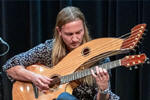
Widely regarded as one of the worlds finest harp guitarists, Stephen Bennett has developed a highly melodic style that manifests itself in his original compositions and his arrangements of jazz, pop, and traditional tunes. He has excelled in incorporating the harp strings in a way that seems entirely natural and not at all a novelty. Stephen applies this same skill and care to his 6-string work as well. He is a past National (USA) Flatpicking Champion (1st place 1987) and National Fingerpicking Champion (3rd place 1985). Stephen came to embrace the harp guitar upon discovery of a 1909 Dyer that had been owned by his great grandfather. He currently plays a 2007 Kathy Wingert harp guitar. Stephen is the founder of the annual Harp Guitar Gathering. This event brings harp guitar players, builders, and enthusiasts together from points around the world. -FD |
|
Pete Bradshaw says he can’t remember a time when he didn’t want to make music. Classical piano lessons with Rachmaninoff protégé Boris Lang began at age 4. When his 4th grade teacher offered guitar lessons, piano studies were soon left behind. Pete’s next teacher set the groundwork for what he views as his path to the harp guitar with a Rachmaninoff prelude featuring a prominent descending bass line. Years later, Goran Sollscher’s arrangements of Bach cello suites for 11-string guitar provided the next step. It all came together when Pete heard instructor Stephen Bennett play harp guitar at one of Mark Hanson’s Accent On Music Guitar Seminars. Like Bennett, Pete plays a Merrill Dyer copy and a new Wingert harp guitar (Pete’s with 7 sub-basses). Maestro Bennett provided Pete’s harp guitar debut with a performance slot at the 5th annual Harp Guitar Gathering. His recording debut soon followed with a track on Harp Guitar Dreams. Pete’s music is inspired by classical and folk sources with a special focus on the Hawaiian slack-key guitar tradition. -FD |
|
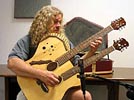
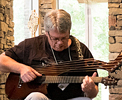
The harp guitar was lucky enough to have two champions arrive in the 1980s; one being the late, great Michael Hedges, and the other being John Doan. John is the acknowledged master of the distinctive 20-string harp guitar (additional super-treble strings as well as sub-basses). To this day, John remains one of the standard-bearers of the harp guitar. He initially studied classical guitar and lute before finding his true voice in the harp guitar. So, it’s no surprise that John’s music has a strong classical influence. As is the case with many classical composers, he also finds inspiration in folk traditions, Irish musical traditions in particular. John is a music professor at Willamette University in Oregon, a historian, and a multi-instrumentalist specializing in unusual vintage instruments. Unlike many contemporary players, the harp guitar is John’s primary instrument. -FD |
|
William Eaton is a musician and composer drawing on diverse influences from India, Africa, and the Middle East to Appalachia and the American Southwest. He is particularly well known for his collaboration with Native American flutist R. Carlos Nakai. William also designs and builds all of the instruments he uses. He is a co-founder of the Roberto-Venn School of Luthiery in Arizona. He has invented several unique and beautiful instruments, many of which are highly original variants of the harp guitar. -FD |
|
Brad Hoyt is a composer, pianist and harp guitarist who has performed and recorded frequently around the world. Brad graduated from Ball State University with a Bachelors degree in Telecommunications and an associate’s degree in Jazz/Commercial Music. Part of his studies included classical guitar lessons and private piano lessons with renowned jazz pianist Frank Puzzulo. Also while attending Ball State, he performed with the school’s big bands, small jazz groups and with his own rhythm and blues band. After graduation, he moved to New York City and made his living by performing regularly as a solo pianist and ensemble musician. Recently, Brad has performed and recorded extensively in Europe during a three-year period while living Prague, Czech Republic. Brad is currently arranging new music on his 30 string harp guitar, the arpa viola capira and is recording tracks for a music CD featuring piano and harp guitar. |
|
Andy McKee was so taken with the guitar that he quit high school, and got his GED, in order to have more time for his guitar studies. He was initially drawn to the electric guitar after hearing a cousin play. He was later inspired to focus on the acoustic instrument after discovering the music of Preston Reed, and then Michael Hedges. Andy has since studied the music of several acoustic greats in an attempt to find his own voice on the instrument. He has received several awards including a 3rd place win in the 2001 National (USA) Fingerpicking Championship and a 1st place win in the 2004 Canadian Fingerstyle Guitar Championships. His music has brought him a string endorsement deal, and an ever-growing international audience. In 2002, he acquired his first harp guitar, a Spillers, from his mentor Stephen Bennett. -FD |
|
Tom Shinness was born into a musical family. His father and older siblings would often play Dixieland music around the house. Tom’s father’s multi-instrumental talents proved to be a primary influence. Tom received his first 6-string guitar, and formed his first band, in the third grade. He took up the cello in fifth grade, played drums and bass in school bands by 7th grade, received a school award as outstanding vocalist in 9th grade, and developed an original piano style in high school. Tom continues to add new instruments to his arsenal to satisfy what seems an insatiable desire for new sounds. He has shown a particular fondness for, and skill with, the 1913 Gibson harp guitar featured on his CD "Translucent Harp". His recordings showcase all original instrumental music with jazz, folk, and pop elements. He is currently working in a duo with daughter Jasmine (also a multi-instrumentalist). -FD |
|
Andy Wahlberg is two performers in one. The one thing that these two personas have in common is the harp guitar. It is Andy’s main instrument. On the one hand, Andy is a musical comedian performing novelty and parody songs (sort of the Weird Al of the harp guitar?). On the other hand, Andy is a classically trained musician and composer who also finds influence in jazz, traditional music, blues, and popular music. His music has been used in the Smithsonian, on PBS specials, and in movie soundtracks. He is a touring artist in his own right and has toured as opener for artists such as Chicago and Billy Joel. -FD |
Players of
the Harp Guitar Gatherings,
Part 2
(Once- or First-time Guest Artists)
|
Berlin based guitarist Andreas David began playing at age 14, inspired by a school friend and by French fingerstyle master Marcel Dadi. A couple years later, after hearing legendary 5-string banjo player Bill Keith guest on one of Dadi’s albums, Andreas decided to make the banjo his main instrument. Ensuing years brought mandolin, tenor banjo, pedal and lap steel guitars, dobro, and ukulele to his arsenal of instruments though he maintained the 5-string banjo as his primary instrument. A keen interest in playing bluegrass, western swing, and jazz induced one European bluegrass magazine to dub him “the Bela Fleck of the old world.” As more people heard his guitar work, more wanted to hire him as a guitarist. Andreas has performed, recorded, arranged, and written music for a variety of projects including bluegrass, country, folk, western swing, rockabilly, pop, rock, and jazz acts, as well as musical theatre and film soundtracks. In 2003, Andreas was booked as a sideman for a highly regarded Germany country music band. Famed singer Katja Brauneis was on the same bill. The two soon began to work together on a regular basis which has led to their current work performing songs from the Viennese Schrammelmusik tradition. In this context, Andreas uses a Schrammelgitarre (or kontragitarre) with 6 sub-bass strings. He is unique among players of this instrument in adopting Stephen Bennett’s standard tuning for the sub-bass strings. -FD |
|
Belgian born multi-instrumentalist Paul Oorts was inspired by friend Joe Morgan to add harp guitar to his arsenal. Like Joe, Paul plays a Stephen Sedgwick harp guitar. Paul is an expert in 19th century Belgian dance music, which he performs and records - along with Celtic and French music - in a duo with his wife (renowned hammered dulcimer player Karen Ashbrook) and in their trio Pavilion 3. He can be found teaching this music and more on guitar, bouzouki, mandolin, mountain dulcimer, and accordion at festivals around the world. Paul also plays for contra and English country dances with groups Goldcrest and Gigmeisters, and conducts a dulcimer orchestra called Carillion. He also teaches instrumental techniques and arranging for ethnic music, and French and Italian languages at Baltimore’s Peabody Music Conservatory. -FD |
|
Conventional
Harp
Guitarists:
Other Players Around the World |
|
|
(1953-1997) |
Michael Hedges is a name well known among harp guitar aficionados. The 1986 release of his composition "Because It’s There" can be credited with reawakening a great deal of interest in an instrument that had become little more than a pawn shop curiosity. Michael is also known for changing the way people play the guitar. He pioneered the use of slapped harmonics, percussive use of the guitar body, and 2-handed tapping techniques. He was always searching for new sounds with his 6-strings, his harp guitars, an even a few instruments without strings. Michael used Dyer harp guitars, a Knutsen and a custom made Klein electric harp guitar. Tragically, Michael was killed in a car accident in 1997. -FD |
| NOTE: It has become increasingly difficult in the rapidly-growing world of the harp guitar to keep track of all the new players and the extent of their activities. The Players list below makes no determination or distinction between which are professionals, amateurs or in-between; full- or part-time; nor to what extent harp guitar is actually used or showcased. Additionally, while most players have communicated with us, some never respond to queries, so status and content of their harp guitar activities is unclear. | |
|
Tim performs and records with several guitars, including three vintage harp guitars. |
Nate, a Gathering regular from the beginning, performs and records with a Hewett harp guitar with added super-trebles. |
|
Adam began playing guitar at a young age, often sneaking into his older brother's room to steal some practice time on his Stratocaster. He spent well over a decade studying guitar and performing in numerous styles until eventually falling in live with the acoustic sound. In 2006, Adam became enamored with the capabilities of the harp guitar, and in May, 2009 released his first solo harp guitar CD, recorded on his Lark in the Morning instrument. |
|
In 1966, Michael Dunn began his professional career by undertaking a 3-year apprenticeship in guitar making, studiing under Jose Orti and Jose Ferrer at the George Bowden workshop in Palma de Mallorca, Spain, where he learned the traditional arts of classical and flamenco guitar construction. A love of Django Renhardt’s “gypsy jazz” music has been the main inspiration for Michael’s own guitar designs, and the music he has chosen to play. Chris Knutsen’s work has also become an influence. Michael has constructed several Knutsen inspired instruments. These include harp ukes, a tenor harp guitar, and a nylon-string harp guitar that Michael uses for his own recording and performing projects. Though Reinhardt remains a primary influence for Michael, his recent compositions also include elements of West African, Arabic, Spanish, Hawaiian, Turkish, and South American musics. -FD |
|
Charlie Faege is a man with hand in many different pies, so to speak. He is a storyteller and novelist. Musically, he considered him self a singer first, performing in various rock formats. His more recent instrumental music is a cross-pollination of genres inspired by spiritual themes and experiences. Charlie plays a variety of stringed instruments including 1908 and 1910 Gibson harp guitars. He also runs URTH Studios (Upward Reaching to Heaven) which specializes in music for films. -FD |
Versatile French fingerstyle guitarist Philippe Fouquet has owned a vintage Schrammel-style harp guitar for years, featuring a solo composition for it on his first CD. He is actively composing new harp guitar solos to be performed on a new instrument for an upcoming CD. |
|
Doug Geeting is a singer, guitarist, and wilderness pilot in Talkeetna, Alaska. He bought an old Gibson harp guitar, more than 20 years ago, after seeing Robbie Robertson play one in the film “The Last Waltz”. Doug became firmly hooked on harp guitar after seeing Michael Hedges perform on a PBS/Windham Hill program. The Gibson was used for two tracks on Doug’s second CD “The Alaskan Mile”. Another track on that same CD received Alaska Public Radio’s 2001 award for instrumental song of the year. Doug is now working with a Merrill Brothers harp guitar. He is finding it to be good company when the Alaska winter keeps him indoors. -FD |
|
Joe has performed for many years with a vintage Knutsen harp guitar - now traded for a vintage Dyer - as a singer-songwriter-instrumentalist. |
Paolo resides in Italy though he regular tours and performs throughout Europe with various acoustic guitars, including acoustic and electric harp guitars built by David Castellaro. |
|
Joesf (pronounced Joseph) Glaude has used a variety of instruments (guitar, tenor guitar, banjo, tenor banjo, mandolin, harmonica, melodica, flute, dulcimer, bass, and violin) in many settings including classical, jazz, bluegrass, folk and punk rock. In 1999, he left his position as Head Guitar Instructor at Oral Roberts University to focus on a career as a performing and recording artist. Joesf's first exposure to the harp guitar came from Michael Hedges. Glaude worked closely with luthier Glen Morgan on an original harp guitar design, taking delivery of the instrument in 2002. -FD |
Echo Greywolf is a Native American guitarist who "delights in composing moving and whimsical fingerstyle pieces". He is entirely self-taught, initially inspired by his Sunday School teacher’s son who played bluegrass. Echo then decided to take up the guitar after a dream in which he saw a guitar floating in mid-air with glittering stars flying off the fretboard. The harp guitar he commissioned from luthier Jim Worland was modeled after the guitar of his dreams. Much of Echo’s music is inspired by spiritual experiences, showing Celtic, classical, and new age influence. -FD |
|
Nate plays an instrument built by Benoit Meulle-Stef patterned after the 20-string instrument of his harp guitar teacher John Doan. |
Iwan Hasan is the main force behind the Indonesian symphonic progressive / jazz rock fusion / world music band Discus. In addition to other instruments and voice, Hasan plays harp guitar. His is a 21-string instrument modeled after the 20-string harp guitar of his teacher John Doan . While studying with John, Iwan won Willamette University’s Outstanding Music Student Award and was a semi-finalist in the 1991 Portland (Oregon) Classical Guitar Competition. His current work with Discus is truly bringing the harp guitar where none has gone before. - FD |
|
In the 1990s, John was inspired to reconnect with music after attending a Michael Hedges concert and receiving encouragement from singer/songwriter friends. John bought a Lark in the Morning harp guitar in 2003. He immediately began composing for the instrument. John has performed and recorded with his harp guitar and looks forward to continuing to explore the possibilities offered by the instrument. -FD |
Don Kush is a performing and recording artist from the Spokane, WA area. He counts the late, great Michael Hedges as a primary influence. Don uses Hedges-inspired techniques to make original music that he hopes will "create for people an experience that will be both memorable and inspiring". He plays a James Hewett 11-string harp guitar. -FD |
|
Eric Loy has led a double life as the guitarist for the progressive fusion trio "The Hipperoos" and as a solo acoustic artist. He has performed with a harp guitar for some years now. He initially used an old Gibson (c. 1910). Then, in 2001, he commissioned a new custom instrument from luthier Mark Kaiser. This is based on the Dyer design but features 8 sub-bass strings, 5 mid-range harp strings, 5 super-treble strings, and the standard 6 strings on the neck. This unusual instrument is used to play equally unusual music. -FD |
Sean performs original instrumental compositions on vintage Knutsen and Dyer harp guitars. |
|
Joe Morgan has played guitar from a young age but it wasn’t until college that he found his primary influence in the music of Doc Watson. In addition to guitar, Joe has gained proficiency on banjo, mandolin, and hammered dulcimer. He was inspired to add harp guitar to his arsenal after hearing a Stephen Bennett performance. As co-organizer of the Winter Festival of Acoustic Music in Irving, Texas, Joe was quick to book Stephen for the event. Stephen, in turn, tapped Joe and his wife Linda to help run the first Harp Guitar Gathering, where Joe eventually commissioned a Sedgwick harp guitar in 2004. Since 1995, Joe has performed in a duo with champion hammered dulcimer player David Moran. The duo play an eclectic mix of originals, traditional, pop, funk, jazz, Latin and other styles, and have become featured performers and instructors at festivals from coast to coast. -FD |
|
Singer-songwriter-instrumentalist Joe Myers gigs in Arizona, often with a vintage Dyer harp guitar. |
William performs Hedges-influenced instrumental compositions on a Harry Eibert harp guitar. |
|
Kim is well-known to the harp guitar community as the peerless recording engineer behind all of Stephen Bennett's CDs. She is also a singer-songwriter-guitarist, who has added a Sedgwick harp guitar to her playing. |
KEV (Kevin Rones), a solo acoustic performer who added a Dunae Noble harp guitar to his act in 2008, is the founder of the San Diego Guitar Society. He is known for his high energy acoustic performance and his enthusiasm in promoting acoustic music. |
|
Blas Sanchez began his musical studies at age 6 in his hometown of Ingenio on Spain’s Gran Canaria Island. His first instrument was violin and he was performing as an orchestral soloist by age 16. By the time he received his degree from the Professional Conservatory of Tenerife, the violin had taken a backseat to the guitar. Blas commissioned his first harp guitar, or guitarrarpa, from Kiko Dohër in 1973. The current version was built by Manuel Contreras. The guitarrarpa features 7 strings on the neck and 6 sub-bass strings. Eventually settling in France, Blas became a professor of guitar and music at the Municipal Conservatory of Vitry sur Seine. He has composed approximately 2000 works for a variety of instruments and ensembles. His performance experience has included work with violinist Jascha Heifetz and poet Pablo Neruda. Blas is also responsible for the Blas Sanchez foundation which sponsors and international guitar festival and competition in Ingenio. |
Dan Schwartz is one of only six people in the world to hold a degree in American Finger-Style Guitar Performance (from the late, lamented University of Wisconsin-Milwaukee program), and one of only two people to own a Charles Hoffman harp guitar. This instrument made its debut on Dan’s 2003 CD, “Acoustic Relaxation”. Dan has released two acclaimed singer/songwriter CD projects, and his solo guitar work has been featured on several compilation CDs. Dan’s current focus is on writing, performing, and producing music for Compass Productions’ Lifescapes Series, a line of recordings distributed through Target stores. He is also in demand as a producer, studio musician, and backing performer for a variety of acts from the busy Minneapolis music scene. Dan has been on the faculty of the Wisconsin Conservatory of Music and worked with the Milwaukee Foundation for Guitar Studies and Stropes Editions, Ltd.. -FD |
|
Tony is co-creator of the Seraph harp guitar, along with fellow Englishman Nathan Sheppard, the builder of the instruments - which Tony begun demonstrating in 2008. |
Robert writes and performs with several guitars, including a Lark in the Morning harp guitar. |
|
John Stropes has devoted himself to the advancement and promotion of American finger-style guitar music as a distinct art form. He was Chair of the Guitar Department at the Wisconsin Conservatory of Music where he implemented degree and diploma programs in finger-style guitar performance. He has been President of the Milwaukee Classical Guitar Society, President of the Milwaukee Foundation for Guitar Studies, Artistic Director of the American Finger-Style Guitar Festival and Advisor to the Beijing Guitar Research Association. John is a well know teacher, music historian, author, and instrument collector. Today, he devotes his energies to music publication and education through Stropes Editions, Ltd. He has developed a highly detailed transcription system for finger-style guitar music and has used this to document the work of several important players. A significant amount of this effort has been spent on the music of Michael Hedges. John and Michael created the book "Michael Hedges / Rhythm, Sonority, Silence. John has also released several individual transcriptions of Michael’s compositions, including the influential harp guitar piece "Because It’s There". - FD |
Fred Vandenberg received his formal training in the prestigious jazz program at William Patterson College. He has since performed throughout the United States and Russia, including a memorable performance at Philadelphia City Hall with the mayor and the President of the United States in attendance. He is a versatile performer who can play classical music, jazz, pop, and traditional music. Fred primarily performs on 7-string guitars, but also plays the Vtar. This is a 33-string harp guitar (7 strings on the neck, 7 sub-bass, 7 on a U-shaped arm extending off the top near the soundhole, and 12 across the lower bout). - FD |
|
Adam Werner is a Los Angeles based solo guitarist whose atmospheric and rhythmic music shows a great love and respect for the work of Michael Hedges. Adam is actually known for his Michael Hedges tribute performances. Rock guitar icon Steve Vai was impressed enough to release Adam’s first CD on his Favored Nations label. Adam is in good company there with other acoustic artists including Pierre Bensusan, Tommy Emmanuel, and Adrian Legg. Adam performs with 6-string guitars, a Klein electric harp guitar and a Lark in the Morning harp guitar. - FD |
Michael Hedges’ harp guitar playing brought the instrument to Morihiko Yasuda’s attention. Upon hearing John Doan’s “Departures” recording, Mori was hooked. He is now the proud owner of not one, but three harp guitars from revered Japanese luthier Mitsuhiro Uchida. The first, completed in 1994, is a 24-string (6 sub-basses, 6 on the neck, and 12 super trebles) instrument modeled after John Doan’s 20-string harp guitar. 1997 saw the birth of the 18-string (6 on the neck and 12 super trebles) Mignon harp guitar. Mori then welcomed a 27-string (6 sub-basses, 6 on the neck, and 15 super trebles) Terz (tuned a third above normal pitch) harp guitar in 2001. The 24 and 27-stringed instruments each feature a different dual soundboard design. These have a secondary soundboard, that extends into the body of the instrument, for the sub-bass range. Mori composes original music that is inspired by the wonders of everyday life, and is a conscious reflection of his Japanese identity and heritage. -FD |
|
EGG is made up of William Eaton, Anthony Mazzella and Fitzhugh Jenkins performing on three new electric harp guitars (a matched set) created by Eaton. - GM |
Todd Green does not play the harp guitar as we know it. The closest, in his vast collection of stringed instruments, are two custom built instruments from Fred Carlson. One is called the "Guitarangi da Gamba". This instrumental oddity can be bowed like a viola da gamba or plucked like a guitar. It features 6 strings on the neck, 10 sympathetic strings that run through the neck and over the top of the instrument, and 14 strings across the bass side of the instrument that can be used as sympathetics or plucked. The other is an instrument Fred Carlson calls a "Harpouditar". He sees it as a combination of a wire-strung harp or zither (15-treble strings across the lower bout), a Middle-Eastern oud (bridge set-up and fingerboard configuration), and a classical guitar (tuning used for nylon-strings on the neck). These are but two of a dizzying array of stringed instruments, winds, and percussion that Todd uses. Todd performs all original music influenced by musical traditions from around the world. - FD |
|
Polish multi-instrumentalist Tomasz Martyniak has been collecting accolades and awards across Europe on his own and with the improvisational fusion trio The Mechanical Cat. He also took on the role of luthier in creating his “Electroharp.” The instrument, completed in early 2005, consists of a 6-string electric guitar with two banks of 6 harp strings. Tomasz explores a variety of techniques on the instrument, primarily tapping with the left hand on the guitar neck and playing chords with the right hand on the harp strings. He cites Pat Metheny’s Manzer Pikasso guitar as his main inspiration in building and playing the Electroharp. Other musical influences range from Mozart to Jaco Pastorius to Metallica. Outside of The Mechanical Cat, Tomasz enjoys composing music for animated films. -FD |
Rob utilizes a sitar-guitar as a harp guitar by creatively plucking the sympathetic strings. |
|
Pat Metheny’s love of jazz music began at an early age. He made his debut performance at age 15. He studied in the jazz program at Miami University but was soon chosen to teach their new electric guitar course. A year later, at age 19, he was asked to join the faculty at Boston’s Berklee College of Music. Pat developed a distinct style combining elements of jazz and rock music but sounding very different from the fusion style popular at the time he started recording. He has remained unrelenting in his search for new ways to expand and build upon his musical vision. He recorded some tracks with a 15-string Gibson harp guitar in the 1970s and has experimented with other guitars and guitar variants since, including a Linda Manzer 42-string Pikasso (harp) guitar. - FD |
Born in India and raised in England, Rajan Spolia began playing music at age seven. His music fuses elements of Indian Classical music, jazz, and blues. He is most commonly heard playing guitar in duet with a tabla player. Unlike most Indian guitarists (who have a fluid micro-tonal lap-slide technique), Rajan plays with a pick. This attack allows him to find a certain angularity in his melodic lines. Rajan plays an arch-top guitar fitted with 2 banks of sympathetic or strummed strings across the top. It was built in England by Oakwood Guitars and is based on a design by William Eaton. - FD |
Bob Ault is an acknowledged musical historian with a focus on the ragtime era. He is a known ragtime pianist and composer who also performs on a variety of other instruments, including a rare 12-bass Gibson Harp Guitar. Bob was the lone harp guitarist performing in a recreation of a classic Clef Club Orchestra performance at Carnegie Hall in 1985. -FD
|
Known for his huge collection of
vintage Nationals, Bob also owns Dyer and Knutsen harp guitars. He used
the Dyer for rhythm playing on a couple of his older albums, and also
created a great solo on his Knutsen harp-Hawaiian guitar for David
Grisman’s Tone Poems III. -GM |
Popular 6-string fingerstyle guitarist Alex has occasionally dabbled with the elaborate harp guitar creations of his friend, luthier Fred Carlson. He made his recorded debut with one such instrument in 2008 on Harp Guitar Dreams. -GM |
Now retired, Hans built his own 13-string "lute-guitar" to play his own unique compositions. He used his first instrument - a true harp guitar with 3 floating strings - for live performances, while a second fully-fretted instrument was used on all his recordings. -GM |
In 2006 Ms. Harris commissioned a "Mini-Harp" Guitar with an unfretted low A drone from luthier Julius Borges. A second is planned. -GM |
Steve’s impressive
collection of guitars, including a Gibson Style U, along with other harp
guitar-like instruments, can be seen in his book, The Steve Howe Guitar
Collection. He also played the harp guitars of the Scott Chinery
collection on Masterpiece Guitars, along with Martin Taylor.
-GM
|
Way back in 1967, in the groundbreaking group Kaleidoscope, David used a scroll-bridge Gibson harp guitar on the group's first 2 albums. He tuned the sub-basses chordally. -GM |
Jeff Martin See below |
One of the more infamous "is he or isn't he?" harp guitarists, I agreed to add John after watching him perform with his 1975 band Shakti on DVD. His famous Wechter "Shakti" guitars were originally intended as having only vibrating sympathetic strings, but the sound was not pronounced enough - so John instead incorporated frequent strumming of them within his playing. -GM |
Jimmy Page See below |
Robbie Robertson See below |
Martin has made two forays into harp guitar – one playing a Gibson Style U on David Grisman’s Tone Poems II, the other with Steve Howe, playing the harp guitars of the Scott Chinery collection on Masterpiece Guitars. -GM |
|
Ben has only played harp guitar once – a Dyer for one track of his Some Towns and Cities CD project. A tour de force, one wishes the classical virtuoso would do more with the instrument! -GM |
George, while known for his piano playing, also dabbles in many other instruments, including guitar. On a number of recordings and performances he has used either a Martin with a retrofitted 7th floating "C" string, or a custom 8-string Erwin Somogyi harp guitar (2 floating sub-basses). These are tuned for, and used mainly for Slack Key music. -GM |
The original owner of
Lark in the Morning in addition to a huge private collection of stringed
instruments, Mickey has recorded two tracks with his Dyer. -GM |
|
"Notable" Wikipedia Harp Guitarists All it takes is for a rock star to pose with a harp guitar and they are immediately added to the fabled Wikipedia Encyclopedia.Harp Guitar entry as a "notable harp guitarist." I no longer even try to police or edit that absurd site. Instead, this list will highlight the completely arbitrary and amateurish quality of the aggravating site. There is no fighting it. You delete any of these and they'll just pop up again - with no explanation, references or sources. While the Wikigeek Police like to bust you for every little site format infraction, they are clueless about this instrument and its music. So, if you can't beat 'em, join 'em! While none of our "Honorable Mentions" above should realistically be added to any "notable harp guitarist" list (their fame or popularity notwithstanding), these below are singled out as "poorest choice for a Wikipedia 'Harp Guitar' entry" (but only if and when someone lists them on Wikipedia- until then, let's give them their due respect above). Note: For the benefit of the Wikipedia "editors" who continually add these names, let me spell it out for you. The growing community of harp guitarists (many more than grace this page) are committed to playing the instrument in a significant manner (utilizing harp guitar techniques) and percentage of repertoire. This community does not necessarily consider a celebrity who takes a harp guitar out of his collection and strums it in a video a "notable harp guitarist." A well known or even famous guitarist who has used a harp guitar in some legitimately musical way, yes. And we encourage any activities that bring the harp guitar to more people's attention. Many of us respect and enjoy the music of these various artists - we are just trying to keep things in perspective. |
||
|
Michael Lardie
Michael Lardie? Yes, he of the rock bands Great White and Night Ranger. Try as I might, I cannot find any reference to him and a harp guitar. Did he pose with a Gibson in a guitar store or something? Please enlighten me. -GM |
Jeff Martin
Jeff Martin, lead guitarist of the popular Canadian group The Tea Party, uses numerous stringed instruments on the band's CDs, including a 1916 Gibson harp guitar. I checked all the recordings and clips and saw him hit one sub at the end of a song. He recently added a resonator guitar with a floating 7th string by Andrew Ellis of Perth, Western Australia. This is, indeed, a "meets minimum requirements" harp guitar, and I will be curious to see his use of it. -GM |
Jimmy Page
Page has appeared in a video with a Gibson harp guitar. It's on YouTube and I suppose is a cool video as far as it goes. -GM |
|
Robbie Robertson
I admit it - arguably the highest profile use of a harp guitar ever - and unfortunately one of the least legitimate - was the last scene of the 1976 Scorcese film The Last Waltz - where Robbie Robertson of The Band used a large scroll-bridge, 10-sub-bass Gibson to play the Theme. Like Lindley, he appears to have tuned the basses chordally (as he begins with a "sub-bass" strum!) -GM |
||
|
Dennis Cinelli was inspired to pick up the guitar after hearing Jimi Hendrix. His direction changed to jazz after hearing players such as Charlie Christian and Django Reinhardt. He worked as a jazz musician for some years before performances by Andres Segovia and Julian Bream signaled another change of direction. Today, Dennis is known as a top notch classical guitarist, mandolinist, and lutenist, and an expert in the history of the lute and early guitar. He is a consultant for, and endorsee of, La Bella strings. Since 1989, he has been on the faculty of Montclair State University in New Jersey. He has performed and recorded with a copy of an 1856 Scherzer guitar with 4 sub-bass strings. Aside from a very successful career in classical music performance and education, Dennis still enjoys revisiting his earlier influences by playing rock and jazz styles for theatrical productions on and off Broadway. - FD |
|
James Kline is one of a small group of players specializing in the arch-guitar. The arch-guitar is the brainchild of player Peter Blanchette who wanted an instrument with a sound somewhere between a lute and a classical guitar. James took the idea further by deciding to have 8 of the 11 strings on the guitar neck and 3 bass strings suspended harp-like. Later, he had a detachable bank of 8 super-treble strings added to his instrument. This all makes James Kline the one and only master of the arch-harp-guitar. James is an internationally known performing and recording artist who has won numerous international prizes and awards for his artistry. His repertoire includes music from the Renaissance to the present day. -FD |
|
John is a virtuoso player of all forms of lute, and now plays a 7-string guitar (similar to Coste's "floating 7th bass string" instrument), with a Coste CD completed. He is also having a 10-course instrument built, with four strings (D,C,B,A) off the fingerboard. |
|
Brian Torosian has a special affinity for the work of virtuoso 19th century (harp) guitarist and composer J.K. Mertz. His doctoral dissertation was on Mertz, he lectures on Mertz, edited an anthology of Mertz music for Mel Bay Publications, and regularly performs music by Mertz. Dr. Torosian uses a copy of a Scherzer instrument with 4 sub-bass strings, built by luthier Richard Brune, that is like an instrument Mertz played. He is on faculty at DePaul University, head of the guitar program at Northeastern Illinois University, an instructor at the Mid-American Guitar Ensemble Festival, and a board member of the Chicago Classical Guitar Society. Dr Torosian is also highly regarded for his performance of rare and standard repertoire from past to present day on a variety of instruments aside from his Brune. -FD |
|
Brigitte Zaczek’s path began at age 10 when her aunt, virtuoso guitarist/composer Luise Walker, provided guitar lessons. Brigitte went on to receive degrees in guitar performance, theorbo, renaissance and baroque lute performance, and master class study with Andres Segovia and Alirio Diaz. She has been a professor of classical guitar at the Universitat fur Musik und darstellende Kunst in Vienna since 1972. Today, her attention is focused on the interpretation of guitar music of the 19th century. To that end, she has amassed a fine collection of period instruments, including 3 that we may label as harp guitars (1837 Stauffer with 2 sub-bass strings, Reis circa 1840 also with 2 sub-basses, and an instrument made by an unknown Viennese luthier around 1860 that has 4 sub-basses). Brigitte has recorded with her Stauffer, Reis, and a borrowed 1855 Lacote Heptacorde (with 1 sub-bass string). She has performed and given master classes across Europe and South America. -FD |
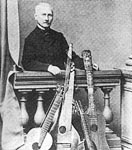
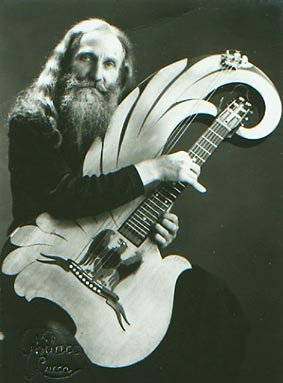
Encyclopedia of Harp Guitar Players of the Past
![]() |
![]() |
![]() |
![]() |
![]() |
![]() |
|
If you enjoyed this page, or found it useful for research, please consider supporting Harpguitars.net so that this information will be available for others like you and to future generations. Thanks!
|
|
All Site Contents Copyright © Gregg Miner, 2004,2005,2006. All Rights Reserved. Copyright and Fair Use of material and use of images: See Copyright and Fair Use policy. |

|
|
|
All Site Contents Copyright © Gregg Miner, 2004,2005,2006,2007,2008,2009. All Rights Reserved. Copyright and Fair Use of material and use of images: See Copyright and Fair Use policy. |