The Harp Guitars of Joseph
Bohmann
by Gregg Miner
Updated May 2025
|
The latest Bohmann findings
including those seen here can be found by
searching
my blog for "Bohmann." |
|||

|
 |
 |
 |
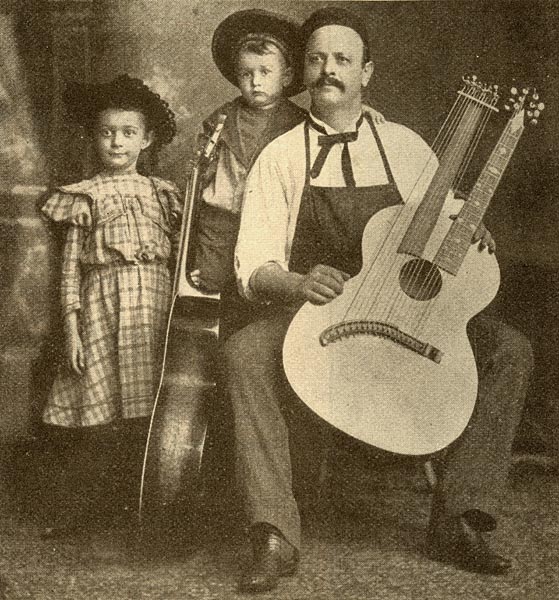
Image of Joseph Bohmann and his children
from his c.1899 catalog |
 |
 |
 |
 |
 |
 |
 |
 |
 |
 |
 |
 |
 |
 |
 |
 |
 |
 |
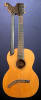
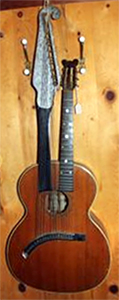
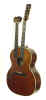
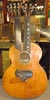
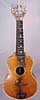
| c.1885-c.1899 | c.1890 | c.1894-c.1896 | c.1890s-c.1899 | c.1911-c.1916 | |||||||||||||
|
|
"The
Worlds Greatest Musical Instrument Manufacturer" This is how Frederick J. (Joseph) H. Bohmann described himself, and repeatedly. How much of it was hype, ego or truth is difficult to say. Most of his biographical and promotional materials seem to have been authored by himself, and some – like his 1899 Paris “Gold Prize” – may be truth-stretching. There aren’t many people today comparing his guitars and mandolins directly against the Bohmann competitors of the period, especially the other Chicago firms, such as Lyon & Healy. But compare directly Bohmann did, and he constantly offered “challenges” to all other manufacturers to prove him wrong. One such offer specified $125,000 as a “reward” for such “proof.” That amount is equivalent to about four million dollars today, and the prize was never claimed, so what does that tell us?! Bohmann did provide a lengthy list of international awards he received for his instruments – which instruments are unclear, though he states “violins, mandolins, guitars and zithers.” Writer Michael Wright mentioned that Bohmann’s “Perfect Artist violins won a number of international honors.” |
|
Little is known of Bohmann’s career, and much of it is
conflicting. It is thought by many that he was one of the first, if not the
first, to build mandolins in America, or at least, Chicago. These were
the Neapolitan-style bowlback mandolins, which Bohmann made in many
grades. Most examples known today
are rather pedestrian, but high-end and “presentation” Bohmann
mandolins and guitars also exist. Michael
Wright states that Bohmann was an early mandolin supplier for both Wards
and Sears (1894). According to Wright, Bohmann
“was born in Neumarkt (Bohemia), Czechoslovakia in 1848. He later
emigrated to America, and then founded Bohmann's American
Musical Industry in 1878.” Wright gives Bohmann’s instrument
building dates as “1878 to the late 1920s,” while Michael Holmes of
Mugwumps gives 1876-1930. Regardless, it’s unclear exactly
when Bohmann died, or what happened to the business when he did. He
would have been 68 when the last patent was issued in 1916 – a ripe
old age for a guitar maker at that time. Much of the above historical information is continually being re-written by Bruce Hammond (my colleague and today's Bohmann expert, who authored the New Grove Dictionary Bohmann entry). He hopes to one day be able to publish this vast trove of information. More unclear is the fate of the factory and instruments after Bohmann’s death. Stories abound from many different sources, but the facts are inconsistent. Apparently, the building was locked up for forty or so years! Eventually, in the ‘70s or ‘80s (again, unclear), the factory was opened by the inheritors – by some accounts, a Bohmann grandson. There are tales of instruments “discovered in the attic of the old factory building in Chicago where (Bohmann) had his shop…several instruments in completed and near completed stages, wrapped up in World War II newspapers.” The fellow who obtained the catalog featured below originally said that “the catalog came from the factory in the early 1970s, where I saw all of the old instruments, and also high end Bohmanns at a Bohmann family member’s house."
Again, Bruce Hammond has followed numerous leads to ferret out all this more recent history, as he tracks down numerous rare specimens (including many unfinished instruments) and documentation. A huge lot of Bohmann’s papers – all manner of personal letters, documents, circulars and the like – were auctioned off on eBay around 2000. Bruce eventually managed to acquire a portion which has proved historically priceless. The larger lot of historical documents remains private and hidden, a terrible waste. |
|
The next six images are essentially priceless, found in an undated scrapbook and now licensed for the Harp Guitar Foundation's use by collector Jim Bollman. |
|

|
|
|
Here, we find Joseph holding his violin in front of his store, along with family and workers (and one of his St. Bernards from the "Trapped Horse" story!). This is his No. 376 West Madison Street shop, and hjudging by the age appearance of the children is likely between 1903 and 1905. |
|
 |
|
|
Around the same period, this photograph shows Joseph at his workbench surrounded by workmen and a cluttered space of tools and unfinished instruments. |
|
|
|
|
|
Three cut-out snapshots of Joseph's wife, Marie Nagl Bohmann, and a later image of Joseph. |
|
 |
|
| Bohmann's grave marker in Acacia Park Cemetery and Mausoleum in Cook County, Illinois. | His wife Marie and two of their children reside alongside. |
|
Bohmann
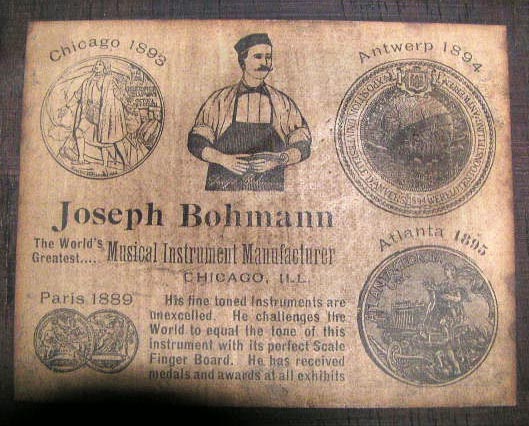
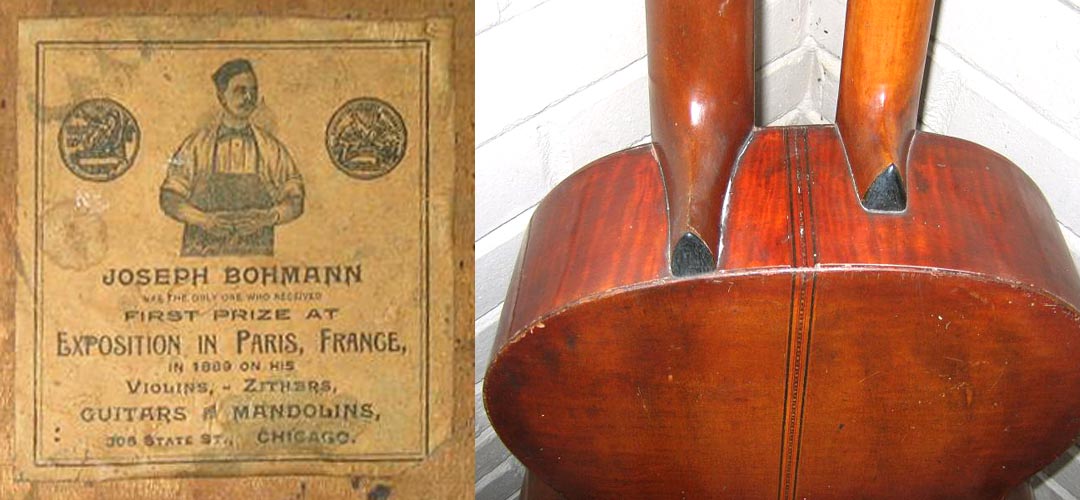
Labels Dating of Bohmann instruments from his labels remains problematic. He first used labels with no illustration (Fig. 1), then added his own image on “authentic” or guaranteed instruments, while adding awards won at various world’s expositions. Curiously, he didn’t add each award as they happened but jumped from a Paris label (Fig. 2) to a post-1895 with four awards (Fig. 3), then eventually the whole list of seven awards. |
|||
|
|
|
|
1900 seems to be the last year for awards. |
| Bohmann Patents | |||||||||||||||||||||||||||||||||||||||||||||||||||||||||
|
Bohmann was an inveterate tinkerer, and many of his ideas - good or bad (but always fascinating) made it into patents. An 11th final patent was granted after his death. He also boasted of banjo tailpiece and guitar bridge patents in his catalogs, but these were never granted (if even filed). Here is Bohmann's complete patent list, sorted by filing date:
The reason I've sorted the patents above by file date is because that is the best clue to accurately date instruments by the features described in the patent. For example, his infamous "tone rods" were first introduced in his October 1911 patent filing. Just a few months later, he filed another patent that focused mostly on the tone rods, to which he had added a damping mechanism. (We find this hilarious today, as the rods produce very little sympathetic vibrations). Then both of these patents were finally granted in 1915, long after they had been in use. Similarly, during 1914, he filed three different patents (two on the same day), yet we find all of these features on a some single instruments, along with tone rods and domed construction from 1911. Complicating the comparison of patent features to extant instruments was the discovery of many unfinished instruments in Bohmann's factory long after his death. The instruments were from many periods, and those in various stages of completion clearly show Bohmann might take a body and/or neck from the 1890s and install 1911/1912 tone rods in it just for the fun of it. For the purposes of this site, I'm concentrating only on those features that appear in Bohmann harp guitars. Only one - #1,135,347 - seems to have been intended for mainly for harp guitars, along with some of his experimental 8-string guitars and the like.
|
|||||||||||||||||||||||||||||||||||||||||||||||||||||||||
|
Bohmann’s Entry Into the World of Harp Guitars It’s been over two
decades since I first wrote about our collective knowledge of Joseph
Bohmann and his harp guitars. The specifics still elude me, as does the
“elephant in the room” question: Did Bohmann make the first “harp
guitar” in America? The simple answer is no – C.F. Martin made a
couple of 10-string instruments in 1859/1860 (though he didn’t refer
to them as harp guitars). Not counting Martin’s
tiny batch of custom instruments, the bigger question occurs in the
mid-1880s. As I proposed in our exhibit and accompanying catalog to Floating
Strings: The Remarkable Story of the Harp Guitar in America, the
Jenkins Co. of Kansas City, MO likely created both the first production
harp guitar in America and the term “harp guitar” that we would
forever associate with guitars with extra floating strings. They got the
idea, not from an existing European instrument, but from a crude
original invention by a traveling salesman named J. Hopkins Flinn. |
|
Bohmann had been building
mandolins for almost ten years by this time, in the factory co-founded
with his father. Though Joseph’s birthplace and teenage European home
remains somewhat nebulous, it is likely that he – and certainly, his
father – was aware of guitars with extra bass strings when they
emigrated. The question is, when did Bohmann build his first one? We
don’t know. All we know is that he almost certainly copied the “harp
guitar” name from Jenkins by
the early 1890s. It may well be that he
Bohmann simply didn’t get a request for an instrument, or think to
build one, until he saw Jenkins’ offerings and/or saw Italian
instruments in the hands of some of his customers like Emilio Calamara.
The latter is the more likely, as Bohmann’s first instruments were
“theorbo-style” harp guitars – meaning that their floating basses
were attached to a simple (or elaborate) extension of the neck’s
headstock, with no second support arm as in the common “double-neck”
harp guitars. In this site’s double
feature on Emilio Calamara, Bohmann’s most famous customer,
we explore Calamara’s harp guitars and the time frame. Did Bohmann
build Calamara’s first or second
instrument? If either, then when?
The precise answer is still shrouded in mystery. I'll begin with two near-identical instruments that expert Bruce Hammond and I now believe represent Bohmann's first attempts at a harp guitar, both sometime before 1890. (But how much time before? A year? Several?) |
|
We
believe that this 9-string Bohmann
actually represents Bohmann's first foray into the harp guitar. It is
surprisingly crude. The simple,
enlarged slab headstock contains 9 holes – 6 for the standard neck and
3 for sub-bass strings. We can surmise this from the offset neck and
bridge with its 9 evenly-spaced holes. What’s missing is the nut,
which was a robust “extension nut” made of bone or metal that protruded off to
the left to position the 3 floating bass strings. Owner Bruce adds:
"Salient points:The tuner plates were stock items, commonly
available, and using them sped up the build, as they did not require the
trouble of designing and fabricating a new sub bass headstock and tuner
design."
Amazingly, the original owner's own hand-written label is still inside, and even more amazingly, Bruce has a letter from this owner (John Russell) to Bohmann! The March 31, 1891 letter unfortunately doesn't help date the instrument, as Russell doesn't refer to a harp guitar, but to his just-received Bohmann mandolin. Additional photos of the instrument as found are below: |
|
 |
 |
 |
 |
 |
 |
|
In early 2024, this beautiful card was discovered (shared by Document Records), and after study, we ascertained that the instrument is an original Bohmann harp guitar much like Bruce's own instrument. Bruce thinks Note that the main neck on both is offset, while the bridge is centered; clearly, both were built as harp guitars from the outset and are not "modified 6-strings." Each has a large blocky simple headstock; On Bruce's, this is angled back quite significantly, on the instrument in the photo, it appears longer and straighter. Bruce surmises that this one came before his above; for me, it's impossible to say. The instrument held by the woman (whose clothing has been circa dated to the early-to-mid-1880s) has the large Bohmann pearl inlays and an ivory bridge, which he would offer as an option in the mid/late 1890s. Her instrument also reveals the sub-bass nut extension and her three very thick (gut?) bass strings. Image copyright and courtesy of Document Records |
|
|
Here's a close-up of her instrument, and with Bruce's instrument next to, then overlaid. The top right insert is just to illustrate an extant Bohmann ivory bridge. |
 |
 |
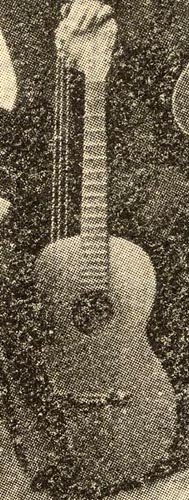 |
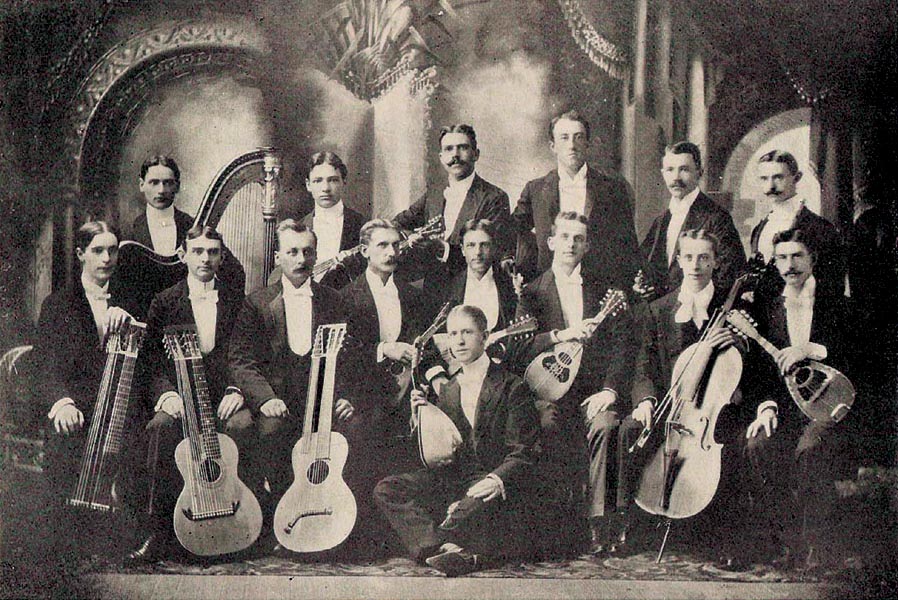
Chicago Mandolin Orchestra and Bohmann's Quartett, Signor Ernest Libonati, Director. Harp guitarist Emilio Calamara sits at left. |
|
I don’t believe Calamara’s first harp guitar was built by Bohmann – but this one, his second, may well be. It is still a simple instrument, but has a more shapely head and extension to hold 3 sub-bass strings. It was likely built around or before 1890. This image is from the important Bohmann catalogs, which I reference throughout this article. Though the catalogs date to c.1896 and c.1899 (the latter a "re-issue" with various corrections), images prior to 1896 – up to a decade earlier – appear in these remarkable “time capsules.” Thus, the images, and therefore, history, are hard to pin down to a precise date. For much more on Calamara, see our special 2-part feature. |
|
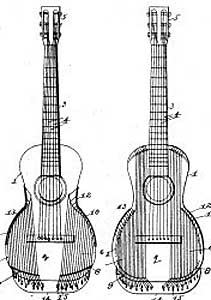
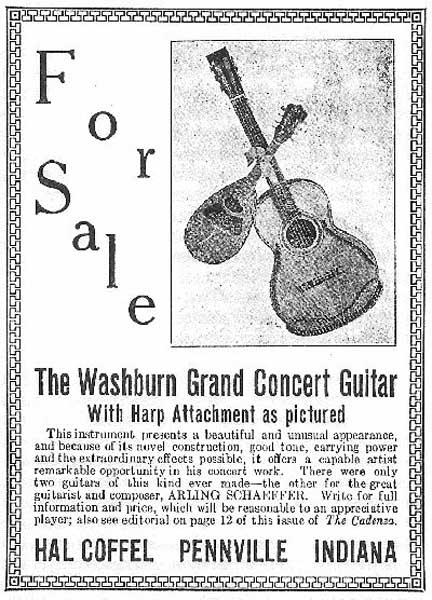
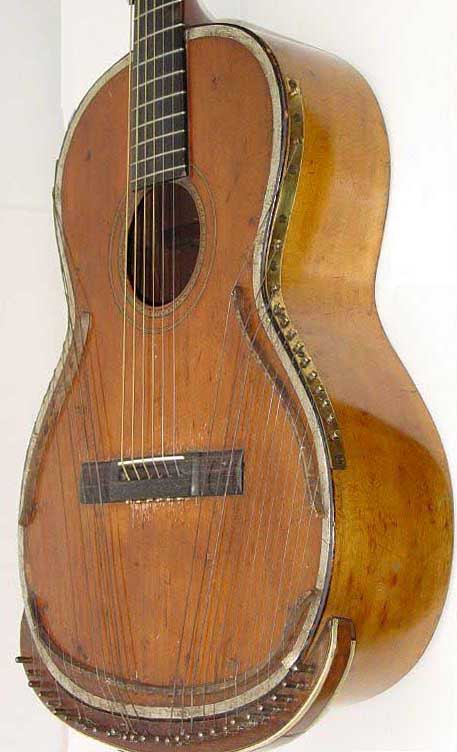
A curious side trip was this Bohmann creation around 1890. It's actually someone elses invention – an unusual Form 4 instrument, with harp strings only on the body. They are strung on both sides to form two banks of chordal arpeggiated strings – nominally the I and IV chords. The instrument is an exact interpretation of an 1890 patent by one Arling Shaeffer, of Denver, Colorado. Shaeffer apparently granted license to both Bohmann and Lyon & Healy to build them, as evident from the label inside the Bohmann and this private advertisement (courtesy of Michael Holmes) depicting one of just two Washburn (L&H’s brand) versions produced.
|
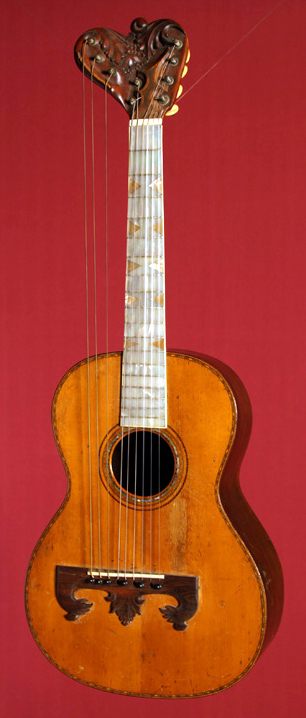 |
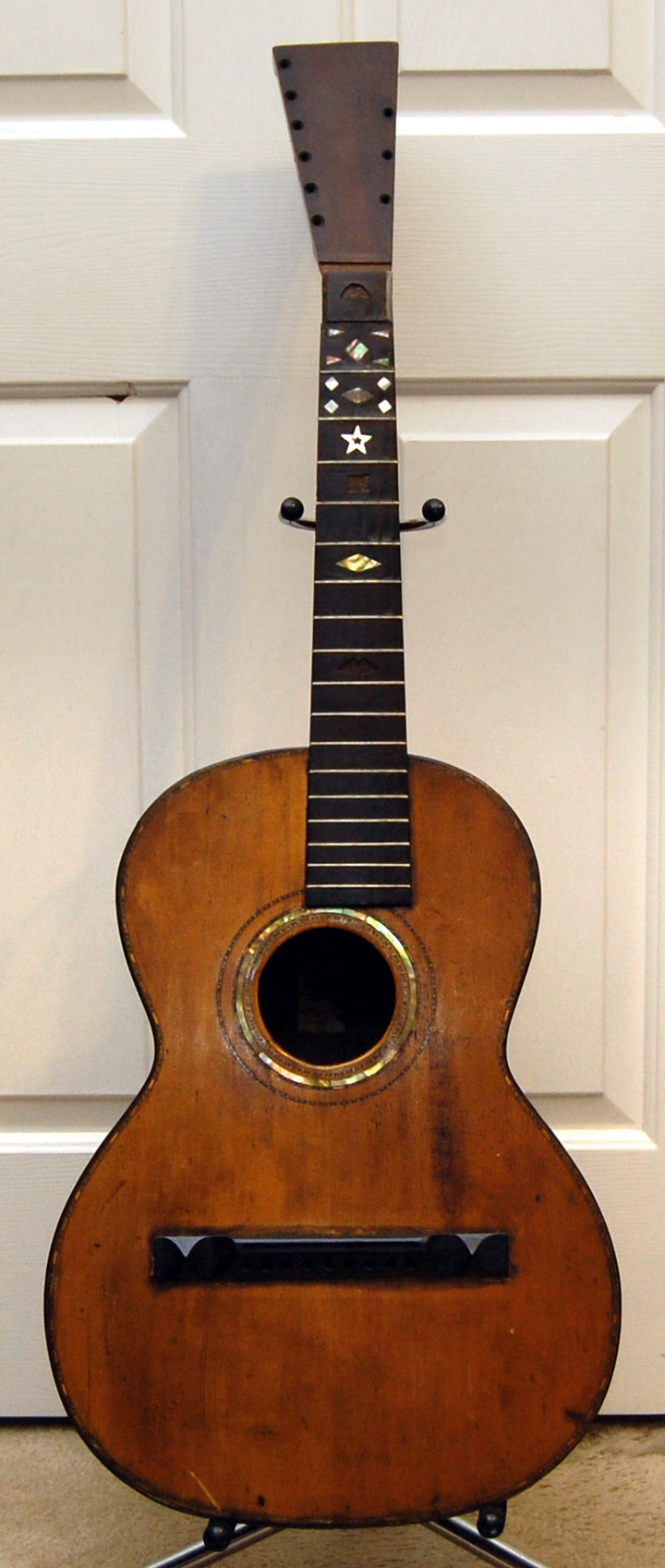
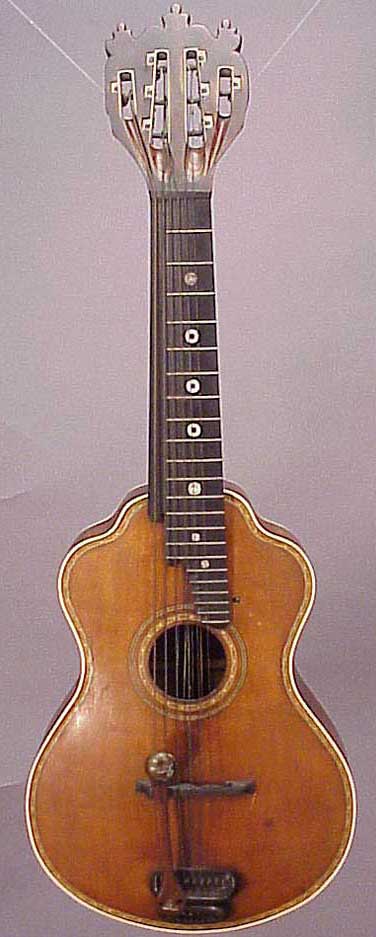
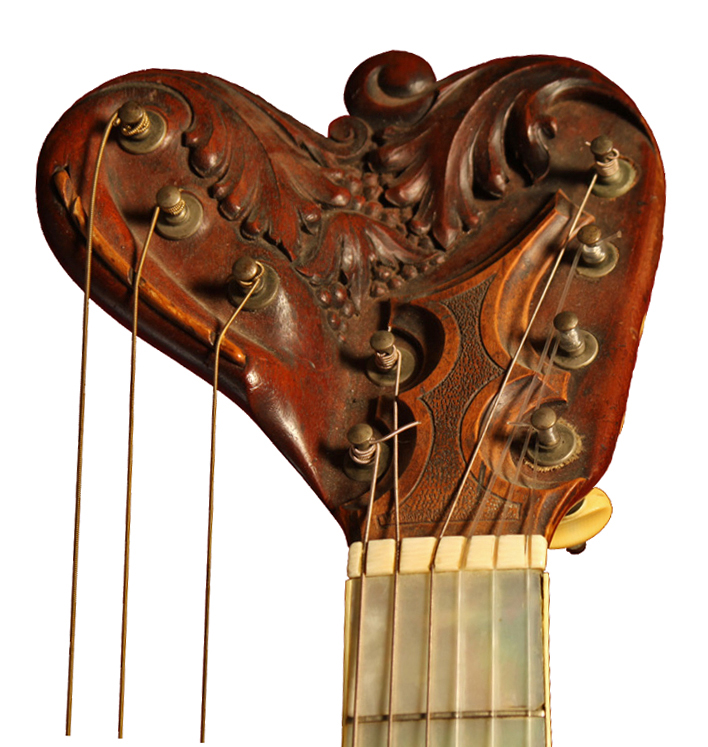
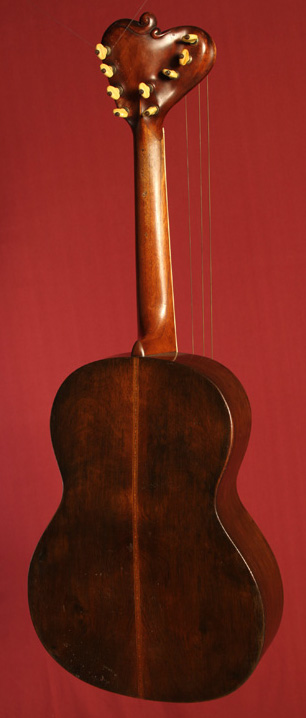
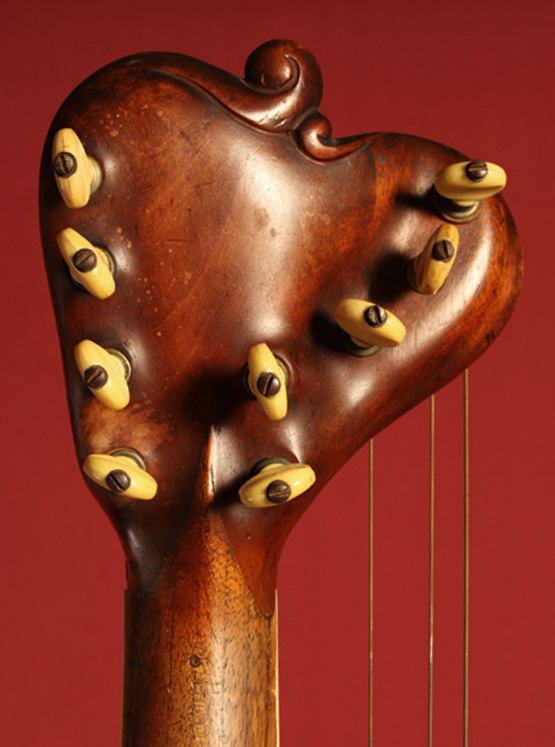
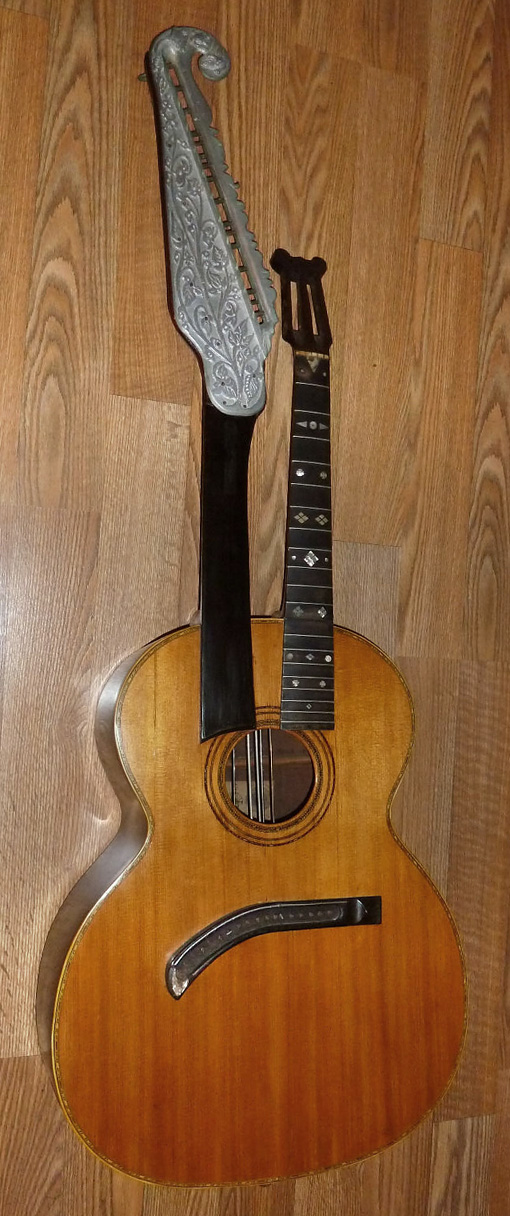
Now we jump to his
incredible 9-string. Bohmann was building fine violins and mandolins,
but still, this elaborate and stunning carved headstock is almost
certainly someone else’s work. The solid mother-of-pearl fretboard and
decorative rosewood bridge are unique as well. This instrument has the
Paris award label, which would date it from c.1889-c.1894. These are so far the only
Bohmann harp guitars that do not have a second “neck” or support
arm. |
|
 h h |
 |
|
 |
||
 copyright Vintage Guitar |
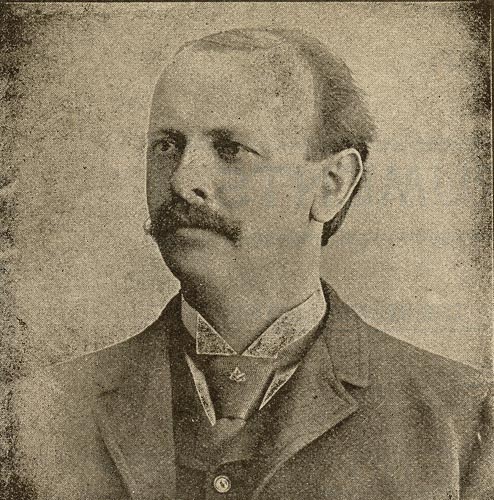
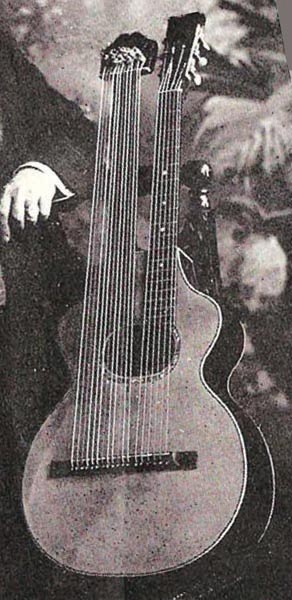
This rare and important portrait of Joseph Bohmann himself appeared in the October 1996 Vintage Guitar Magazine. The photo is fairly hard to date, but Bruce and I believe we have it pinned down to the very beginning of the 1890s (compare his features to his later catalog image, for starters). We can only assume that he built this guitar himself, although we continue to believe that he never got around to carving refined fancy scrolls (or any fine headstocks, as above!). Perhaps he took the time on this one, or had help with the carving. To my eye, it appears as if the bass head may be pitching forward along those extension pieces. (We know he pitched this "neck" significantly forward on his next model.) Again, I'm always looking for Bohmann's place in the overall American harp guitar timeline, beyond his own instrument evolution. Here, we find six sub-bass strings, along with a second "neck" (actually, only a support for the sub-bass head). Note also the ebony of the sub-bass veneer extending onto the body, as it will more significantly in the next instrument. But I also noticed what appear to me as elements borrowed from the Harwood creations by Jenkins. Notably, the scroll sub-bass head (on Harwoods from the 1880s to 1900, and the shape and ends of the bridge. Unfortunately, that bridge wouldn't appear on a Harwood until at least 1895, although it could have been introduced years before. More mysteries! |
 copyright Vintage Guitar |
|
|
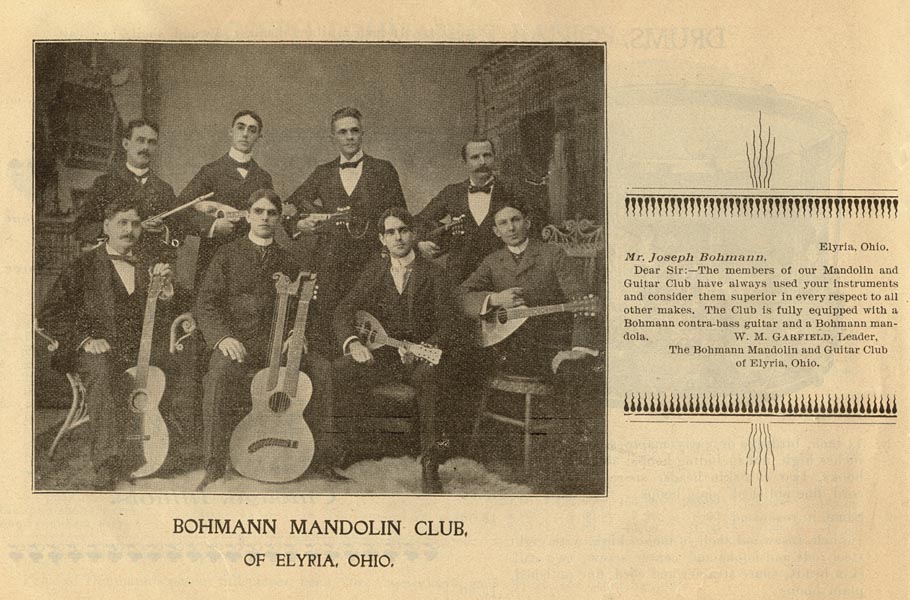
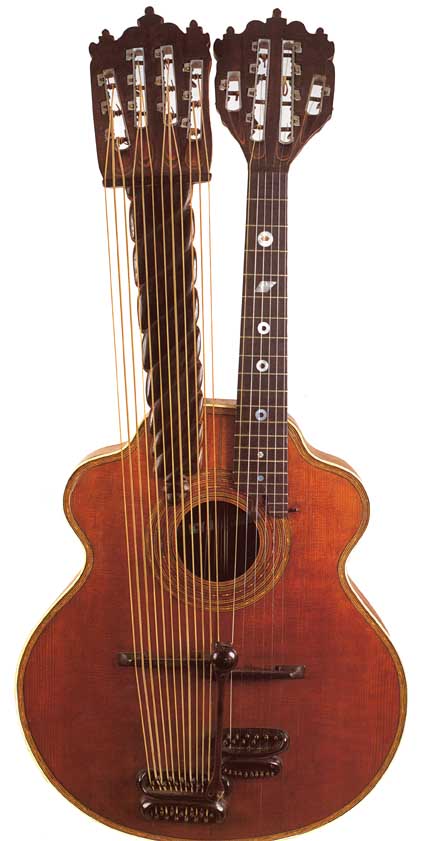
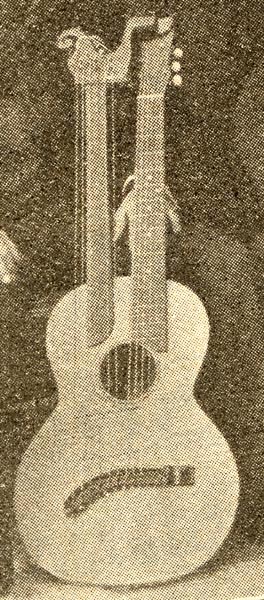
We now progress to Bohmann's "double-neck" harp guitars. Of course, the "bass neck" is not a playing neck, only a support structure. The bridge was a dead give-away that this was also a Bohmann, but it is still nice to have corroboration. The letter to Mr. Bohmann from the group specifically mentions their "Bohmann contra-bass guitar." However, once again, the sub-bass headstock is unlike any other Bohmann harp guitars. Happily, one turned up for study: |
 |
 |
I was able to obtain it,
eventually selling it, after an imperfect restoration. I will say this
– it was one of the most live
and sonorous harp guitars I have had the pleasure of hearing. It appears virtually
identical to the catalog instrument, other than having the main neck
centered on the body, rather than offset. Bohmann seems to have done
much experimentation with the engineering of his harp guitars: body
proportions, bridge placement, neck placement (both), neck angles
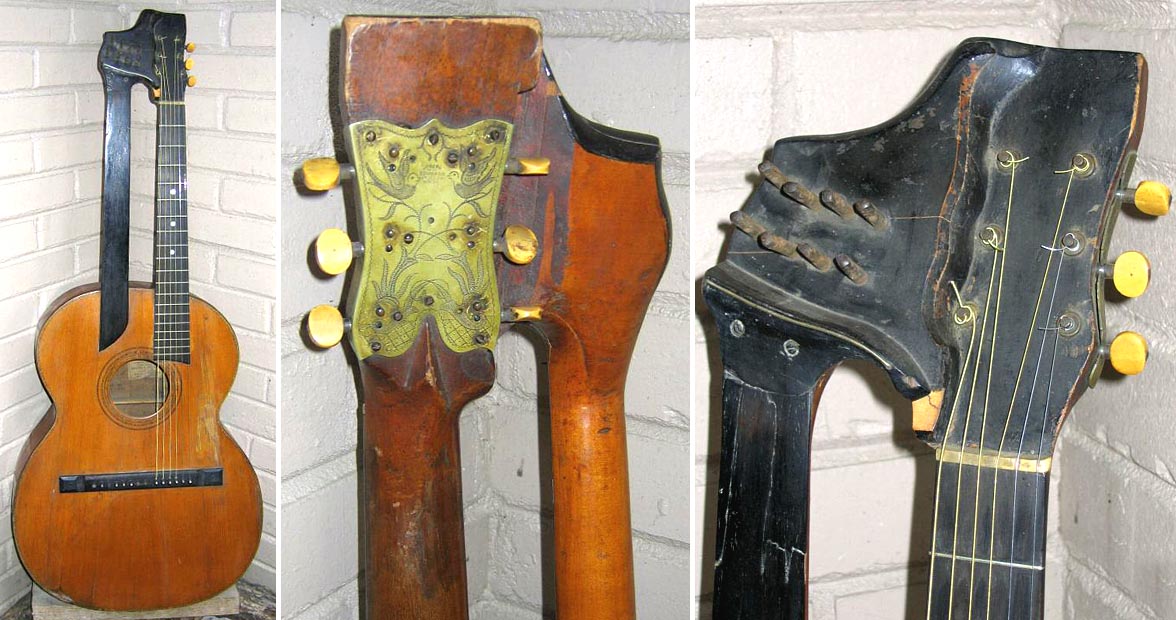
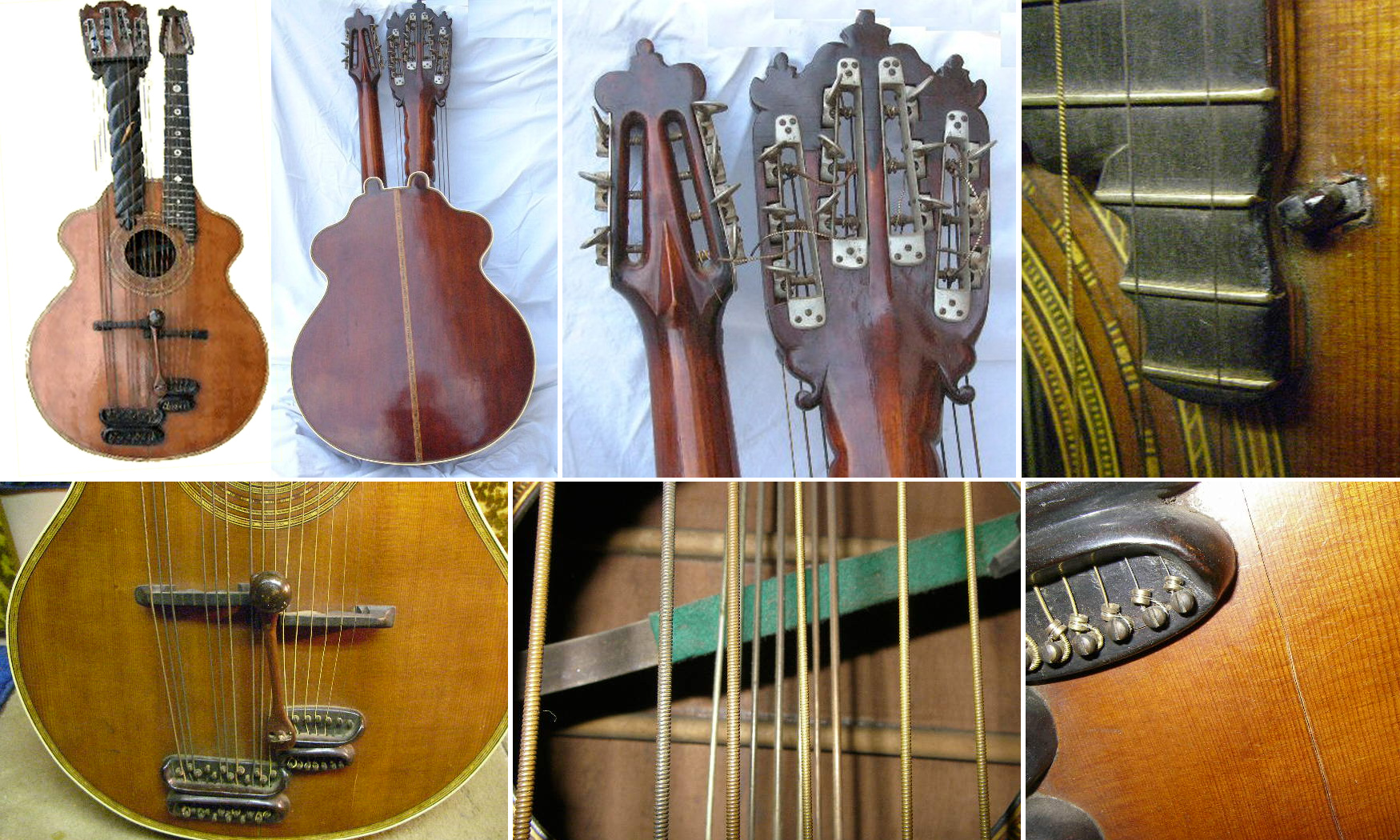
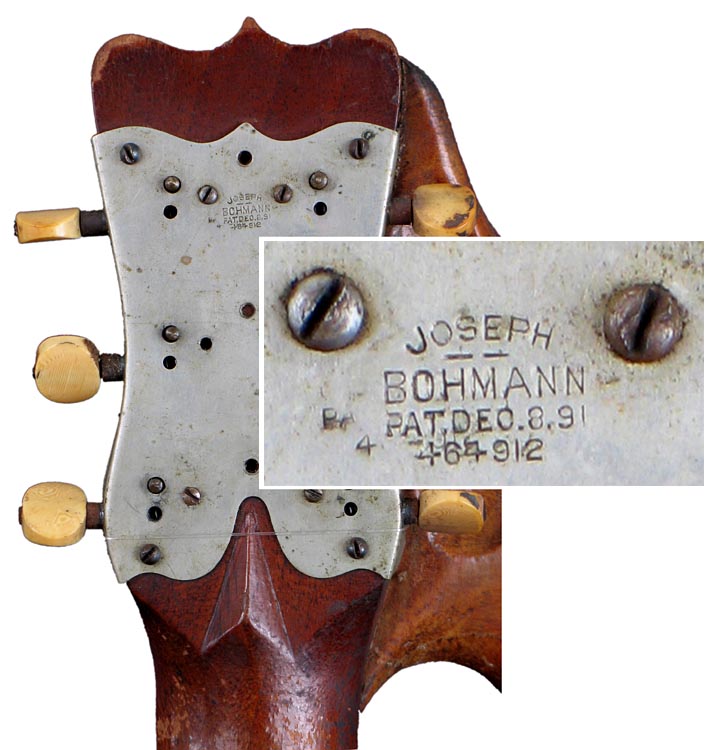
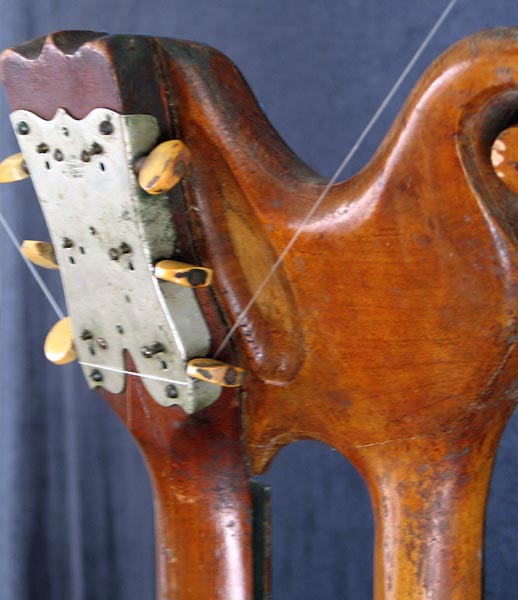
(relative to each other) and sub-bass string length and attachment. The remains of the label show it to be the “Paris award” variant – and, as it also has Bohmann’s Dec 8, 1891 patent tuners, we can assume that this instrument was built within c.1890–c.1894. Here, Bohmann begins with his classic pre-1900s main headstock shape, and then glues to it - onto the front - an elaborate carved bass extension affair. This piece, contiguous with the neck, consists of three laminated pieces of maple, with Brazilian rosewood veneer. It appears to be exactly the same as the specimen in the historical photo. The eight sub-bass strings are tuned with zither pins, and pass over a slotted screw to act as nut and spacing/height guide. The neck attaches to the body with a shallow butt joint, rather than a heel. What is quite strange is that this arrangement pitches the bass strings forward a rather significant amount. This makes it virtually impossible for the player to see the fingers of the left hand on the neck – nearly all other vintage harp guitars avoid this design flaw.
|
 |
|
|
||
 |
 |
 |
|
|
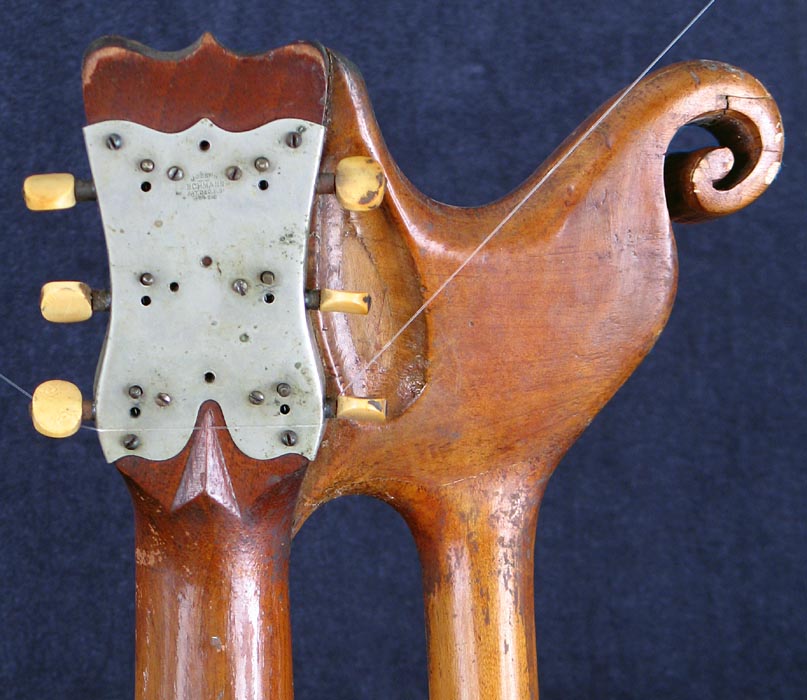
Compare the level of this typical Bohmann design and carving with the elaborate 9-string example above from the same general time period. From the back, we can see why Bohmann had to pitch his bass neck so far forward. Rather than come up with variations to the standard headstock or tuners to accommodate a bass extension, he was obviously committed to using his patented tuners. Note the carved-out area so that one has room to turn them! |
 |
 |
 |
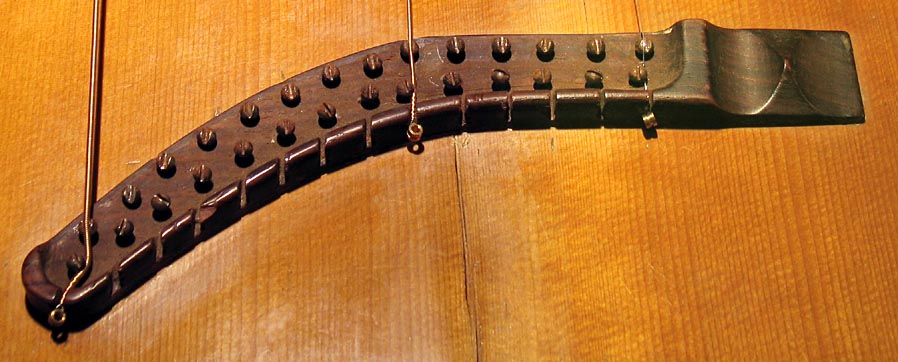
The bridge design is ingenious and simplicity itself. It appears to be what he used on most of his early instruments, until a new design appeared in his 1899 catalog. The (rosewood) bridge is glued down to the finished top with the two sets of screws holding it in place. Strangely, on this instrument there is no bridge plate whatsoever! The screws are then adjusted to handle the strings. Before undergoing restoration, I strung up a couple dummy strings just to figure this out, and it works! The top row of screws are positioned directly above and slightly to the right of the slots cut into the bottom of the bridge, and spaced as in a normal guitar saddle. The lower row is offset slightly. Ball end steel strings are used, as can be seen in many of the above historical photos (does this mean Bohmann was one of the first to build for and champion steel strings? Yes, almost certainly!). The mechanics are that the lip of the round-head screw catches the string to hold it down within the slot of the upper screw, which acts as the saddle. Why not? Think about it - you'd never have problems with string action again - you can raise or lower each individual string as needed! |
|
|
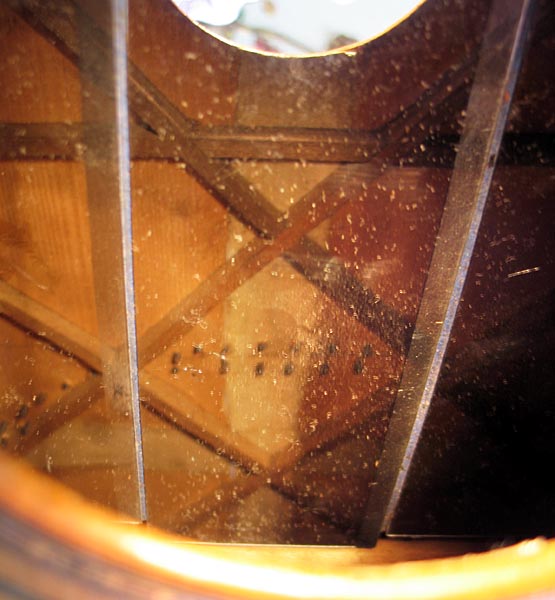 |
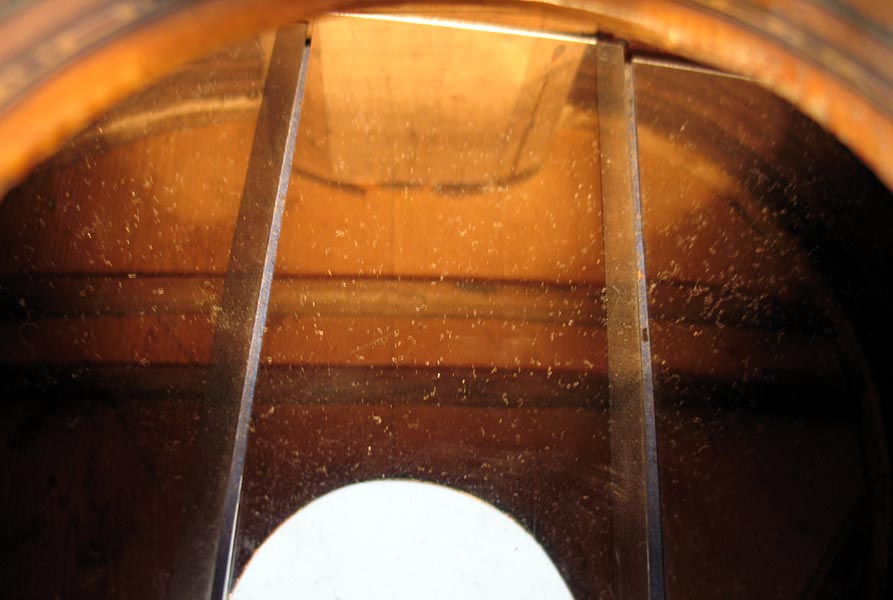
Reflected off a mirror looking up at the top, the string screws can be seen poking through. The top is double-X braced, with fairly crude square braces. Note the seam tape. Two horizontal braces are used above the soundhole. |
 |
 |
And post-restoration, fully strung. This instrument is much smaller - 14-1/2" wide - than the huge 19" wide models Bohmann would introduce c. 1895. The scale (to center of "saddle screws") is about 25". The back and sides are undoubtedly made of Bohmann's trademark 3-ply recipe Brazilian rosewood/Maple/rosewood. This invariably develops micro-cracking in the outer rosewood veneer layer. The specific varnish he used has turned the wood very dark. The fingerboard is Brazilian rosewood, while the bass maple neck is covered with ebony (or possibly grenadillo?). The top is spruce, again darkened with varnish (this restored top turned a little too orange). For more on this Bohmann model, see also Bruce Hammond's fascinating piece on Grace Ravlin: |
 |
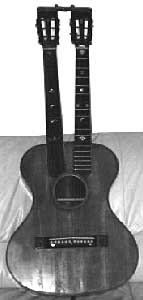
I'm convinced that this specimen was originally virtually identical to the specimen above. The 6-string headstock is the same, while the bass extension looks like it may have had chunks broken off of it, then later smoothed and painted at these breaks. Note the same 8 pin tuner configuration, and how the bass block is a carved piece that lays on top of the 6-string headstock (in order to access the tuners). You can also see what looks like the mark from the original angled bridge, later replaced with this modern version. Unlike my example with its centered playing neck, this one matches the catalog's historical specimen with both necks centered around the soundhole. On all three example, the ebony covering of the sub-bass support neck extends over the body with a (presumably decorative) tapered end.
Like my instrument above, the label includes only the 1889 Paris award, and also has tuners with a Dec 8, 1891 patent date. While mine has a simple butt joint for the bass "neck," this one has a half-length dovetailed heel. |
 |
 |
 |
|
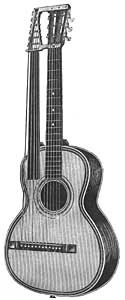
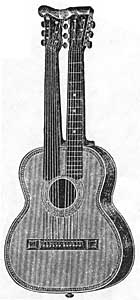
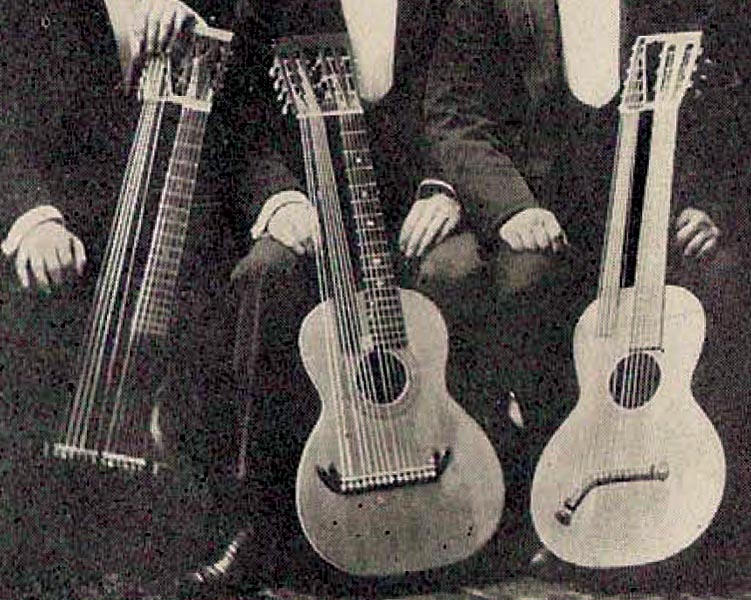
The three suspected Bohmann harp guitars. The one on the left could be an original Lyon & Healy, or it could be a Bohmann copy. The middle instrument could likewise be Lyon & Healy copy, this time with a Bohmann-designed bridge. The third instrument is likely a Bohmann due to a distinctive bridge, and the fact that it has an unusual number of sub-bass strings (8). Note that all three necks are placed differently in relationship to the center soundhole. |
Here are Lyon & Healy's Washburn and American Conservatory harp guitars of the same period. |
|
|
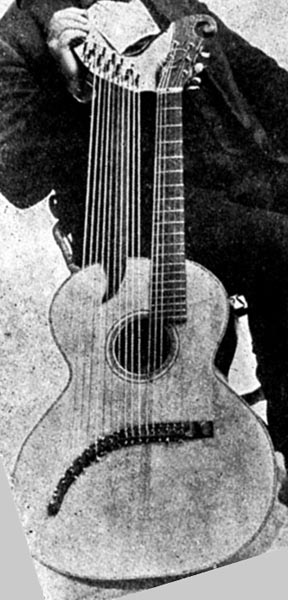
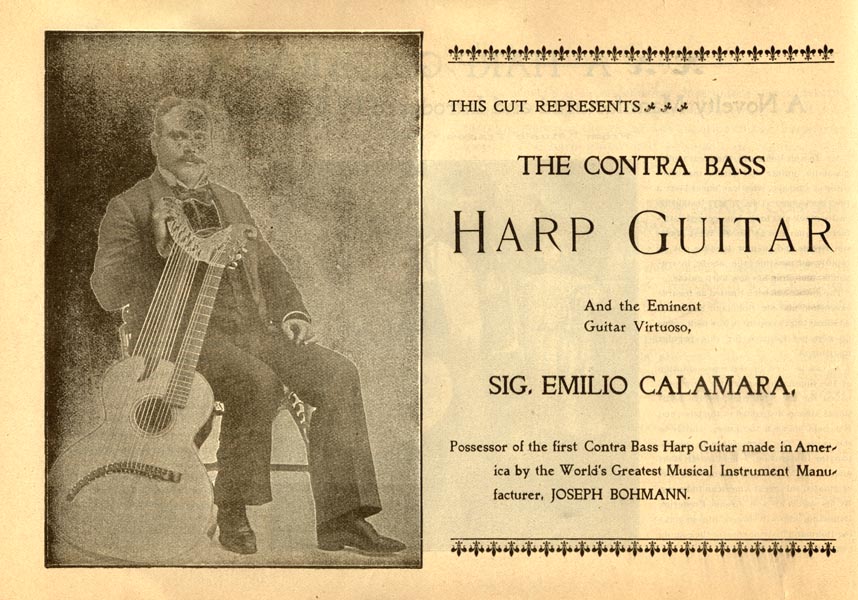
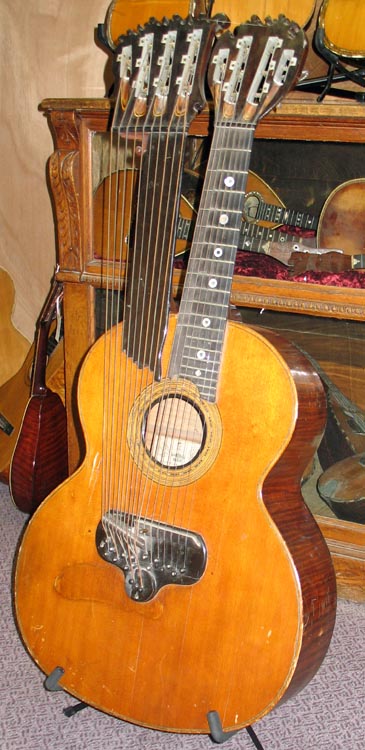
Ah, now we get to Bohmann's incredible "contra bass harp guitars." We first learned of these instruments from the Bohmann catalogs (both undated, the first discovered pinpointed 1899 pretty accurately; the second discovered appears to be very early 1896). Thus, these pictured instruments are from 1895 or possibly even earlier. The first example is claimed to be “the first contra bass harp guitar made in America, built for “the eminent Guitar Virtuoso, Sig. Emilio Calamara, of Chicago.” It is a custom instrument with a distinctive headstock. Other than a salesman’s exaggerated claims, I’m not sure what Bohmann’s "first in America" boast means, as many "harp guitars" had previously been built, including his own. Perhaps his special name was what he was eluding to? It was certainly little different than the existing large, double-neck Harwood instrument, also with 12 sub-basses, built by this time. For the full Calamara story, please see Emilio and Emily Calamara: A Tale of Two Musicians. |
|
|
|
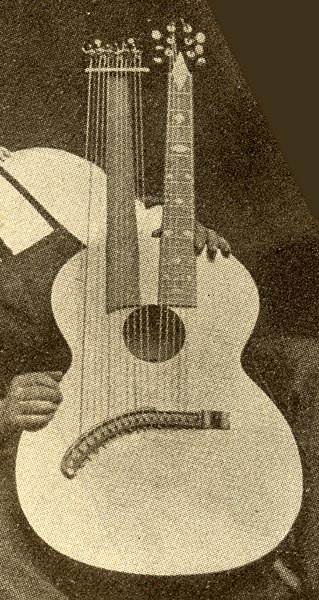 |
The second
catalog instrument is presumably a production
instrument and would have been built sometime before the December 1895
Chicago fire (as the photo also appeared in Music Trades magazine on
Jan 4, 1896). It is also a 12 sub-bass model, with a simpler headstock
(though with elaborately inlaid neck), and similar bridge. Bohmann
himself is holding the instrument. Both instruments have zither pin
tuners for the sub-bass strings, and somewhat blunt, short bass
headstocks. The harp guitars listed in these catalogs were all offered as “made to order,” in a variety of models (degrees of quality), in both 12 bass and 6 bass versions. They were advertised as “positively the largest guitar ever made.” With a body length of two feet, width of nineteen inches and depth of six inches, this was probably true. As so often happens with harp guitars, the tone is inevitably compared to an actual harp (presumably orchestral) – in this case, Bohmann claims that Calamara directly compared his instrument to two harps played at once (winning the contest, of course)! |
 |
 |
|
Another large contra bass Bohmann lies somewhere in design between the two catalog image specimens above. It appears in an all-female group photograph taken in 1898. |
|
|
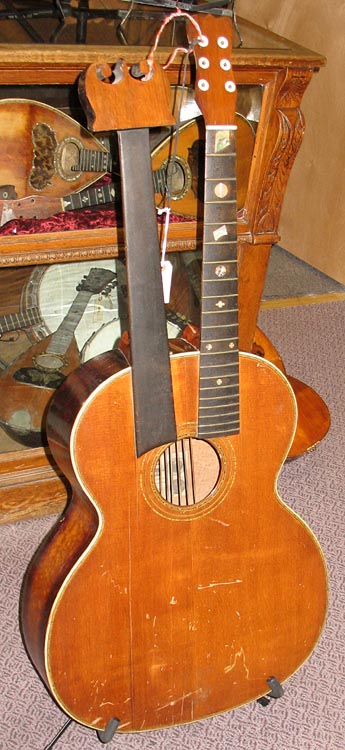
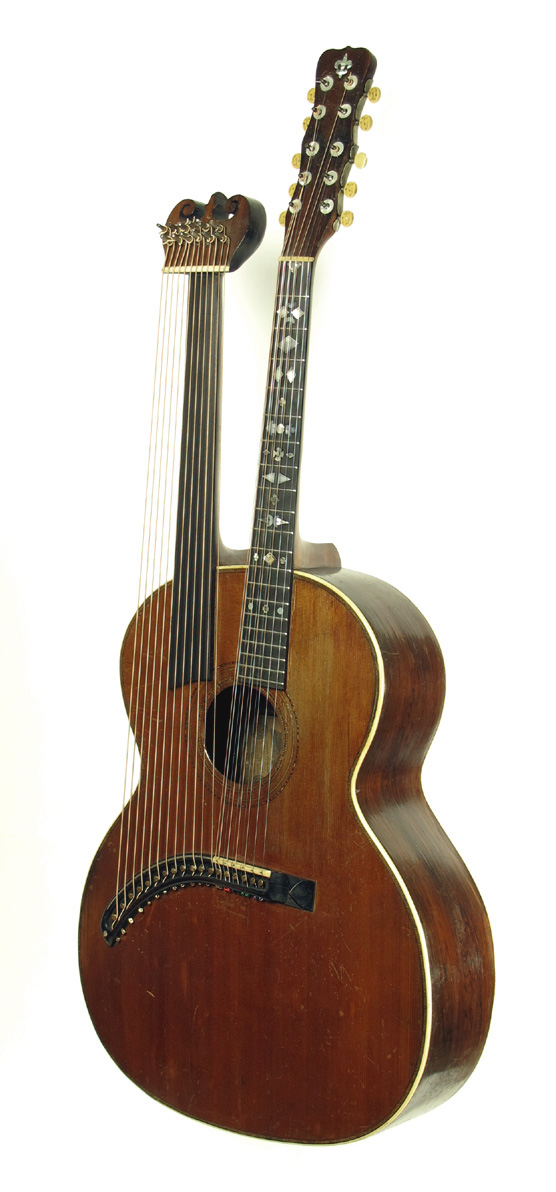
Below are some instruments similar to Bohmann's own (above), but also a whole host of instruments with flat tops and flat-to-arched backs with different bass heads and tuner arrays and added tone rods. We believe that many of these started construction in the 1890s, but were left unfinished at random points along the way, to be finished or "Frankensteined" later, especially with added tone rods in the 'teens. All of these and more will be shown below and some within a special Harp Guitar of the Month article, now that a few have been found. |
 |
 |
 |
|
 |
| Now things get interesting....
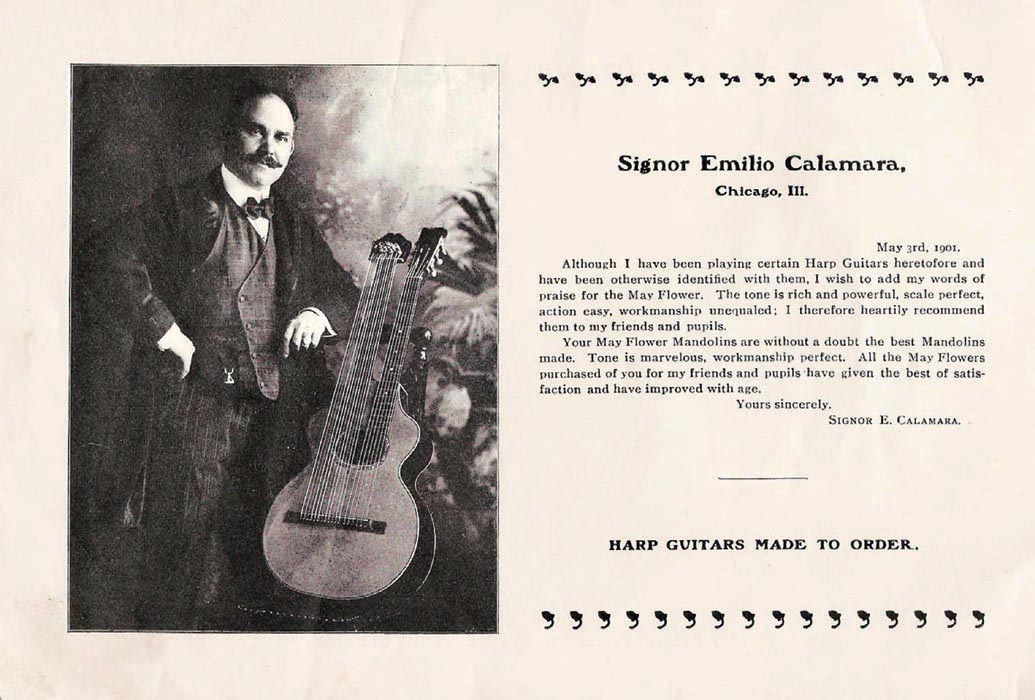
Here is Signor Calamara again, with yet another strange harp guitar - pictured in a May Flower catalog from c.1901. Note "Harp Guitars Made to Order" at page bottom. Is it a May Flower harp guitar? Despite the text, I originally thought it might be another strange Bohmann. I've since changed my mind, with thoughts presented on the updated May Flower Harp Guitars page. Note the strange shortened bass peghead, which is similar (perhaps identical) to Bohmann's own above. Most builders did not provide a full 12 sub-basses - here we see that Calamara has it now fully strung with sub-basses, unlike his previous specimen. The most interesting feature is the body! It sure looks like an early precursor to the sloped shoulder design Bohmann would patent 15 years later (see final specimens below). We don't know when he actually introduced the slope shoulders. |
|
|
|
The May Flower catalog confuses us further by having a second image of the Steinway Mandolin Orchestra that was pictured in the Bohmann catalogs – but now labeled Edgar A. Benson's Celebrated Mandolin Orchestra of Chicago! Though the members have played "musical chairs" and switched places, this was clearly the same photo session in the same studio. Our same three harp guitarists hold the same three instruments, the photo showing somewhat better resolution, especially of the interesting 4-on-a-plate tuners for the unique 8 sub-bass neck. Unfortunately, we have no more detail on the questionable Lyon & Healy instrument. |
|
|
|
|
|
I've had this next instrument up on this page from the beginning. I forget the source, but it was presented as a Bohmann. I'm assuming the sellers saw a label or some other clue. With enough experience now under our belts, it's easy to identify Bohmann's unique large custom fretboard inlays - so, despite the non-traditional Bohmann body, I'd say this is another variant of c.1900 vintage. |
|
|
Perhaps the most well known Bohmann instruments are his so-called “sympathetic string” instruments. Though nearly every owner and writer insists on referring to these internal sympathetic devices as "strings," they are anything but. They are the metal rods specified in Bohmann’s patents #1,128,217 and #1,128,217 of 1911-1915. The rods were stiff, made out of specific materials (for each described note!) and tuned with wing nuts to specific pitches just like a string. There was also a damping bar, activated via a push button in the guitar top. This invention was applied to mandolins and standard guitars, of which multiple examples are now known, including several harp guitars. Most "tone rod" instruments, regardless of type, also include all the features specified in Bohmann's next patent, # 1,179,499 of 1916. These include the sloped shoulders to provide “cutaway” access to higher frets, a novel hand rest, and the incredibly thick convex top and back (part of the earlier patent also). It seems that few of us with "tone rod" instruments have chosen to risk trying to tighten them up to see what we get. One who has successfully done with two of his 6-string guitars is Jake Wildwood. Another managed to get them tuned but discovered they added virtually no sympathetic vibration tone enhancement beyond perhaps a slight "shimmer." Frank Ford has presented one rare example (far left) on Frets.com. And of course, many of us remember the outrageous double necks - the first from Tom Wheeler's American Guitars, the second from the book of Scott Chinery’s collection. Again, although c.1910 has been given as a date (and not impossible), I suspect they coincided more with the last three applicable patent dates, thus c.1914-c.1916. |
|||
|
This is the most recently discovered specimen of Bohmann's harp guitars with the heavily domed top and back. Happily, it made it into the Miner Museum. It has a pencil inscription on the heel block of "1911," which was when the first tone rod patent was filed. I believe that this is indeed a 1911 instrument, built much earlier than the three instruments at right, as it has only the 1911-filed patent features, but no damper or hand rest, as the others do. Note the two tiny soundholes, one under each string bank! This is the only occurrence I've seen of twin soundholes by Bohmann. Not only that, but he also separated his eight tone rods into two sets of four, one running under each neck/soundhole. |
This harp guitar has 8 strings - the lowest 2 lie off the frets. It has/had 6 sympathetic metal rods. See the rest of Frank Ford's great photos and comments - including a look inside! - at Frets.com. |
This example has 7 strings on the neck, 12 sub-bass strings, and 7 sympathetic internal rods. |
This monster has 10 strings on the neck (the low 4 are doubled, so it is a standard 6-course neck) and 12 sub-bass strings, with 7 sympathetic rods inside. |
|
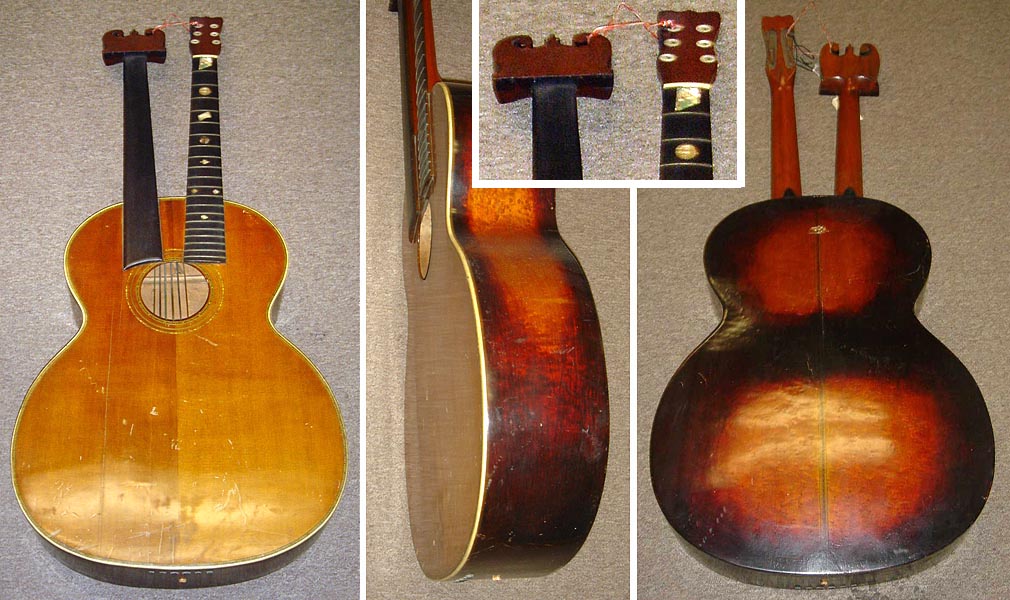
The four mystery instruments below were discovered in the mid-2000s by Bohmann researcher Bruce Hammond. Part of the still-enigmatic "lost Bohmann factory" sale of the 1960s, they are just begging for better photographs and more information. There is also a report of a 5th instrument in a Midwest guitar store.
|
|
|
This instrument just needs a screwed-on Bohmann bridge. And it finally got one! First - note the distinctive sub-bass headstock - this guitar appears to be a duplicate of Bohmann's own personal contra bass harp guitar above! (Only the neck inlays are different.) It even has the same way-ahead-of-its-time 1890s sunburst finish on birdseye maple that Bohmanns' almost certainly had (look closely at his instrument in the catalog). Folks, this is an unprecedented early example of a quality sunburst finish - perhaps one of the very first in American guitar history! But notice something else...it has six internal sound rods! A couple early mandolins have also been seen with the rods - were these truly used before the 1911-1915 patent? This has confounded collectors and Bohmann fans for some time, but the answer is no - as in all such cases, this was in fact a later retrofit of an older, unsold and uncompleted instrument. As it was missing the bridge (and there were no holes in the top), that was the conclusion of Bruce Hammond and I. In other words, Bohmann appeared to have built instruments in batches, leaving them uncompleted at various stages along the way. Thus, this sunburst instrument was almost finished about 1895 - except for the bridge. Over one hundred years later, the unfinished instrument owned by the Ax-In-Hand guitar store eventually made its way to Mike Anderson of Elkhart, Indiana, who had repairman Ron Koivisto (pictured) complete it in 2013. In March 2025, it was listed for sale at Monkton Guitars in Colorado (photos from the dealer below). |
 |
 |
 |
 |
 |
 |
 |
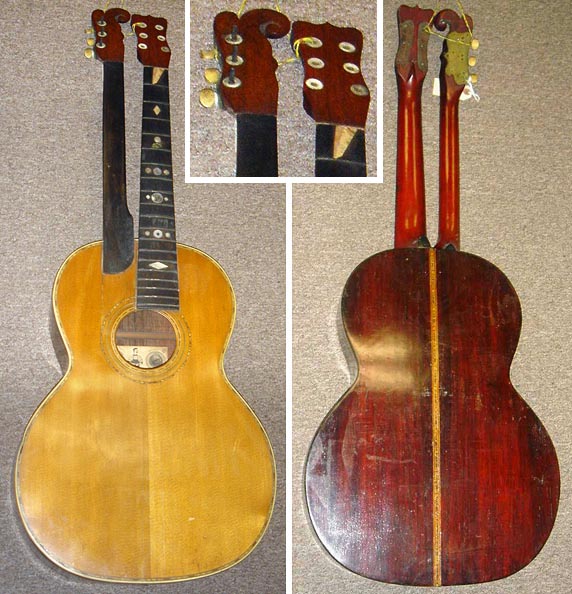
And another new Bohmann model discovered! These two unfinished instruments are identical except for the inlays. The distinctive curl on the sub-bass headstock is broken off on one. These have slimmer bodies and are interesting in that they have a second neck just to hold three sub-bass strings - a bit overkill. Like the above, one of these was eventually finished with a modern bridge and (rather jarring) tuners. (Picture at right from Bizarre Guitars) |
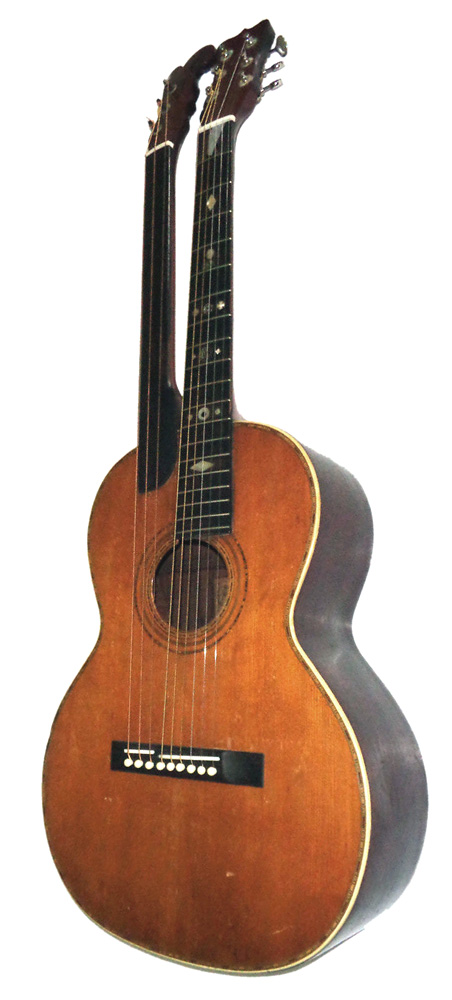 |
|
|
And this one takes the cake. Both photos are of the same instrument. It has the "gothic torture device" tuners of the later tone-rod instruments above, on an early flat-top jumbo body like Bohmann's contra bass harp guitar instrument. And what's with that bridge? An original (later) Bohmann bridge for sure, but replacing something that was previously there below for the bass strings. This specimen has no internal tone rods. Note that the first three "lost" instruments have the early large and gaudy pearl inlays. This one has the dots and circles like the three, presumably later, tone-rod instruments above. |
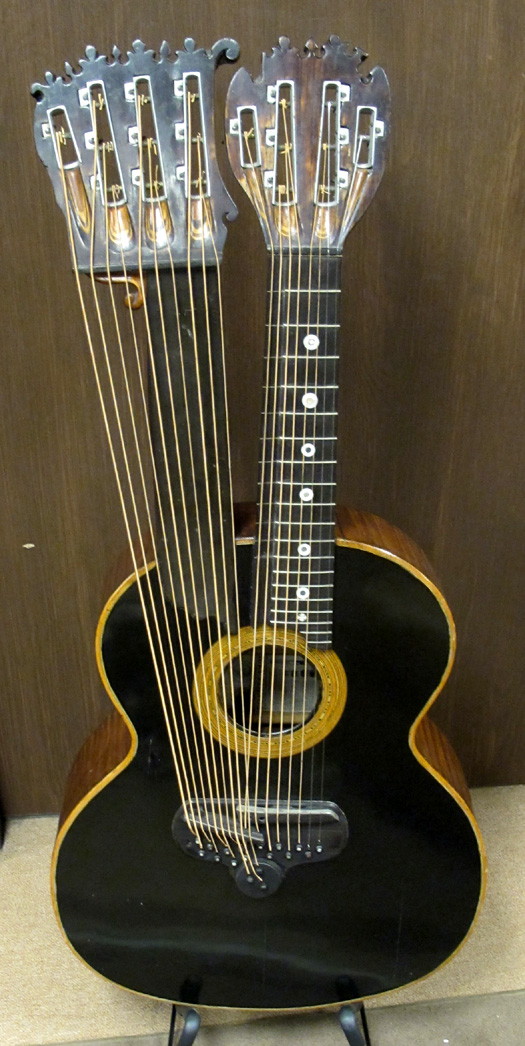 |
With the unsightly top finish issue from the older bridge, the latest owner decided to have the top refinished black to hide that. A striking - if ill-advised - choice, it has given the otherwise problematic instrument new life. See additional images in the Harp Guitar of the Month Bohmann feature. |
|
As with all articles within Harpguitars.net, I consider this a “work in progress” and encourage all to submit photos, information or theories, to continually update and improve our harp guitar history! I am indebted to Rich Myers, Bruce Hammond, Michael Holmes at Mugwumps, Frank Ford at Frets.com, Jim Garber, The Chinery Collection, 150 Years of American Guitars, and Tom Wheeler's American Guitars. Other sources include Robert Hartman, Michael Wright, Fine Guitar Consultants, Jeff Nygaard, Jessica Huebner, and Jim Bollman. |
|
If you enjoyed this article, or found it
useful for research, please consider making a donation to The
Harp Guitar Foundation,
|
|
|
|
All Site Contents Copyright © Gregg Miner,2004-2025. All Rights Reserved. Copyright and Fair Use of material and use of images: See Copyright and Fair Use policy. |