|
Featured Harp Guitar of the Month
|
|
|
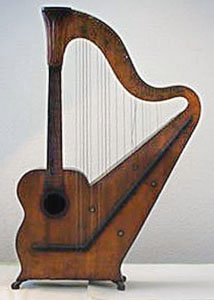
If ever there was an instrument deserving of the name "harp guitar," this is it! This is an unlabeled "harpe-guitare," catalog # 1550 in the Brussels Musical Instrument Museum. As far as I known, it has never been on view (though in the collection for well over a hundred years), and, to my knowledge, was only referenced (in text) in one rare book – a cryptic reference in Curt Sach's 1913 Real-Lexikon der Musikinstrumente. A cryptic English translation from the original German only increased my whetted appetite and pathological desire to get to the bottom of this mysterious-sounding hybrid! I next emailed Tony Bingham of London, who not only deals in rare instruments and books about them, but has undoubtedly the largest personal collection of research material in the world. As a personal favor, he looked into it and came up with something almost immediately! From his book Catalogue Descriptif et Analytique du Musee Instrumental (a reprint of the original 1898 edition), he sent a xerox of this amazing instrument. I had feared it would turn out to be either a poorly-described instrument I was already aware of, or something not truly related to "true" harp guitars. What a wonderful surprise! Next, I drafted our Belgian correspondent, harp guitar fanatic Benoît Meulle-Stef, to visit the Brussels Museum and inquire about it. Ben had never seen it there nor heard of it, and feared it might have been one of the many casualties of the War. A week later (he was as excited as I) Ben emailed these photos, and provided the specifications. |
|
|
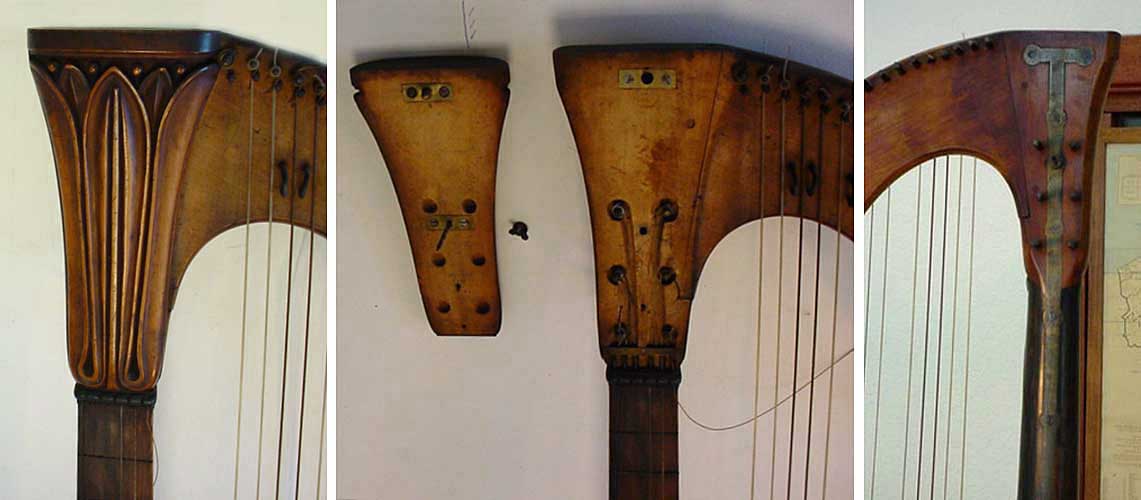
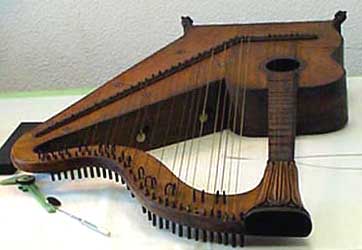
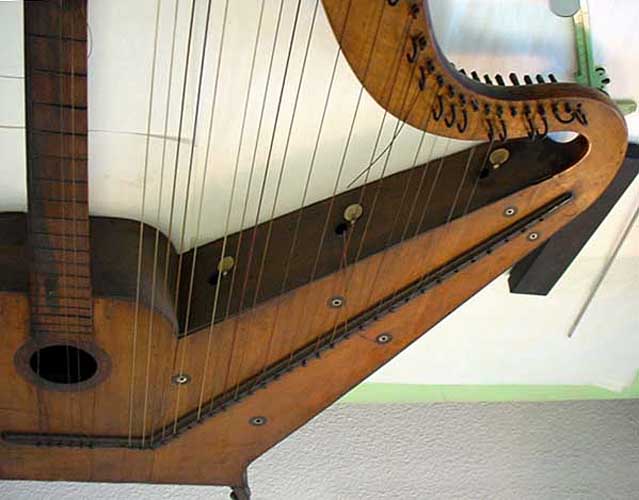
What a marvelous instrument! A full scale guitar (~25" scale length) with a full 31-string diatonic harp protruding from the side. The harp section, tuned to the key of C, has a range of over 4 octaves – more than the guitar! Note how the harp soundbox resembles a true harp's – only turned on its axis so that the strings come off parallel to the soundboard, rather than perpendicular. Quite ingenious, and I bet it probably had a decent tone. Sachs even went as far as to call it a "slightly worthwhile construction." He attributed it to England, "traced to the first quarter of the 19th century" (1800-1825). Benoit pointed out that the "Egyptian" pilaster tuner cover is similar to that of the Grosjean "double harp-guitar," of London, circa 1840. |
|
|
|
|
Now the only question is - where can I find one?! May, 2016: Check out my 2007 investigation into this instrument! |
|
|
Harp Guitar of the Month: Archives |
|
|
Collectors, Authors, Scholars: Want to create a page
about a certain harp guitar maker or instrument? Contact me!
If you enjoyed this article, or found it useful for research, please consider supporting Harpguitars.net so that this information will be available for others like you and to future generations. Thanks!
|
|