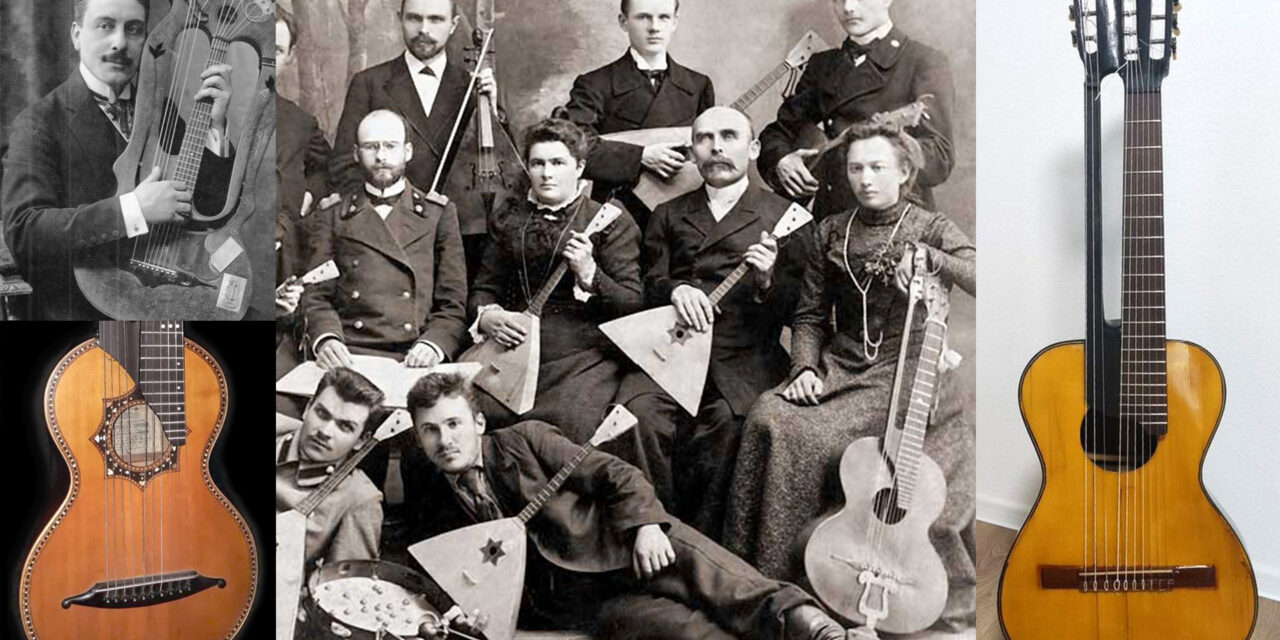
Our tireless Russian correspondent Ilya Kryzhanovskiy continues to supply Harpguitars.net with wonderful harp guitar images of the late 1800s & early 1900s from his country. Here, I catch up with his last four years of fascinating finds. Ilya won’t quite let me call these “discoveries,” saying that he’s no expert; he only has “a moderate searching interest and ability which appears from time to time and manages to obtain some casual findings”! Casual or not, it all adds to our archives and knowledge, and many are super cool!
If you’re new to Russian harp guitars, the first thing to remember is that most – but not all – had seven strings on the neck. This was for Russia’s own guitar tuning of DGDGBD to facilitate open string “harp-like” effects. Builders in both Germany and Russian built both stringing options for professional and amateur players by the thousands.
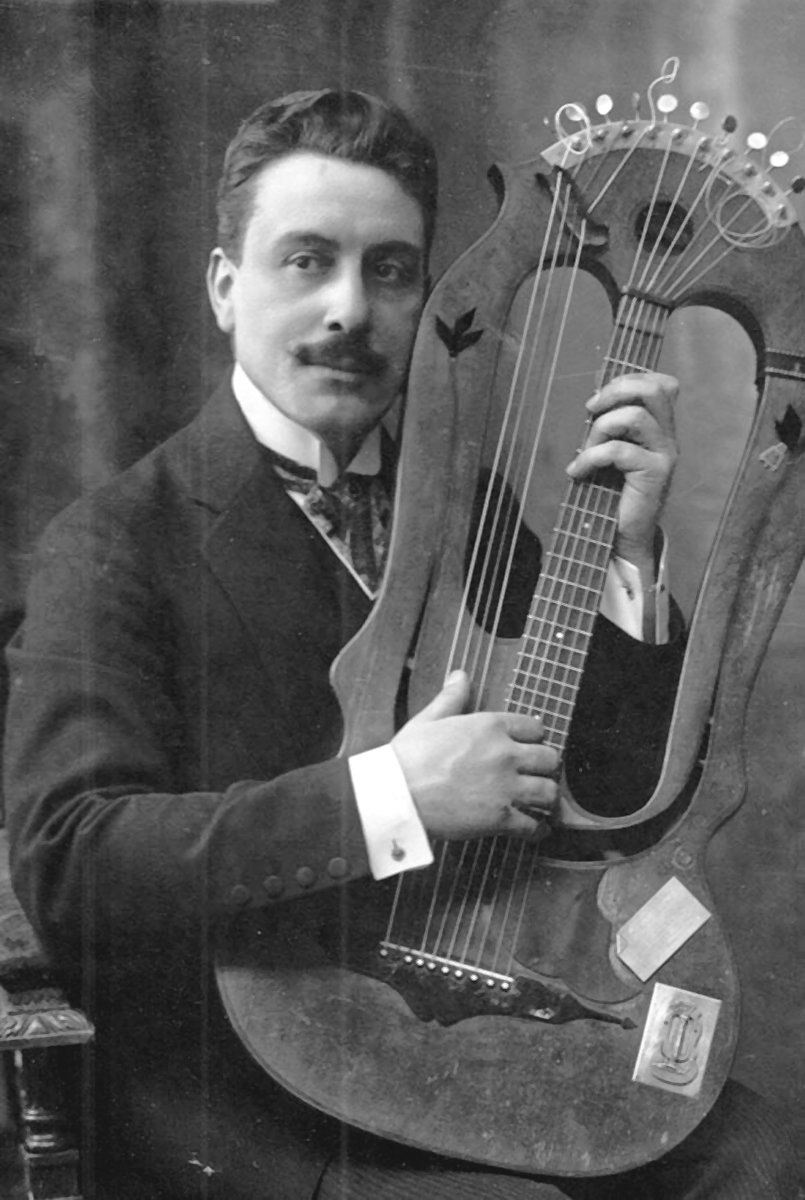
Curiously, the “Russian” above is playing an old Viennese Schenk harp guitar. He is actually a new Historical Harp Guitarist for the Encyclopedia, and gets his own short PDF article: Dmitry Konstantinovich Sartinsky-Bey, the Scoundrel of St. Petersburg
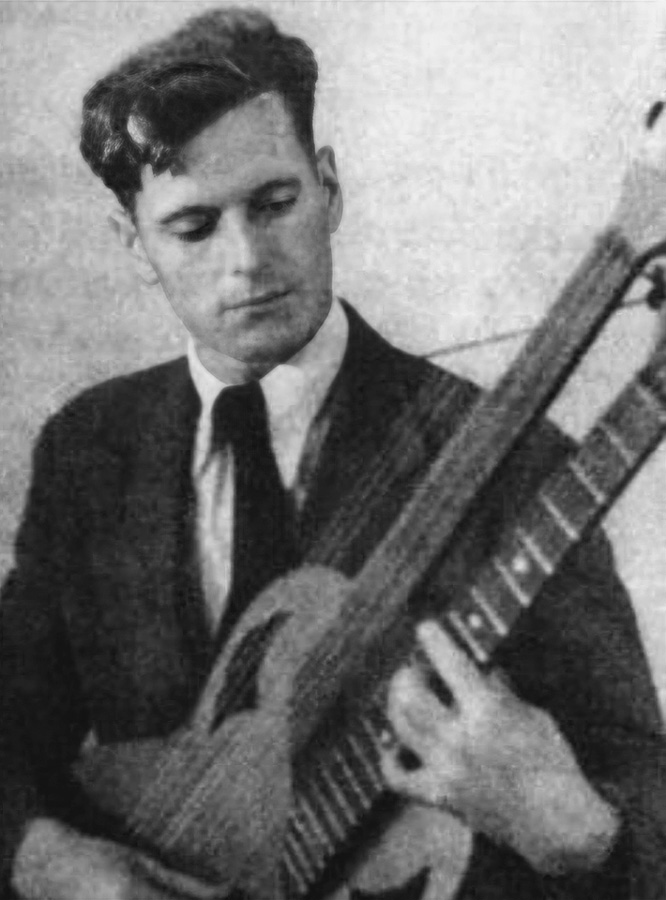
Another new named player is Petr Adamovich Korotkiy, with a unique harp guitar of unknown origin with a full array of kontrabass strings (at least one seems to be missing). Normally, serious soloists only used 3 to 4 basses. Note his instrument’s shape with the “backwards” wappen soundholes (reversed, as the upper bout is round rather than having the “shield’s” points, as seen in this typical Russian instrument below:
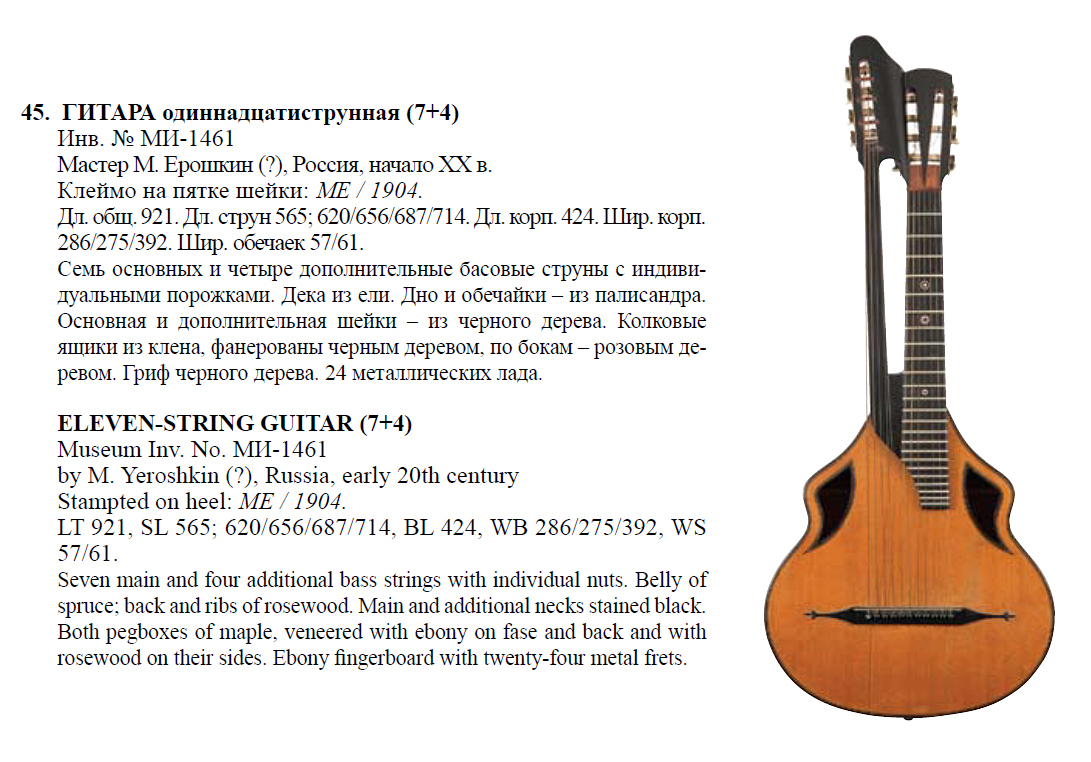
This discovery and image come from Instagramer “zartipo,” who wrote in December 2025 (per my translation):
“Petr Adamovich Korotkiy (1919–1993) was a Belarusian musician and teacher, considered one of the founders of professional guitar education in Belarus. In the second half of the 1970s, he taught me to play the classical guitar from scratch in Minsk. He began his musical career as a seven-string guitar player back in the 1930s. He was a soloist-instrumentalist of the Belarusian State Philharmonic. In 1962, Petr Korotkiy opened the first guitar class in Minsk at a music school (now the Children’s Music School of the Arts No. 2 named after N. I. Aladov), laying the foundation for professional classical guitar instruction in the country. His work played a key role in the development of guitar artistry and pedagogy in Belarus.”
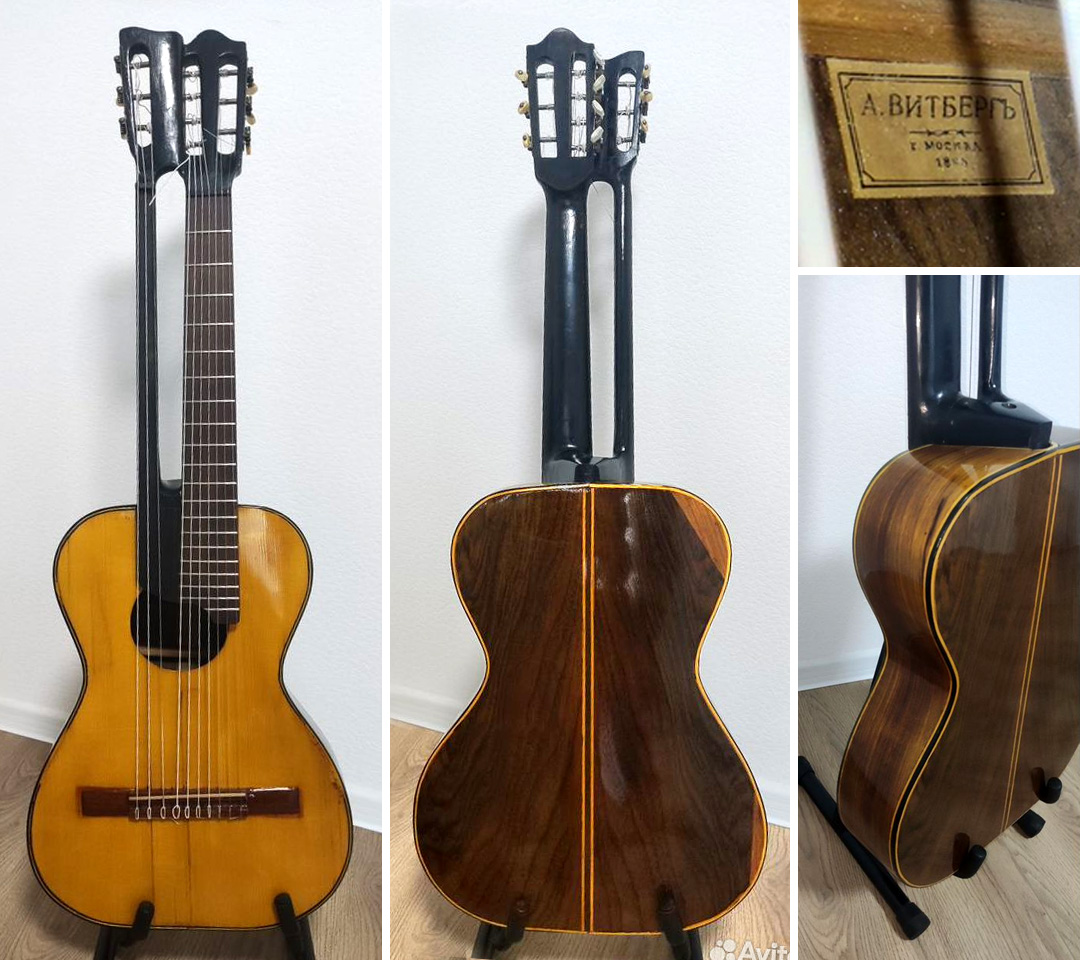
Continuing with new instrument finds and newly unearthed makers, here’s one with a distinctive body shape. The label reads “E. Wittberg, Moscow 1885.”
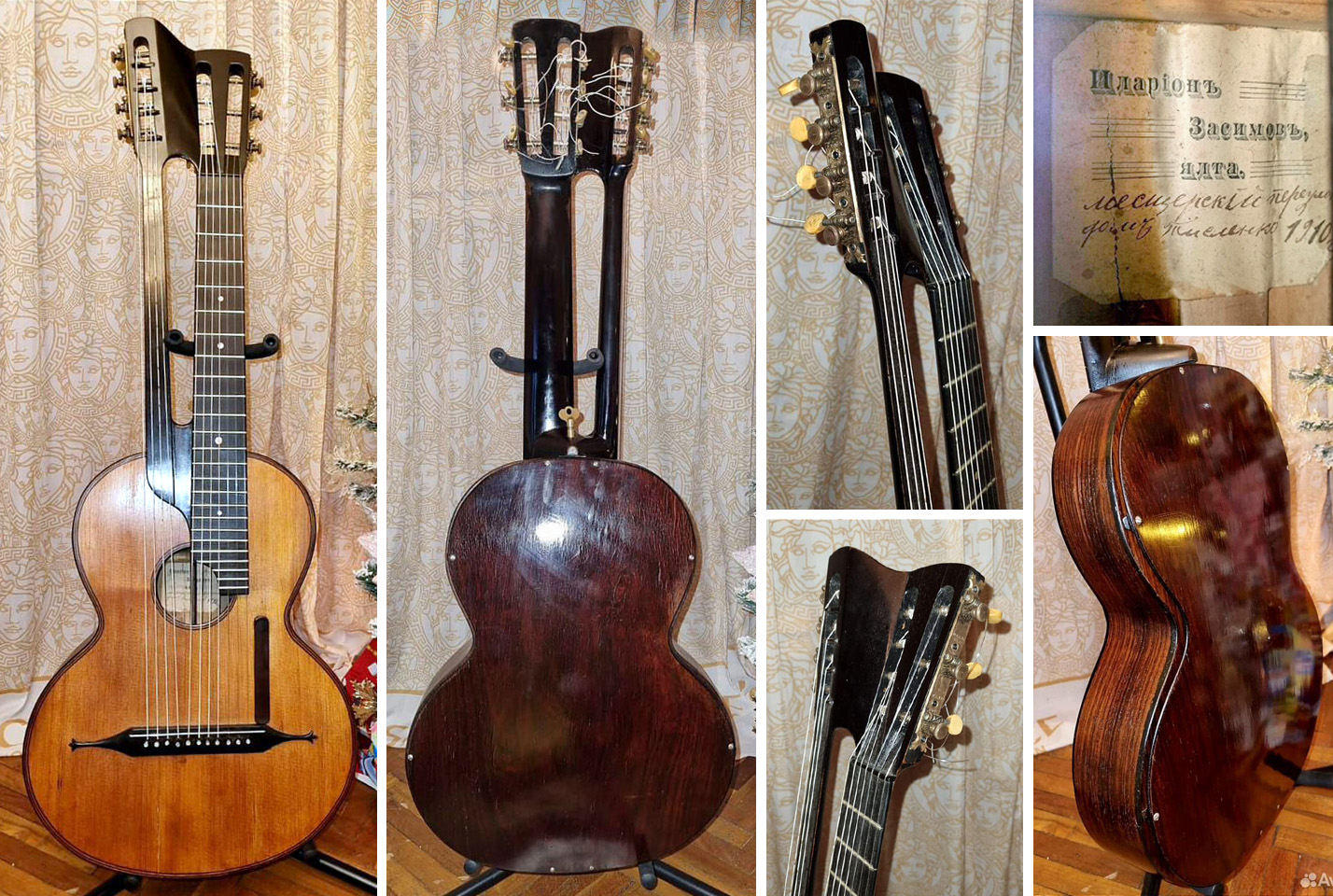
Ilarion Zasimov, Yalta, Crimea, 1910. Note the “Boris Perott pinky rail” (rest for the little finger).
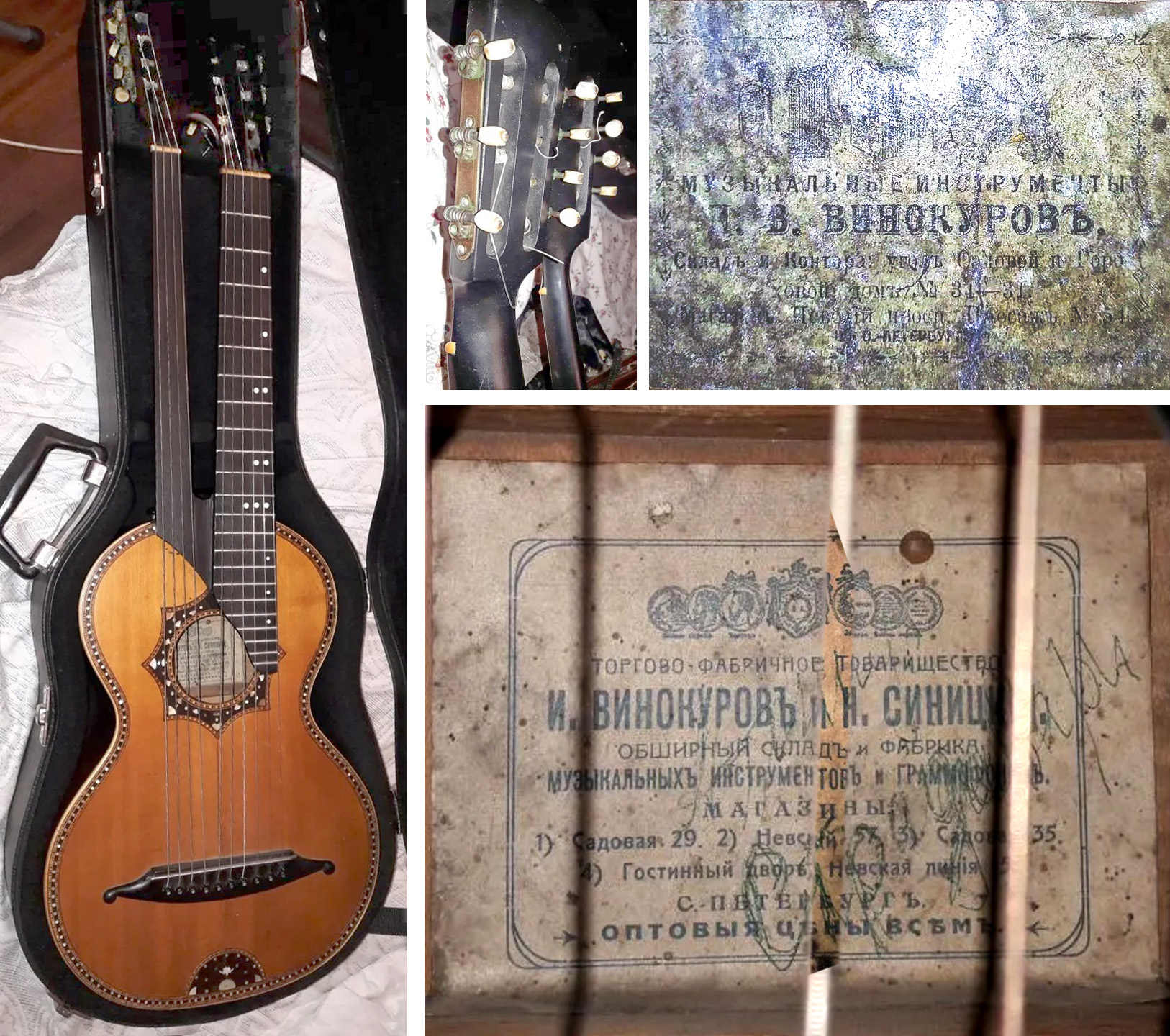
The firm of I. Vinokurov and N. Sinitskiy, c.1909-1918. Per Ilya, “the trading and manufacturing joint stock company of I. Vinokurov, I. Zyuzin and N. Sinitskiy is reported to have started in 1907. I. Zyuzin left the business in April 1909, so the company changed the name to list only two owners. By 1914, they owned five music stores and one manufacturing site in St. Petersburg. It is unclear whether this harp guitar (4+6) was made by them or imported into Russia from abroad and just labelled.” It’s certainly a beautiful instrument.
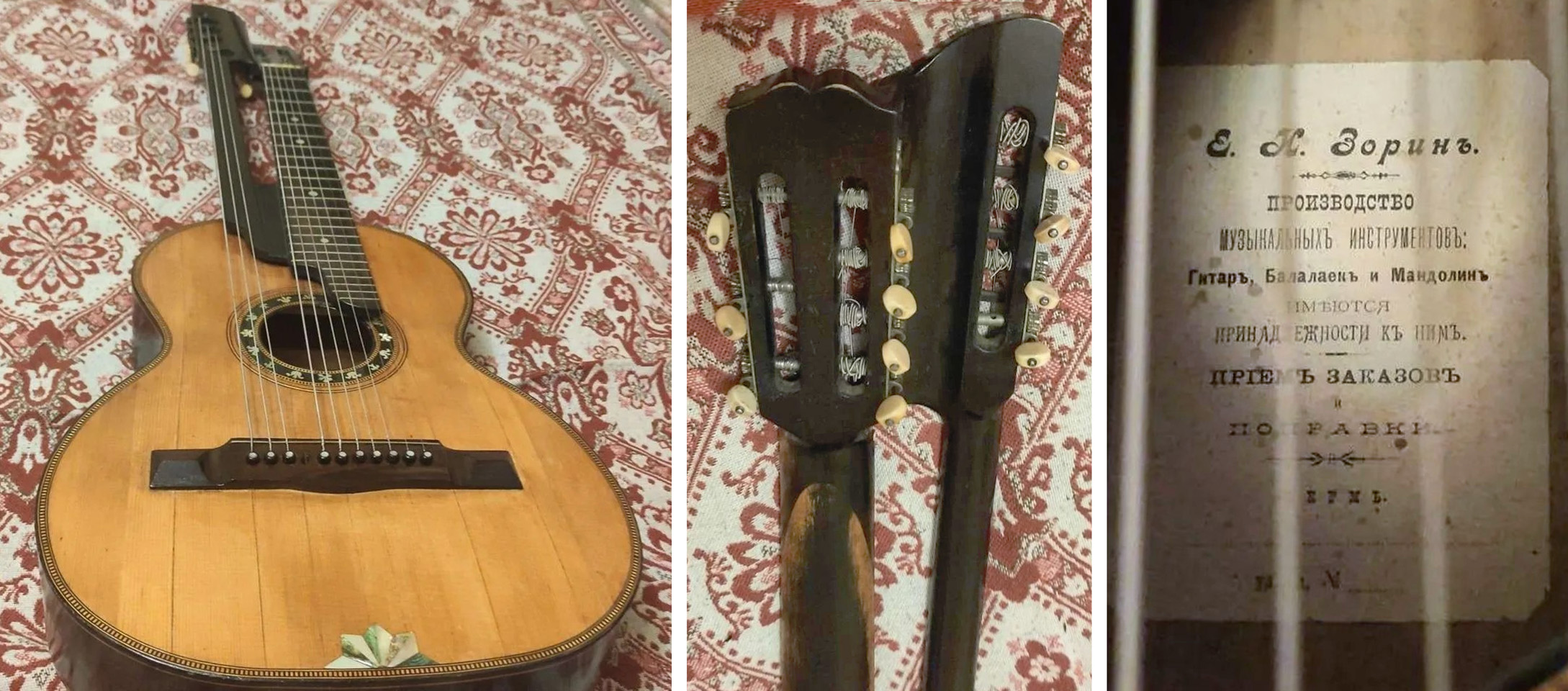
E. K. Zorin, Perm, pre-1918
Next are anonymous Russian players and their unidentified instruments in original images for sale on Russian web sites.
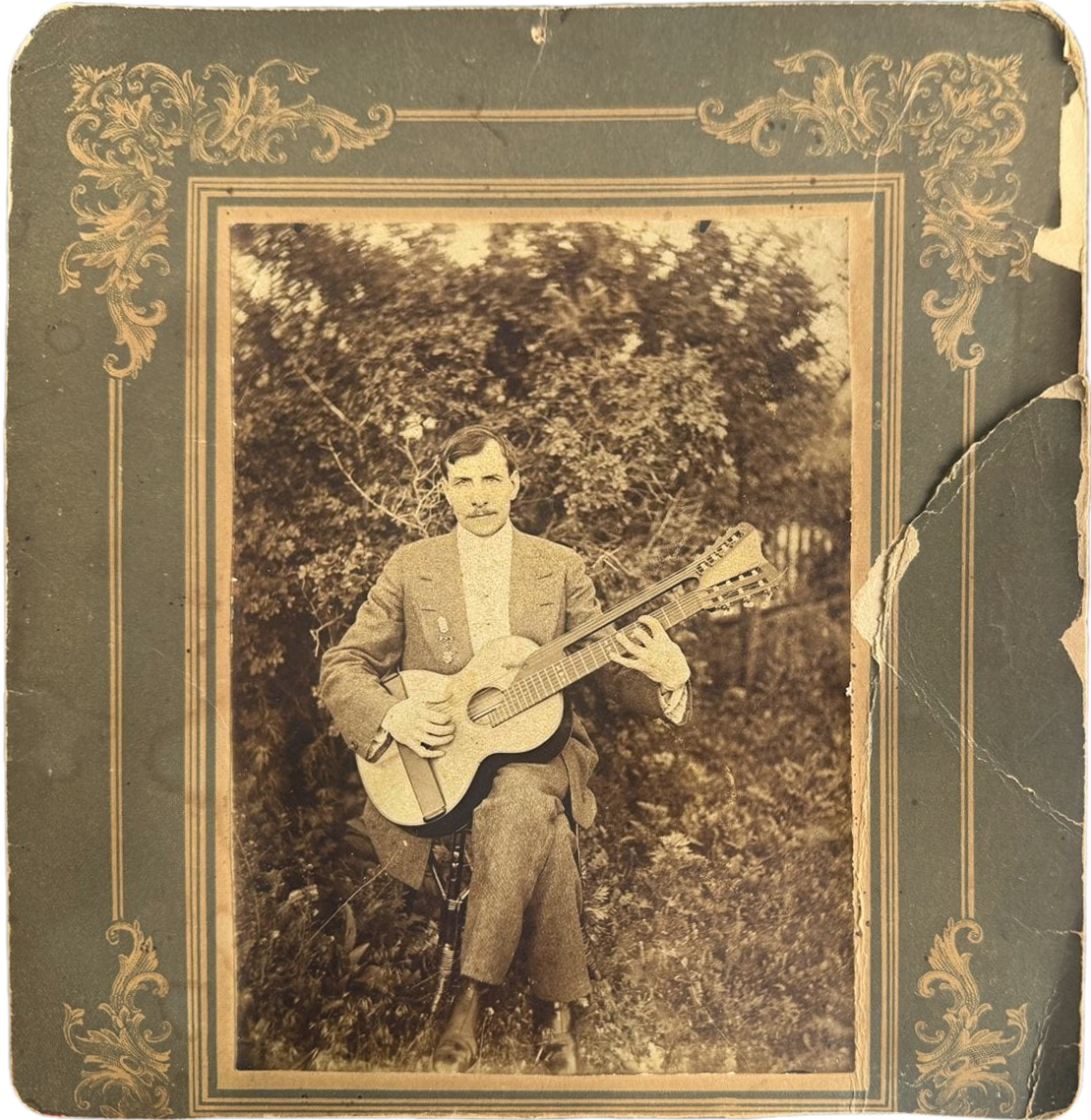
This gentleman plays a typical 4+11 Russian instrument to which he has an added a serious hand rest! The back of this cabinet card is inscribed May 13, 1913, Boguchar. The town of Boguchar is located on the western side, not too far from Ukraine.
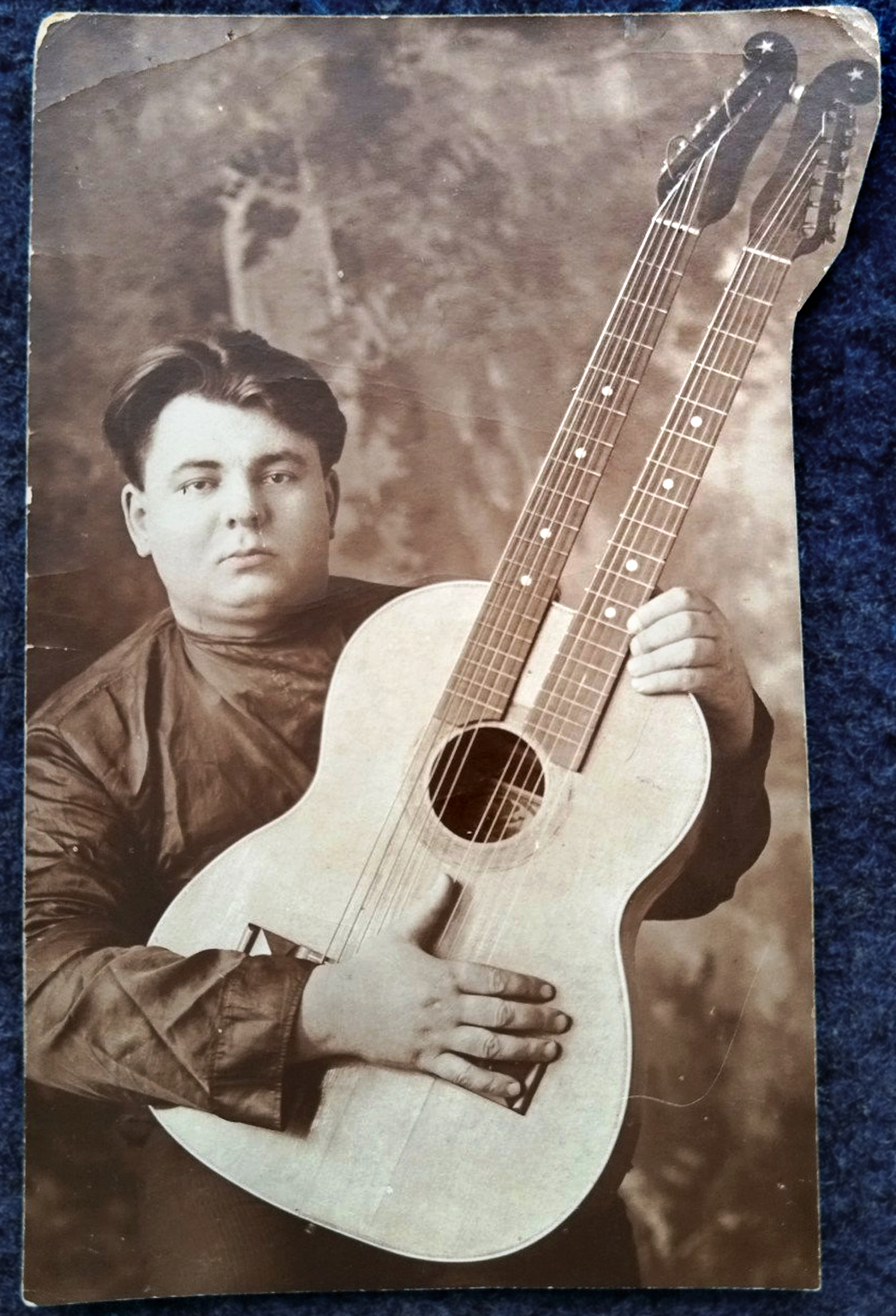
This photograph is only circa dated “pre-1917.” His instrument looks like a Russian or European copy of a Stella 6+6 fully fretted double-neck. Stella also made the same instrument as a harp guitar. Here, the player looks like he strung and played it as a 5+6 harp guitar.
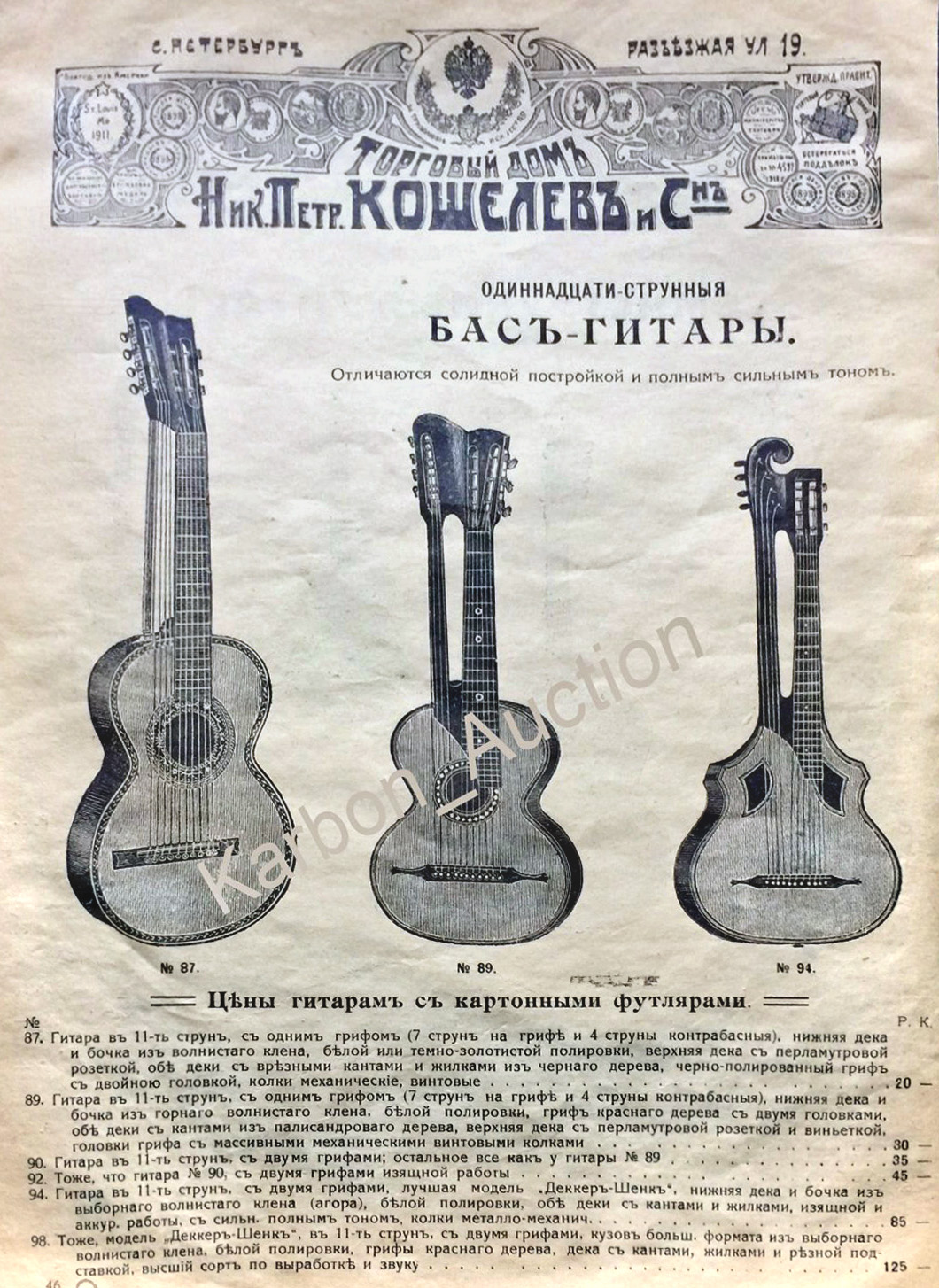
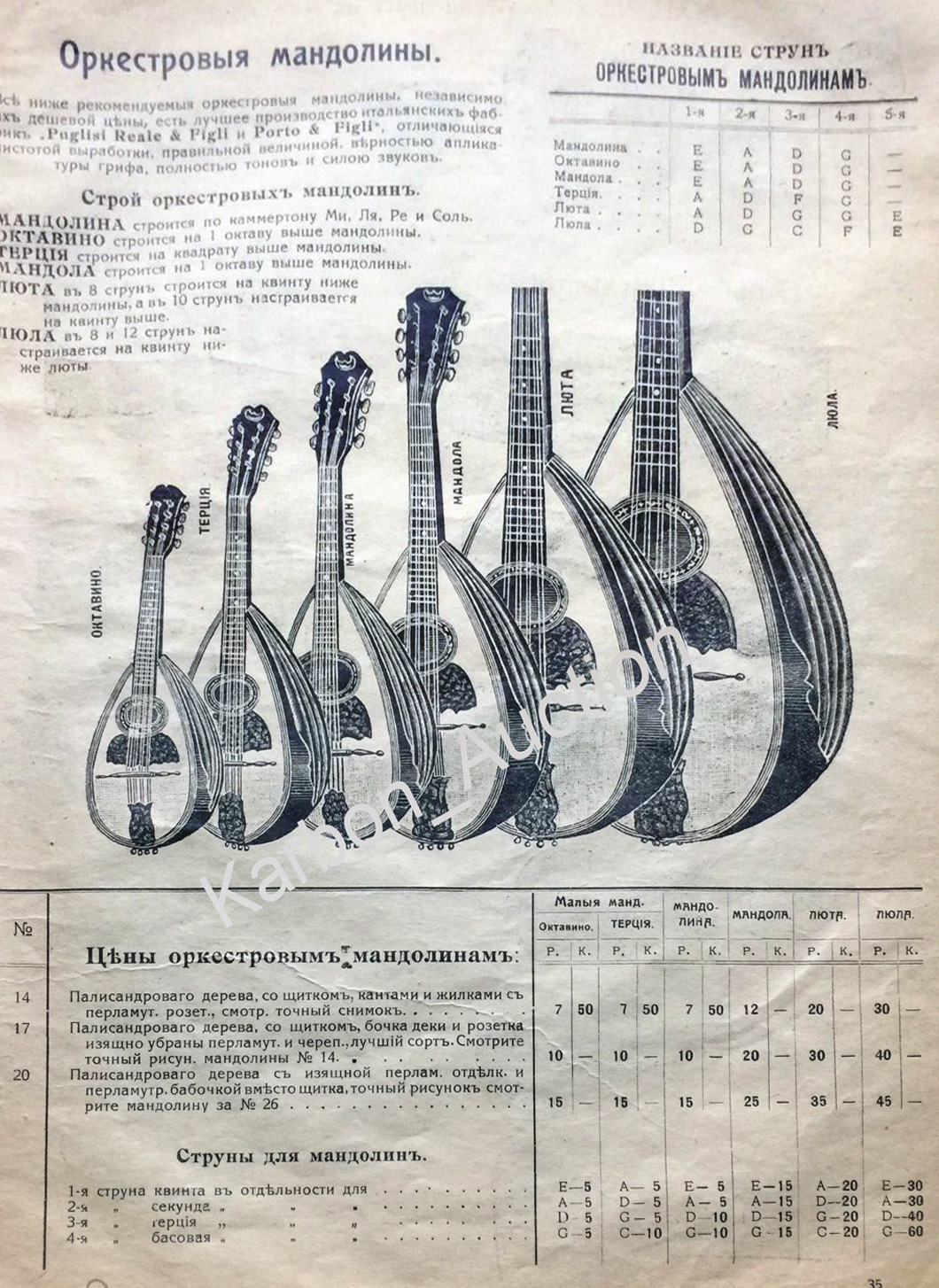
Above and below: Catalog pages from Nikolay P. Koshelev and son, St. Petersburg, Russia, circa 1911-1917
The first above features harp guitars with six or seven strings on the neck.
The second (below) is interesting, showing a set of six Italian orchestra mandolin family instruments, with their Russian names and tunings:
OCTAVINO, one octave above MANDOLINE
TERZIA, a fourth above MANDOLINE
MANDOLINE, standard
MANDOLA, one octave above MANDOLINE
LUTA (mandocello), of 8, a fifth below mandoline (also a 10-string version)
LULA (=mandobass), of 8 or 12 strings, a fifth below LUTA
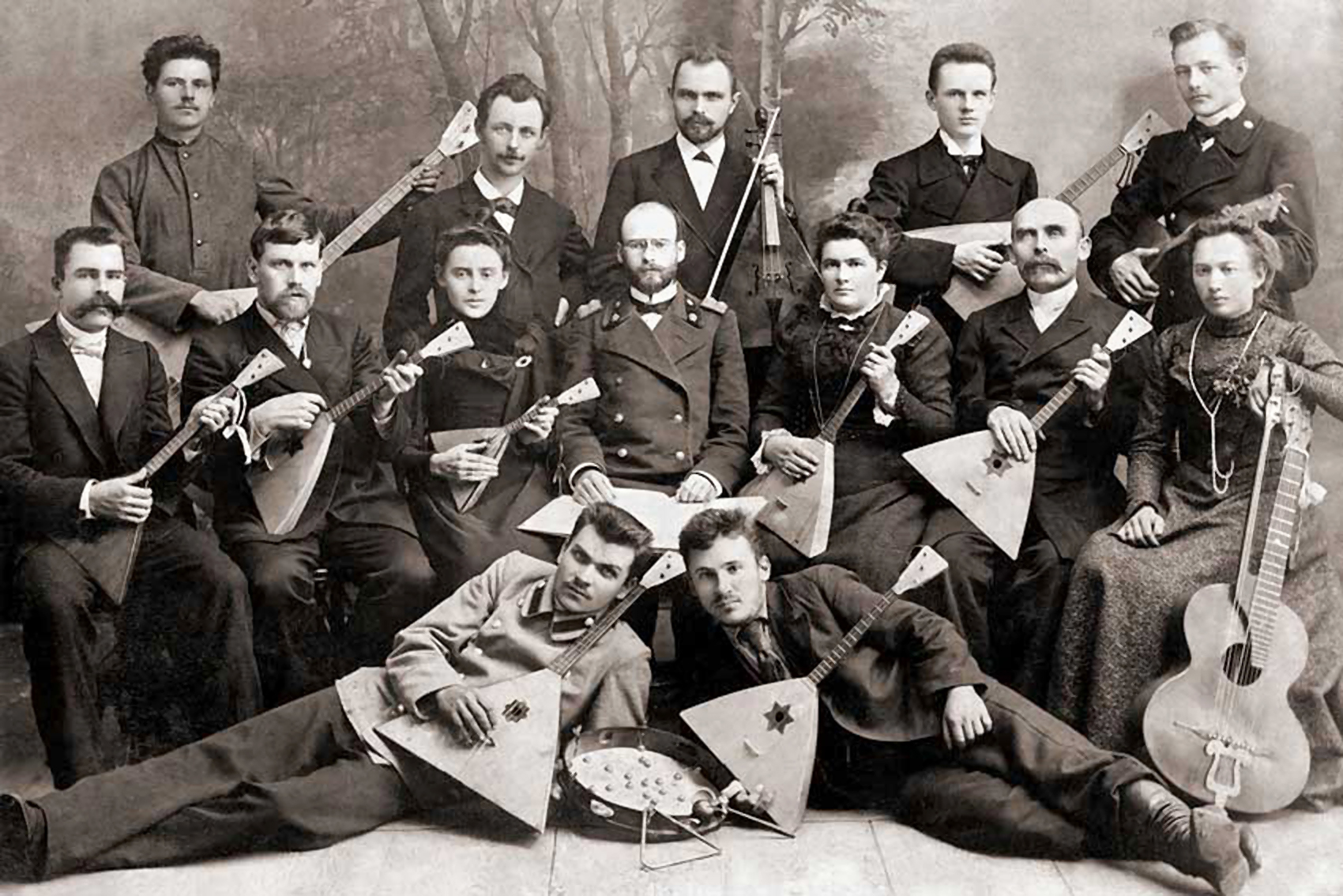
This c.1900 photo of the “Ensemble of Novonikolaevsk town” is from the Museum of Novosibirsk city. The sole harp guitar (3+6) and family of balalaikas are lovely, but Ilya pointed out the rare “gudok” – a bow-balalaika, in the middle of the top row. Below, an ad for this family in a pre-1917 Russian catalog from the Russian National Museum of Music:
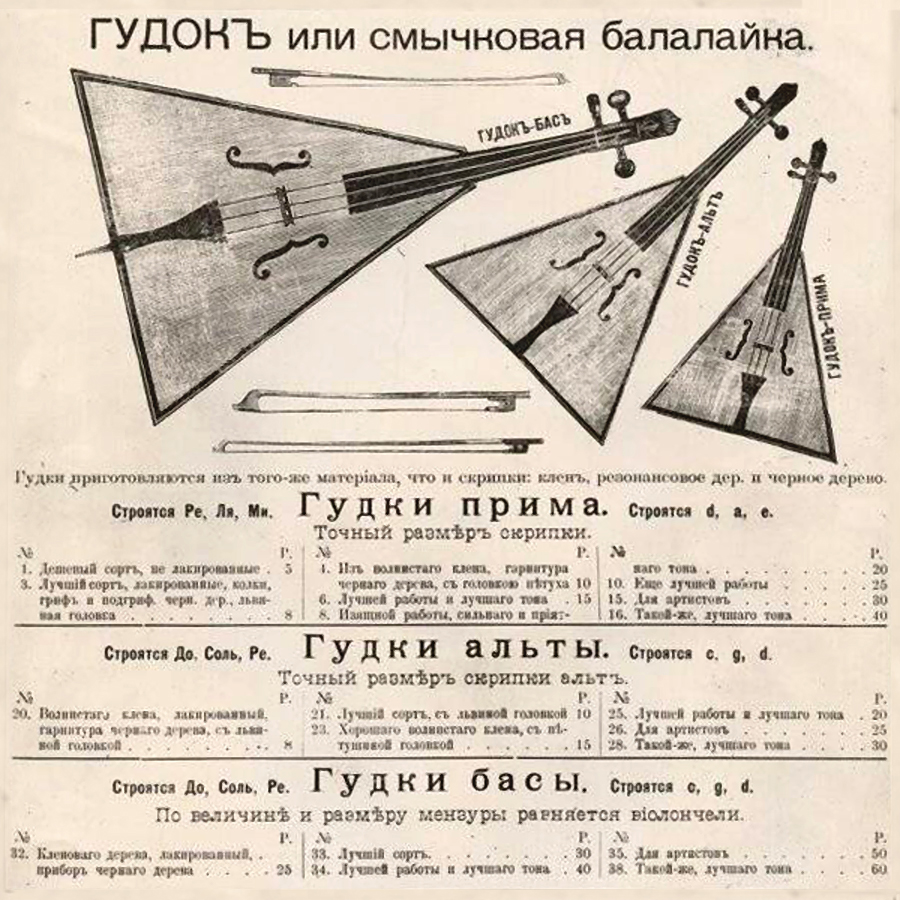
“Bass, alt and proma,” listed as “auxiliary instruments for an orchestra of balalaikas.”
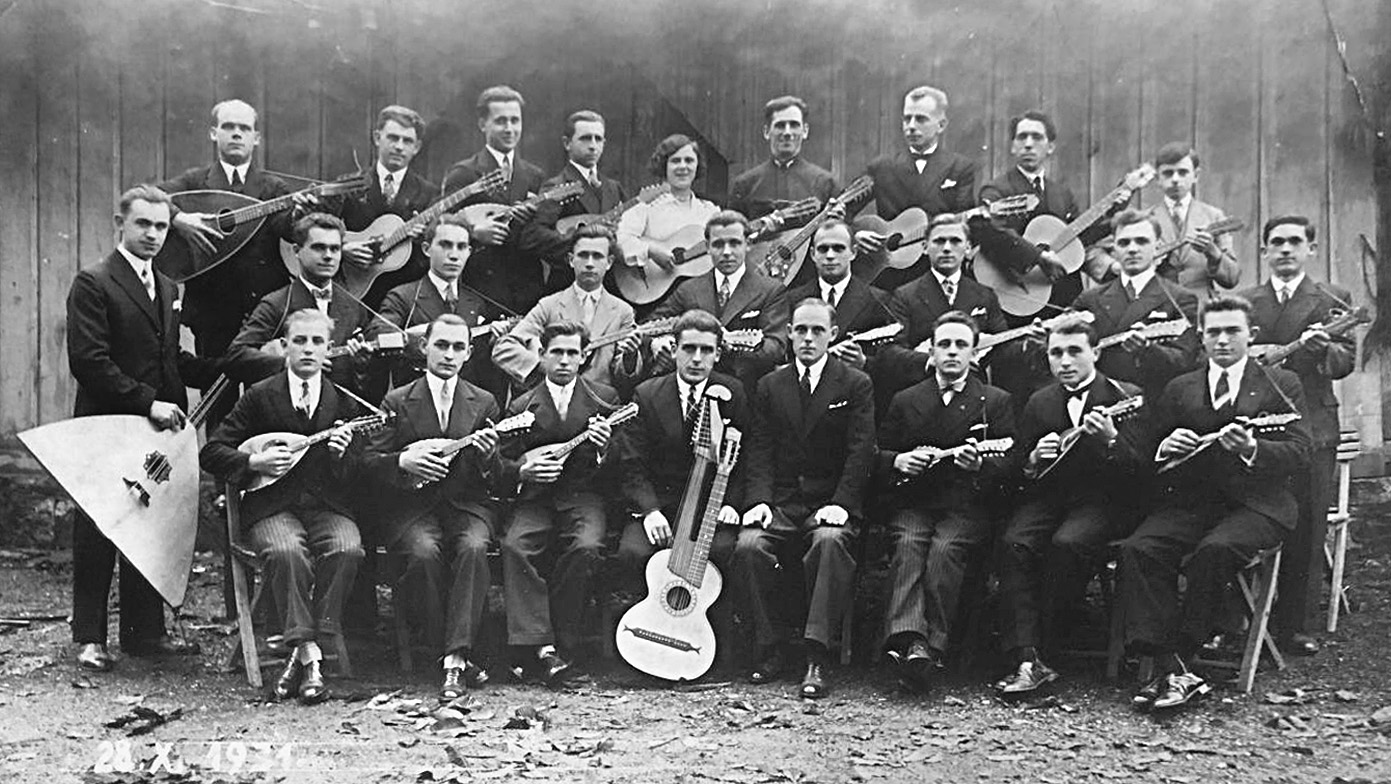
A final image that contains a bass balalaika is purportedly from a Czech ensemble in 1931. They include a German (or Czech?) harp guitar and lute-guitar. The many guitars and mandolins look like typical East European instruments.
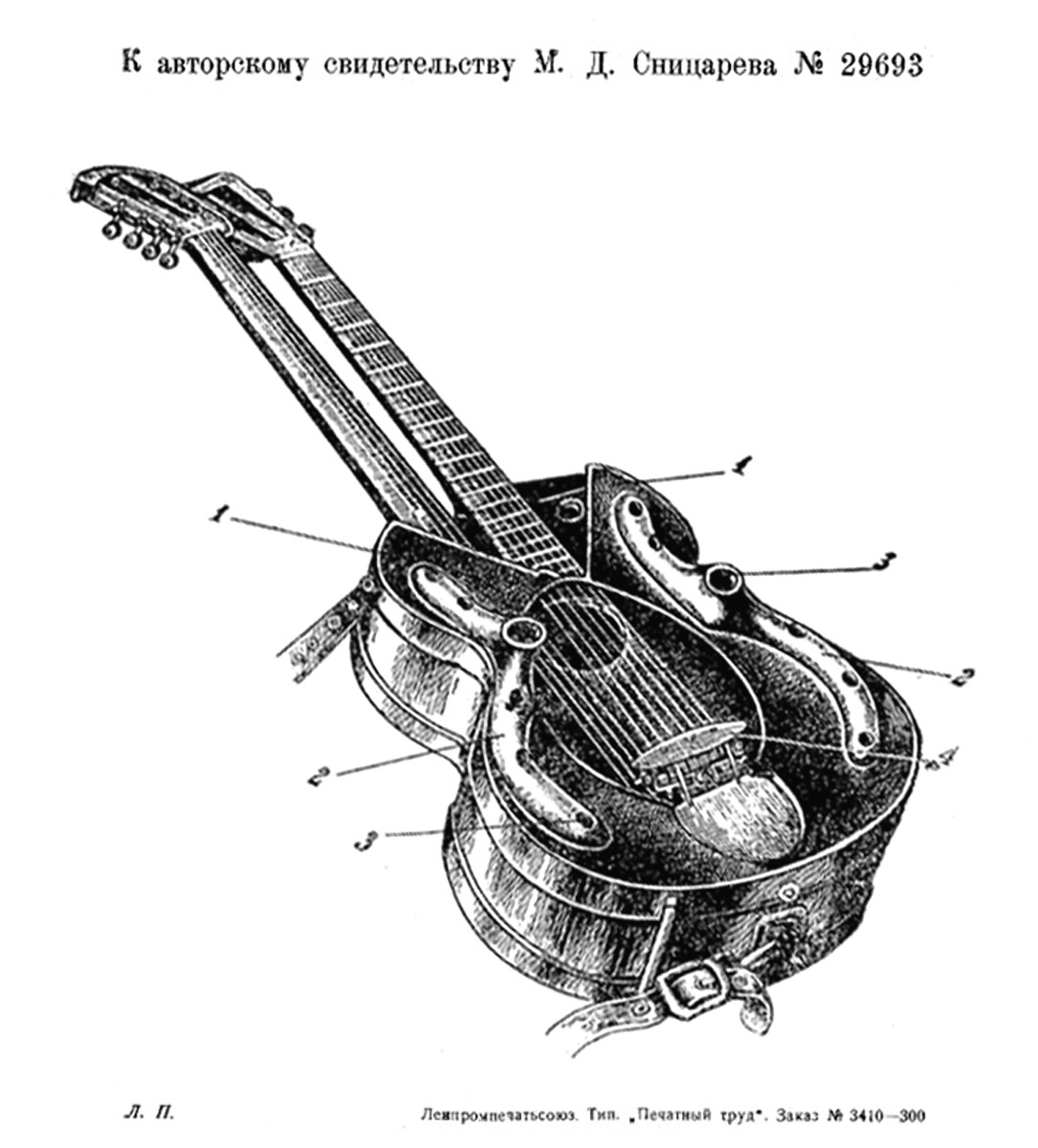
And lastly, a bizarre 1933 Russian patent filed in 1929 for a resonant harp guitar-into-Hawaiian guitar or Ukulele. M. D. Snitsarev’s patent description defies full understanding. It looks like the inventor took a standard Russian harp guitar (4+7) and wrapped it in a metal (?) resonating shell, the two pieces held together by the strap attachment. The top piece contains bizarre raised tubes with sound ports. The sub-bass strings are meant only to prolong the sustain (though it appears that they could still be played). The bar (4) is the real point of the invention. Matthew Hill believes it is a “uke mute,” meant to dampen the strings to mimic the sound of a ukulele, while Ilya reads it as a palm “vibrato bar,” to emulate the sound of a steel guitar. Please do let me know if you ever see one of these!